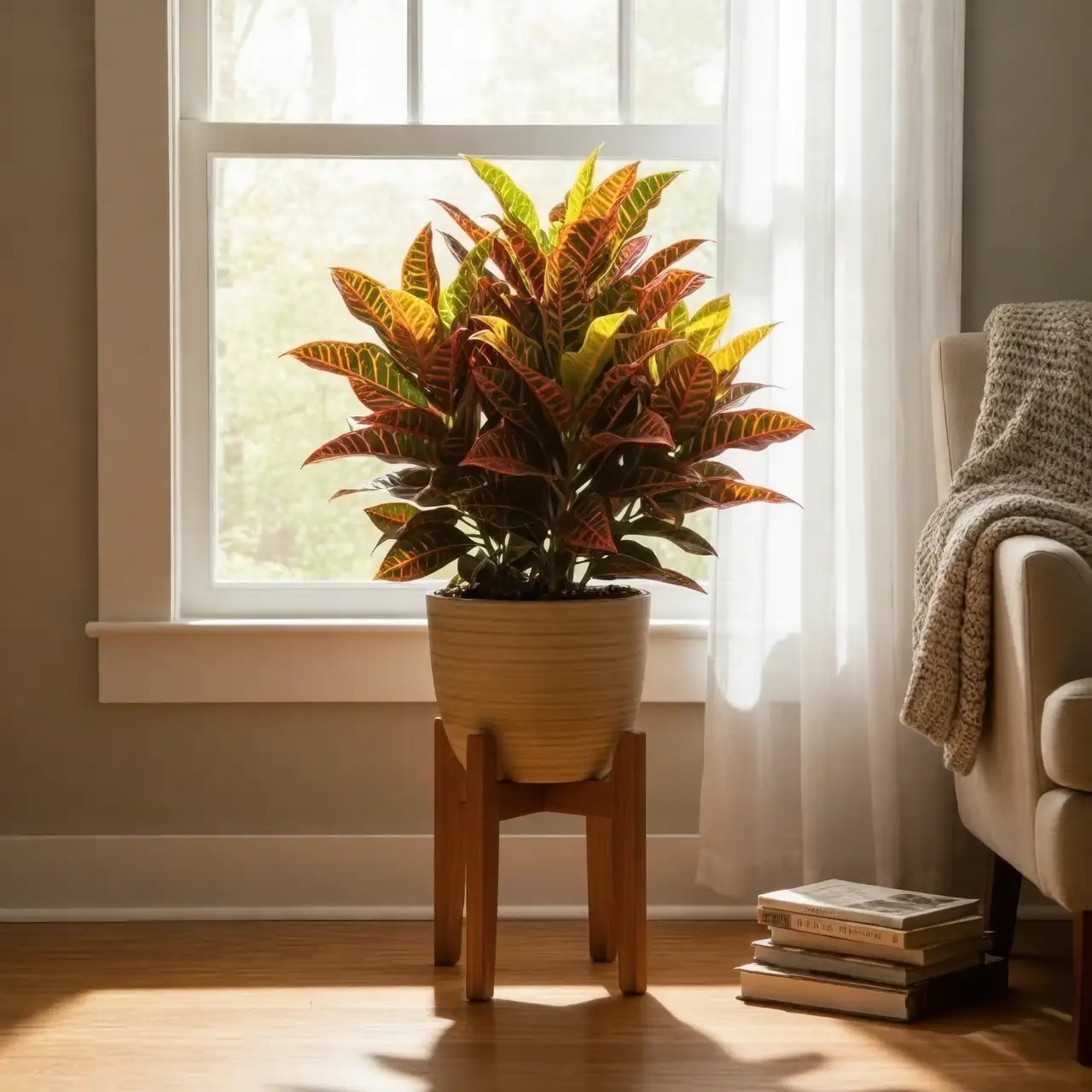
If you’ve ever wondered how a single plant can wear lime, marigold, ember red, and deep forest green on one leaf, meet Codiaeum variegatum—the croton. Think of it as living stained glass: thick, glossy blades painted by chemistry and leaf architecture. In bright, filtered light its colors pop; in dim rooms they soften toward green. Below, we’ll demystify the pigments, the leaf anatomy that stages them, why brighter light sharpens the show, and what “reversion to green” really means—plus exactly how to tune your care so the spectacle lasts.
Meet the color machine: chlorophyll, carotenoids, and anthocyanins
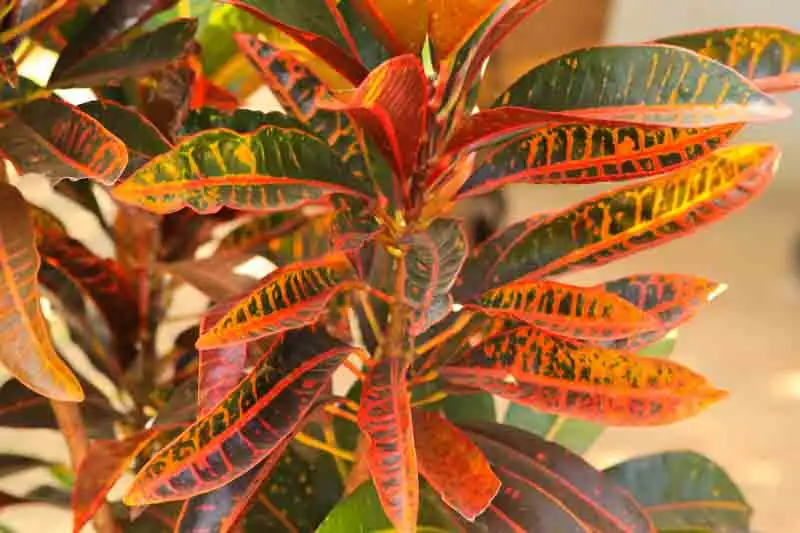
Croton color is a three‑pigment conversation happening inside every leaf cell.
- Chlorophyll (greens)
- Lives in chloroplasts.
- Captures light for photosynthesis, dominating in lower light.
- Carotenoids (yellows, golds, warm oranges)
- Reside in plastids alongside or instead of chlorophyll.
- Act as accessory pigments and photoprotective antioxidants.
- When chlorophyll thins in certain tissues, carotenoids step into the spotlight as bright yellows/golds.
- Anthocyanins (reds, pinks, purples)
- Stored in cell vacuoles, often in upper leaf layers.
- Function as “sunscreen,” absorbing excess light and buffering stress.
- Their hue shifts with cell sap chemistry (pH and co‑pigments), so the same cultivar can read cherry‑red on one leaf and wine‑red on another as tissues mature.
In croton, these palettes overlap like transparent paints. A yellow carotenoid base overlaid with anthocyanins reads orange to red; chlorophyll mixing with anthocyanin yields deep maroon or olive‑red. As leaves age, pigment ratios change—one reason crotons can look different month to month even on the same plant.
Anatomy sets the pattern: where color “lives” in a leaf
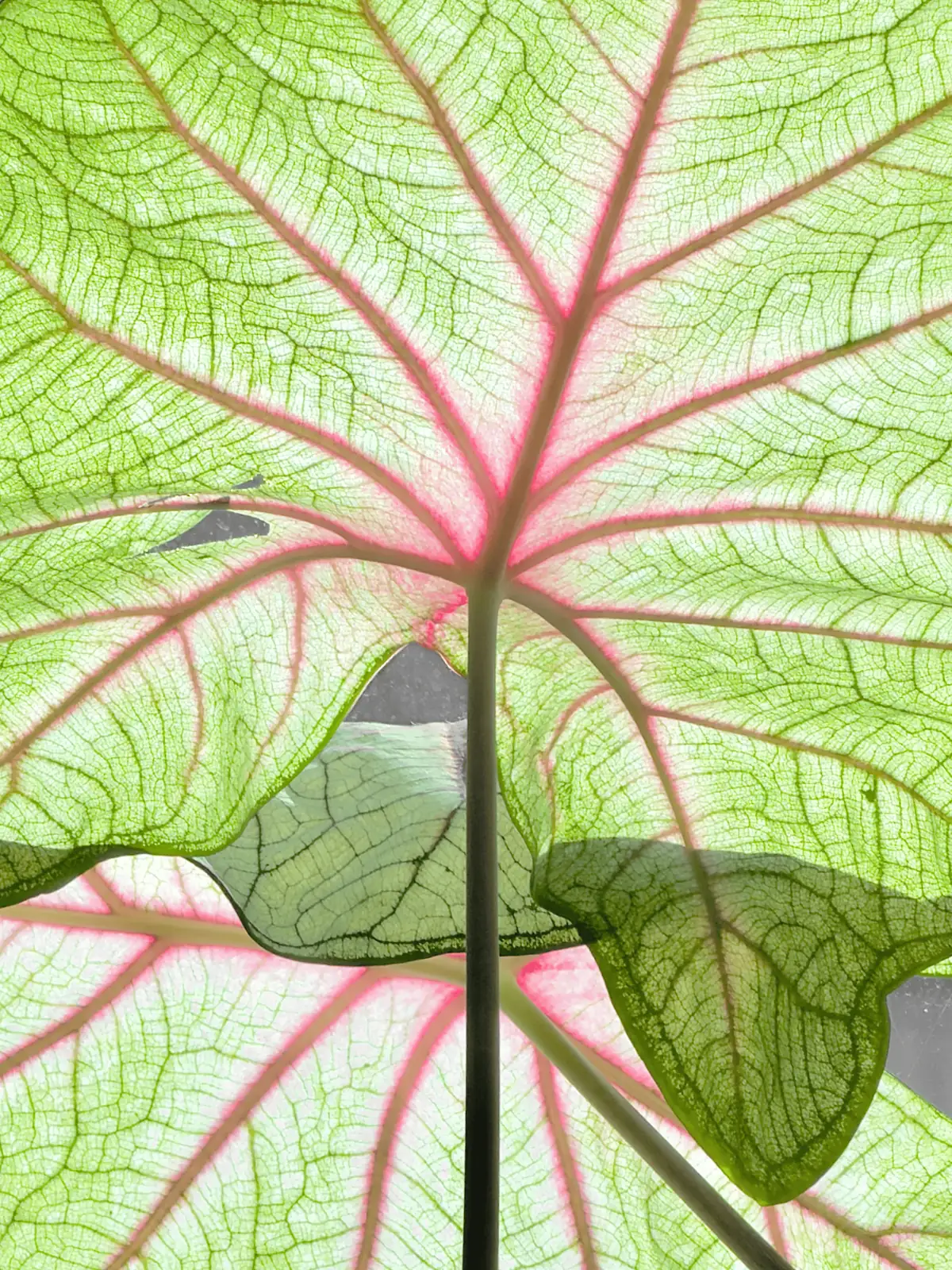
Pigments don’t just vary; they’re positioned. Leaf anatomy choreographs the pattern you see.
- Layering matters
- Upper epidermis and palisade mesophyll often host anthocyanins; when they’re concentrated near the surface, reds appear vivid and “glowing.”
- Chlorophyll‑rich palisade cells drive most photosynthesis—if these cells dominate, green deepens.
- Spongy mesophyll can show lighter tones; if chloroplasts are sparse here, carotenoids read as yellow beneath a thin green canopy.
- Veins as paintbrushes
- Many croton cultivars display color that tracks along veins. Vascular networks influence hormone and sugar flow, which in turn regulate pigment gene expression—hence vein‑aligned streaks, marbling, and speckles.
- Variegation types you’re seeing
- Pigment variegation: reds/oranges/yellows created by active pigments (typical for croton).
- Chlorophyll distribution patterns: some sectors have fewer chloroplasts, so yellow/orange carotenoids dominate there.
- Note: Unlike white‑variegated plants that lack chlorophyll in entire sectors, croton’s color is usually not “albino” tissue—its bright zones often still photosynthesize, just differently.
Why brighter filtered light intensifies color
“More light = more color” is broadly true for crotons—but with nuance.
- Photoprotection switch
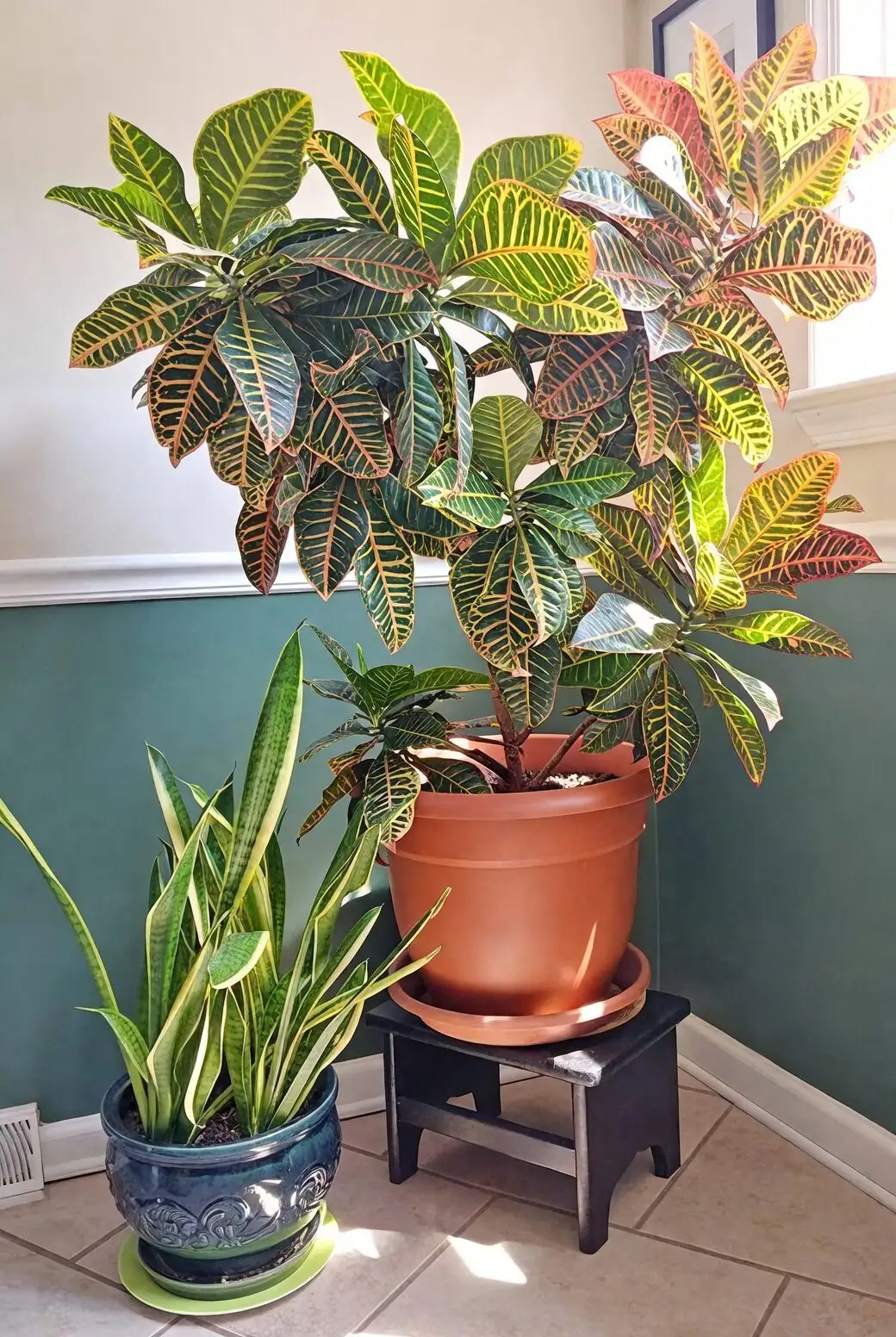
- High, filtered light increases sugar production and nudges the plant to synthesize anthocyanins and carotenoids as a protective shield. Result: stronger reds and richer golds.
- Contrast boost
- Brighter conditions support healthy chlorophyll in green zones while promoting accessory pigments in colored zones, deepening contrast.
- But keep it filtered
- Harsh midday sun can scorch or photo‑bleach tissues, dulling patterns. Crotons shine in bright, indirect light or gentle morning/evening sun.
- Too little light
- The plant compensates by packing in more chlorophyll to capture scarce photons. Reds and yellows fade; leaves lean greener overall.
Practical takeaway: place croton near an east, bright north, or filtered south/west window. Think “sunlit room with sheers”—clarity without the burn.
“Reversion to green,” decoded
Reversion isn’t a personality change—it’s a survival strategy.
- What it is
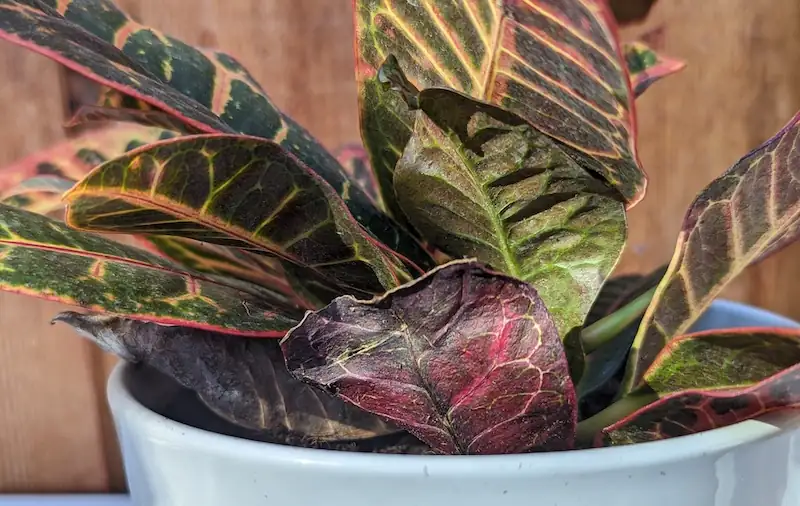
- New growth emerges with more chlorophyll and fewer accessory pigments, so patterns soften or disappear. Sometimes entire shoots go solid green.
- Why it happens
- Low light selects for greener, more efficient tissue.
- Stress (cold, low humidity, erratic watering) diverts energy from color pathways.
- On rare occasion, a strongly green shoot outcompetes patterned stems.
- Can you reverse a reversion?
- You can’t recolor a green leaf, but you can influence future growth:
- Increase light to bright, filtered levels.
- Keep warmth steady (ideally 21–27°C / 70–80°F).
- Maintain even moisture and higher humidity.
- If a solid‑green shoot appears, prune it back to just above a node on a variegated portion so colorful tissue gets the lead role.
Light tuning at home: simple experiments for brighter crotons
- Meter by hand: Hold your palm over the leaf at midday. A soft, well‑defined shadow is about right; a fuzzy shadow is borderline dim; a crisp, hard‑edged shadow likely means too much direct sun.
- Nudge, don’t yank: Move the plant 30–60 cm closer to the window over a week. Abrupt changes can shock crotons and trigger leaf drop.
- Diffuse: Use a sheer curtain on hot south/west windows; allow gentle morning sun where possible.
- Rotate: Quarter‑turn the pot every 1–2 weeks for even color development.
Care that supports peak pigment
Croton is a tropical evergreen shrub from Southeast Asia and the western Pacific. Indoors it usually tops out around 30–90 cm (12–36 in), but with time can reach ~1.5 m (5 ft). Treat it like a warm‑loving color athlete—consistency wins.
- Light
- Bright, indirect (filtered) light. Brief, gentle sun is fine; avoid harsh midday rays.
- Temperature
- Warm and steady is key: 15–29°C (59–85°F), with a sweet spot around 21–27°C (70–80°F). Keep it above 15°C (59°F); chills can trigger leaf drop.
- Humidity
- Aim for 50–70%. Use a humidifier, pebble tray, or plant grouping. Misting can help in some homes, but skip it if it causes leaf spotting and keep air moving.
- Water
- “Evenly moist, never soggy.” In spring–fall, water when the top 0.5–1 in (1–2.5 cm) dries, using lukewarm water. In winter, allow the surface to dry and water less often (commonly every 10–14 days, but go by feel and pot weight). Never let it sit in runoff.
- Soil
- A fertile, well‑draining indoor mix amended with bark/perlite; slightly acidic to neutral.
- Feeding
- During active growth (spring–fall), either:
- Every 2 weeks at label rate (or half‑strength if sensitive), or
- Every 4–6 weeks at half‑strength.
- Reduce or stop in winter.
- Pruning
- Early spring is ideal. Tip‑prune above a node to encourage bushiness. Don’t remove more than about one‑third at once. Wear gloves—the milky sap can irritate skin.
- Repotting
- Spring. Young plants annually; mature plants every 2–3 years or when roots show. Step up only 1–2 in (2.5–5 cm) to avoid waterlogging.
Troubleshooting color fade and leaf drop
- Paler, greener new leaves
- Usually insufficient light. Move to a brighter, filtered spot and be patient—future leaves will color up.
- Sudden leaf drop
- Common stress response to cold drafts, low humidity, or abrupt moves. Re‑stabilize: warm, humid, bright conditions; keep watering consistent.
- Scorch or dulling
- Too much direct midday sun. Diffuse the light.
- Pests that dull color
- Spider mites (love dry air), scale, mealybugs, thrips. Rinse foliage, raise humidity, and treat early with insecticidal soap or horticultural oil.
What the leaf shapes reveal (and why it matters for color)
Crotons come in a wild array of leaf forms—narrow lances, broad ovals, lobed or spiral blades. Narrow leaves with a higher ratio of pigmented surface to internal volume can appear more saturated under the same light, while broad leaves may show more complex marbling and vein‑traced color because there’s more real estate for pigment zoning. Either way, the best color still tracks with bright, filtered light.
Indoors vs outdoors: where crotons thrive
- Indoors
- Best in bright, warm, humid rooms—bathrooms and kitchens are naturals. Keep away from heaters, AC blasts, and cold windows in winter.
- Outdoors
- Year‑round only in frost‑free climates (USDA 11–12). Elsewhere, grow in a container and bring inside well before temperatures approach 10°C (50°F).
Safety first
Croton is in the spurge family (Euphorbiaceae)—a cousin of poinsettia—and shares that telltale milky sap. It’s toxic if ingested and can irritate skin and eyes. Wear gloves when pruning and keep it out of reach of pets and children.
Quick color‑keeper checklist
- Bright, filtered light (add sheers to sunny windows).
- Warmth held steady above 15°C/59°F.
- Humidity at 50–70%.
- Even moisture; never waterlogged, never bone‑dry for long.
- Gentle feeding spring–fall.
- Prompt pest checks; rinse leaves and treat early.
- Prune out solid‑green shoots to favor variegated growth.
When you give croton the light and stability it craves, pigments and anatomy do the rest—layering greens, golds, and reds into a leaf‑by‑leaf mosaic that can make a whole room feel more alive.