
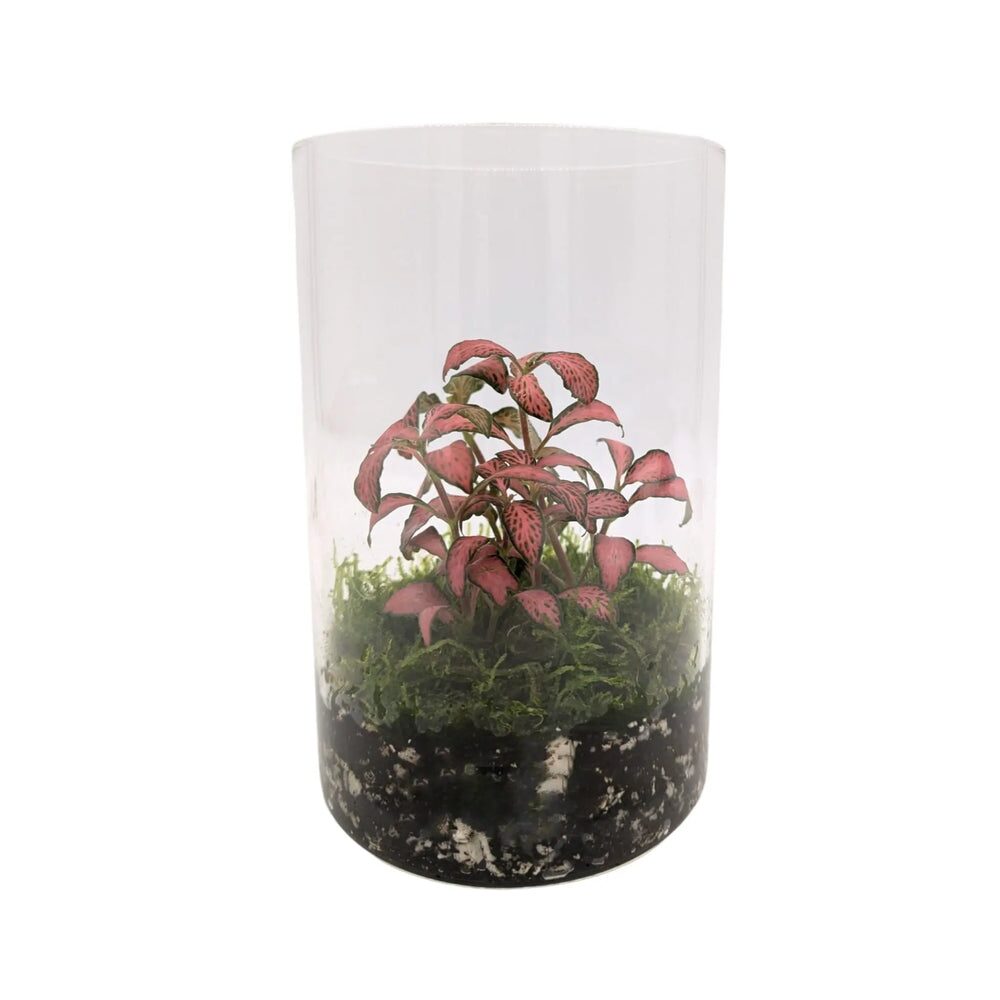
If you’ve ever watched a Nerve Plant “faint” when thirsty and then dramatically spring back after a drink, you know Fittonia verschaffeltii has a flair for rainforest theater. That tenderness is exactly why it’s a terrarium star. Build the right little weather system—steady warmth, 60–80% humidity, bright but gentle light—and its veined leaves stay flawless and photo-ready.
Below, we’ll design both a closed and a semi-closed terrarium step by step: what to put in each layer (with measurements), how and when to ventilate, how to read condensation like a weather report, and which companion mosses keep the carpet green without smothering your Fittonia.
Meet Fittonia verschaffeltii (a.k.a. Nerve Plant)
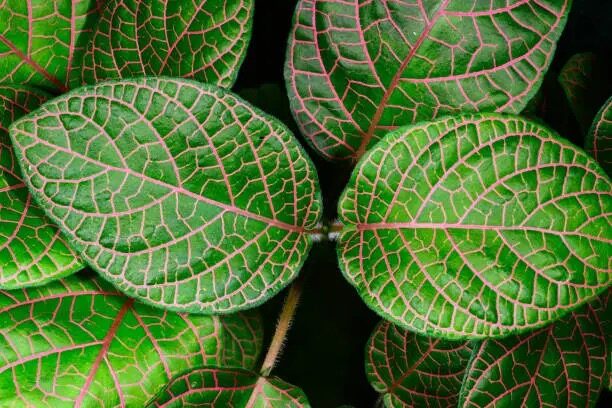
- Origin: Tropical rainforest regions of Peru (Acanthaceae family; genus Fittonia)
- Habit: Low, creeping/trailing stems; 10–20 cm tall, spreading 20–30+ cm; easy to thicken by pinching
- Light: Bright, indirect to partial shade; no harsh sun
- Temperature: Best at 18–25°C (64–77°F); keep above 16°C (61°F) in winter
- Humidity: Loves it high—aim for a terrarium-stable 60–80%
- Soil: Rich, humus-heavy, well-drained; keep evenly moist (never waterlogged)
- Pet safety: Generally considered non-toxic to cats and dogs
Why it thrives in terrariums: Thin, tender foliage bruises and dries easily in household air but looks and grows best in soft light, steady warmth, and consistent humidity. A terrarium is basically Fittonia’s comfort blanket.
Closed or Semi-Closed: Which Build Fits Your Space?
- Closed terrarium
- Pros: Maximum humidity stability (often 70–90% without tuning); nearly no watering once balanced
- Cons: Easy to overdo moisture; needs careful condensation management to stay in the 60–80% sweet spot
- Semi-closed terrarium (lidded with gaps, cork slightly ajar, or a jar with a vent hole)
- Pros: Great airflow-to-humidity balance; easier to hold 60–75% without fogging
- Cons: Needs occasional watering; slightly more forgiving but not “set and forget”
Tip: If your room is already humid, semi-closed is wonderfully stable. If it’s dry or drafty, go closed and control moisture with precise watering and timed venting.

Materials and Moss Companions
- Glass vessel with lid (snug for closed; cork/loose lid or vent hole for semi-closed). Temporary lids can be as simple as cling film while you dial things in.
- Drainage layer: Rinsed LECA or small pebbles
- Optional filtration: A thin sprinkle of activated charcoal (helps with odors and clarity; not essential)
- Separator: Fiberglass or nylon mesh
- Tropical growing mix (moisture-retentive yet airy)
- Base recipe: 2 parts peat or leaf-mold (or coco coir), 1 part fine orchid bark, 1 part perlite or coarse sand, plus a small handful of worm castings for nutrition
- Long-fiber sphagnum moss (pre-moistened) for a cap layer to wick moisture and keep fines from migrating
- Companion mosses (choose one or two for textural contrast)
- Hypnum “sheet moss”: Spreads as a soft, low carpet; very easy
- Thuidium “fern moss”: Lacy, bright green; thrives in 70%+ humidity
- Leucobryum “cushion/pillow moss”: Forms neat hummocks; appreciates evenly moist air
- Tools: Long tweezers/chopsticks, soft brush, spray bottle, paper towels
- A small digital hygrometer/thermometer (invaluable for dialing in 60–80% RH)
Note: Avoid planting leaves right against the glass—constant contact + wet glass = rot. Give your Fittonia headroom and an air gap.
Substrate Architecture: The Water-Management Stack
Think of layers as the terrarium’s plumbing:
- Drainage (10–20% of vessel height): 2–4 cm for small jars; 4–6 cm for taller builds
- Optional charcoal dusting: A thin, even peppering
- Mesh separator: Keeps soil from sinking into drainage
- Tropical growing mix: Typically 5–10 cm (deeper if your plant has a larger root ball)
- Sphagnum cap: 0.5–1 cm, tucked neatly to prevent soil from smearing the glass
- Moss top-dressing: Hypnum/Thuidium/Leucobryum placed on the sphagnum; mist lightly so it grabs
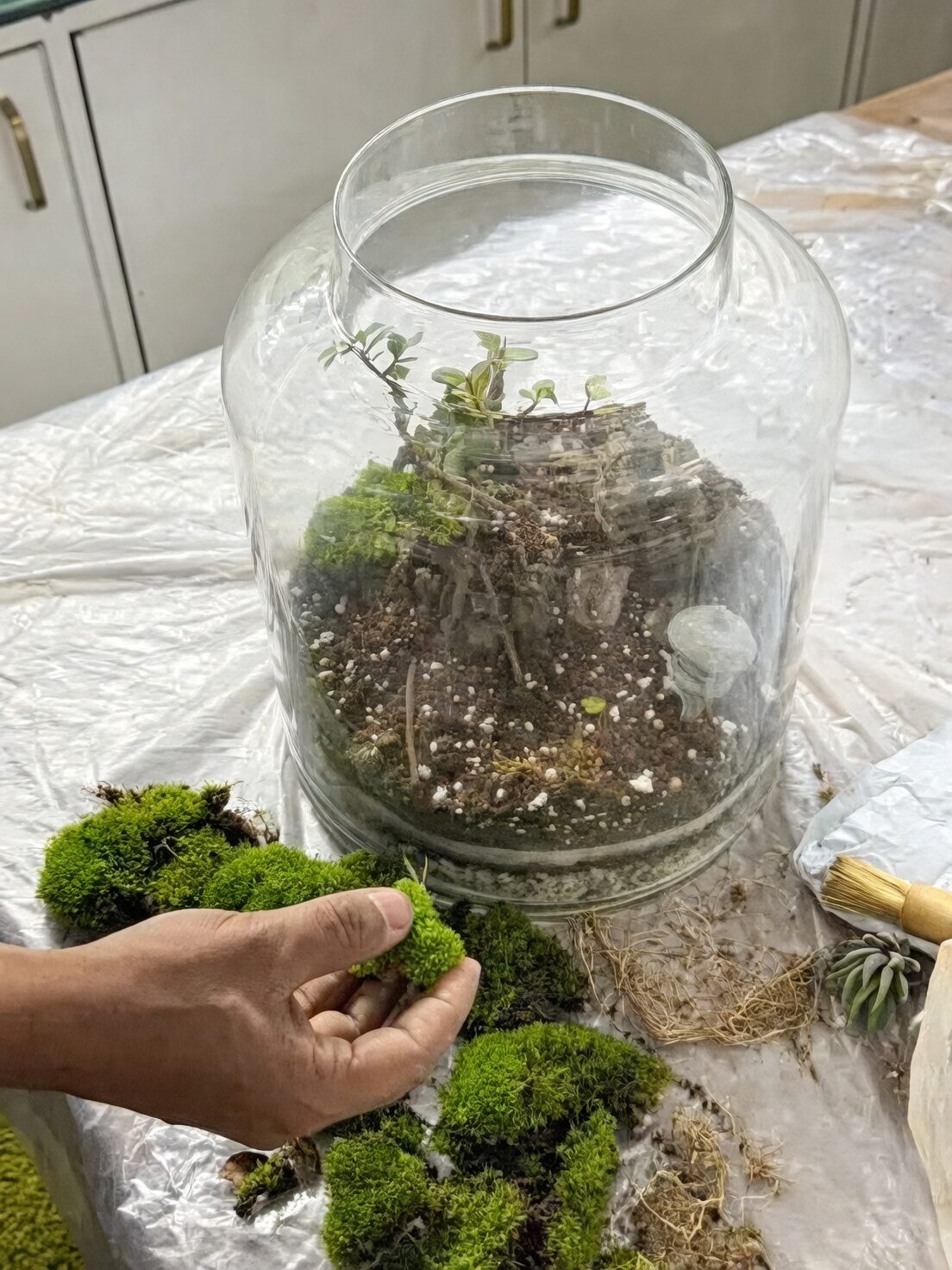
Build 1: The Closed Fittonia Terrarium (70–80% RH, dialed)
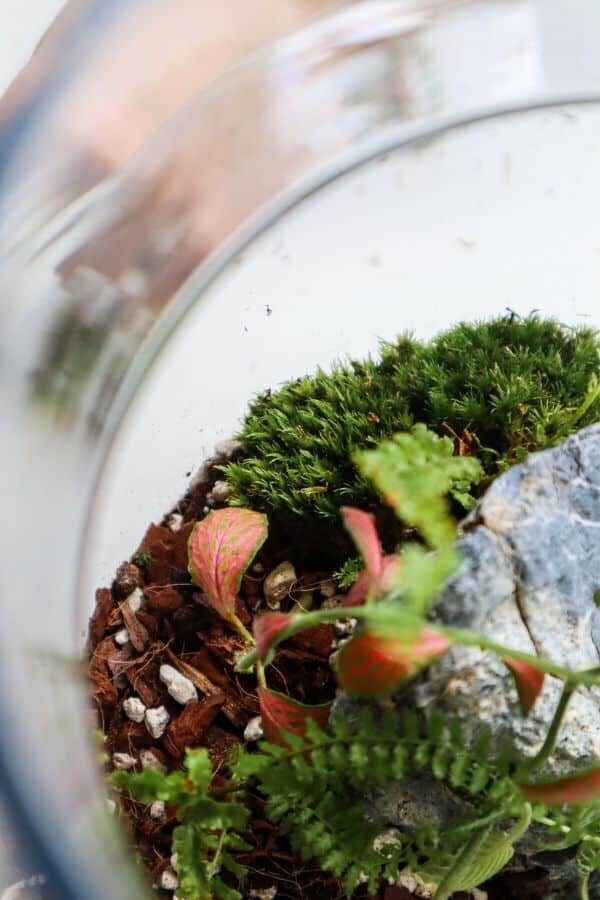
- Pre-moisten your mix
- Squeeze test: It should clump when squeezed and barely weep a drop. Too wet = future fog.
- Lay layers
- Drainage → charcoal (optional) → mesh → 5–8 cm growing mix → thin sphagnum cap
- Mound and plant
- Create a slight central mound. Gently loosen Fittonia roots and trim any long, circling ones.
- Set the plant slightly off-center to avoid glass contact as it spreads. Firm in gently—its leaves bruise easily.
- Add moss companions
- Nestle Hypnum for a sheeted lawn, or accent with small hummocks of Leucobryum. Keep the moss 0.5–1 cm away from the Fittonia stem to maintain airflow.
- First watering (the crucial moment)
- Lightly and evenly water the soil only (avoid wetting leaves). Aim to see just a hint of moisture wick into the sphagnum—no pooling in the drainage.
- If you see standing water in the drainage layer deeper than about a quarter of its height, wick some out with a paper towel “tail” dipped down the side.
- Seal and “season” the weather
- Day 1–3: Expect some fog. Vent for 15–30 minutes midday if glass is opaque. Reseal.
- Day 4–10: Aim for a pattern of light morning dew on glass that clears by late morning. If it stays foggy all day, vent longer (or crack the lid for a few hours). If there’s no dew at all and leaves start to curl, lightly mist the moss or add a tablespoon or two of water to the substrate—not the drainage.
- After week 2: You’re looking for steady 70–80% RH inside, no persistent puddles, and leaves not touching wet glass.
Pro tip: In bright rooms, Fittonia grows wider and denser; in dimmer spots it stretches and thins. More bright, indirect light = lush, compact growth.
Build 2: The Semi-Closed Fittonia Terrarium (60–75% RH, forgiving)
- Use the same substrate stack as above.
- Choose a lid that sits loosely, a cork you can prop slightly, or a vessel with a small vent hole.
- Water a touch less at setup than the closed build (semi-closed loses moisture faster).
- Tuning humidity
- If RH drops below 60% for extended periods, close the gap or briefly cover with cling film.
- If condensation builds overnight and lingers past midday, increase the gap by a few millimeters.
- Ongoing rhythm
- Check twice weekly: touch-test the moss (springy, cool = good; crispy edges = add a small drink). Top up small volumes rather than big soaks.
Ventilation Timing and Condensation Control
Read the glass like a dashboard:
- Morning pearling that clears by late morning: ideal
- No condensation for days + leaf edges curling: too dry—add a small drink or reduce venting
- Heavy fog, water running down the glass, or a “rainstorm” when you tap: too wet—vent longer, wick out excess, and skip watering
- Leaves pressed to glass turning mushy: reposition or prune; keep foliage 0.5–1 cm off the glass
Practical schedule suggestions:
- New closed build: Vent 15–30 minutes midday for the first 3–5 days; extend to 1–2 hours if fog persists
- Mature closed build: Quick 10–15 minute airing weekly or biweekly as needed
- Semi-closed: Micro-vent continuously via the small gap; do a full open-airing 10–15 minutes every week
Always ventilate during the warmest part of the day to avoid chilling. Keep the terrarium in 18–25°C, away from heaters/AC vents and harsh sun.
Light, Placement, and “No-Singe” Rules
- Bright, indirect light is non-negotiable. A sheer-curtained window or bright room is perfect.
- Avoid direct sun on glass—it magnifies heat and can cook a closed system.
- Rotate the vessel monthly for even growth, and keep it off radiators and out of cold drafts.
Ongoing Care Inside the Terrarium
- Watering
- Closed: Once balanced, you may not water for months. If Fittonia wilts (the classic “faint”), check humidity first; if substrate is dry below 1–2 cm, add a tablespoon or two of water and reseal.
- Semi-closed: Small top-ups as the moss just begins to feel dry. Never saturate the drainage layer.
- Feeding
- As a houseplant, Fittonia enjoys diluted feed in spring/summer. In terrariums, use a very weak, balanced fertilizer sparingly (e.g., one-quarter strength, monthly in spring–summer) to avoid algae and runaway growth. Keep fertilizer off leaves.
- Pruning and restarting
- Pinch tips regularly for a compact mat. Remove yellowing leaves promptly.
- If older growth gets leggy, take 10 cm tip cuttings and replant—rooting typically takes 2–3 weeks in warm, moist substrate.
- Pests and diseases
- Prevent rot with good substrate aeration and by keeping foliage off wet glass.
- Watch for scale, spider mites, and aphids—rarer in high humidity, but possible. Treat with insecticidal soap or horticultural oil; briefly open to apply and let dry before resealing.
Optional helpers: Springtails can be introduced as a “clean-up crew” to nibble mold and keep surfaces tidy in closed builds.
Companion Mosses That Behave
- Hypnum “sheet moss”: Low, uniform carpet; doesn’t mound over Fittonia
- Thuidium “fern moss”: Airy fronds spotlight your feature plant; trim if it gets leggy
- Leucobryum “cushion moss”: Sculptural humps add height changes without crowding
Placement tips:
- Frame the Fittonia—keep an open moat of 1–2 cm around the stem for airflow
- Use moss to hide the sphagnum and mesh edge; stop short of the glass by a few millimeters for a clean look
- In narrow jars, plant Fittonia centrally so leaves don’t grow into the glass as quickly
Troubleshooting at a Glance
- Leaf curl and droop: Usually dryness (air or mix). Raise humidity to 60–80%, add a small drink, and keep light gentle.
- Yellow, soft leaves: Overwatering or poor drainage. Vent, wick excess, and check that the drainage layer isn’t a pond.
- Burnt or faded patches: Too much direct sun. Move to bright, filtered light.
- Persistent fogging: Too much initial water or a cold windowsill causing daily dew that never clears. Warm the location slightly, vent longer, and avoid nighttime chills.
- Algae on glass/soil crust: Reduce feeding, increase brief venting, and shade the lower substrate from harsh light.
- Moss browning at tips: Air too dry or light too harsh; adjust lid gap and shift to softer light.
A Note on Symbolism (for the romantics among us)
The Nerve Plant is sometimes linked with Virgo and said to symbolize rationality and wisdom. These meanings aren’t botanical truths but cultural overlays—modern “flower language” riffs inspired by those intricate, map-like veins that look almost cerebral. If that thoughtful aesthetic speaks to you, give your Fittonia pride of place where its living circuitry can be admired up close.
—
Build it like a tiny rainforest, manage it like a gentle weather system, and your Fittonia verschaffeltii will reward you with velvety leaves etched in white, pink, or red. Keep the rhythm steady—soft light, 18–25°C warmth, and a tuned 60–80% humidity—and the only drama you’ll see is the stunning patterning catching the light.