

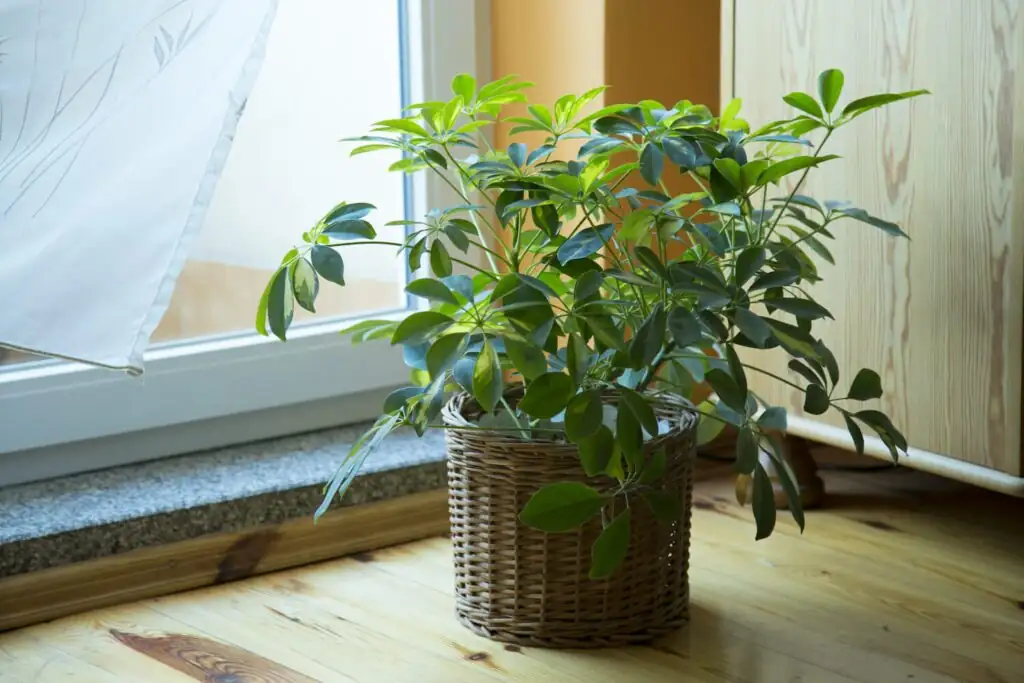
Imagine a glossy green umbrella you can keep in your living room. That’s Heptapleurum arboricola—aka the dwarf umbrella tree—flashing palmfuls of shine, growing fast, and happily shaping into whatever style you fancy, from braided stems to moss-pole standards. Let’s speed through its leaf geometry, why it stretches in dim rooms, the almost-mythic indoor flowers, and pro training tricks that make this plant a showpiece.
Meet the dwarf umbrella tree
- Scientific name: Heptapleurum arboricola (formerly sold widely as Schefflera arboricola)
- Family: Araliaceae
- Origin: Southern China (including Hainan) and Taiwan; now a global houseplant classic
- Vibe: Evergreen, fast-growing, forgiving—equally happy as a dense bush or a small indoor tree
- Nicknames you’ll hear: Dwarf Umbrella Tree, Dwarf Schefflera, Hawaiian Schefflera, Umbrella Tree
Indoors, expect about 1–2 m (3–6.5 ft), with older, well-lit plants reaching up to ~2.4 m tall and ~1.2 m wide (8 ft × 4 ft) in a big container.
Leaf geometry: how the “umbrella” works
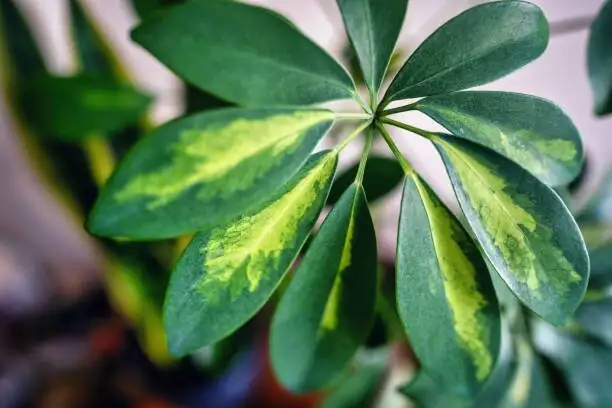
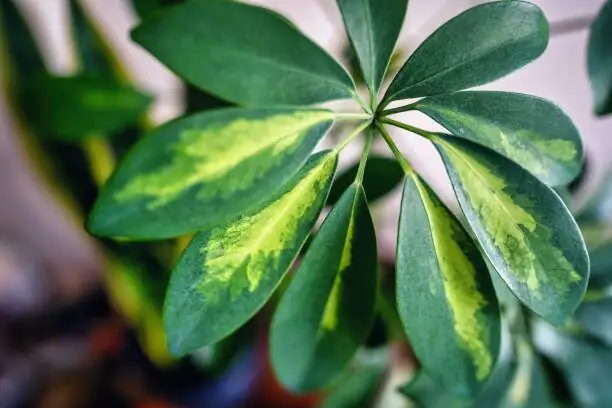
At a glance you see a “hand,” a “goose foot,” or a tiny parasol. Technically, each leaf is palmately compound: several oval leaflets radiate from a single point at the end of a petiole. Many plants display rich green foliage; variegated cultivars add cream or yellow marbling.
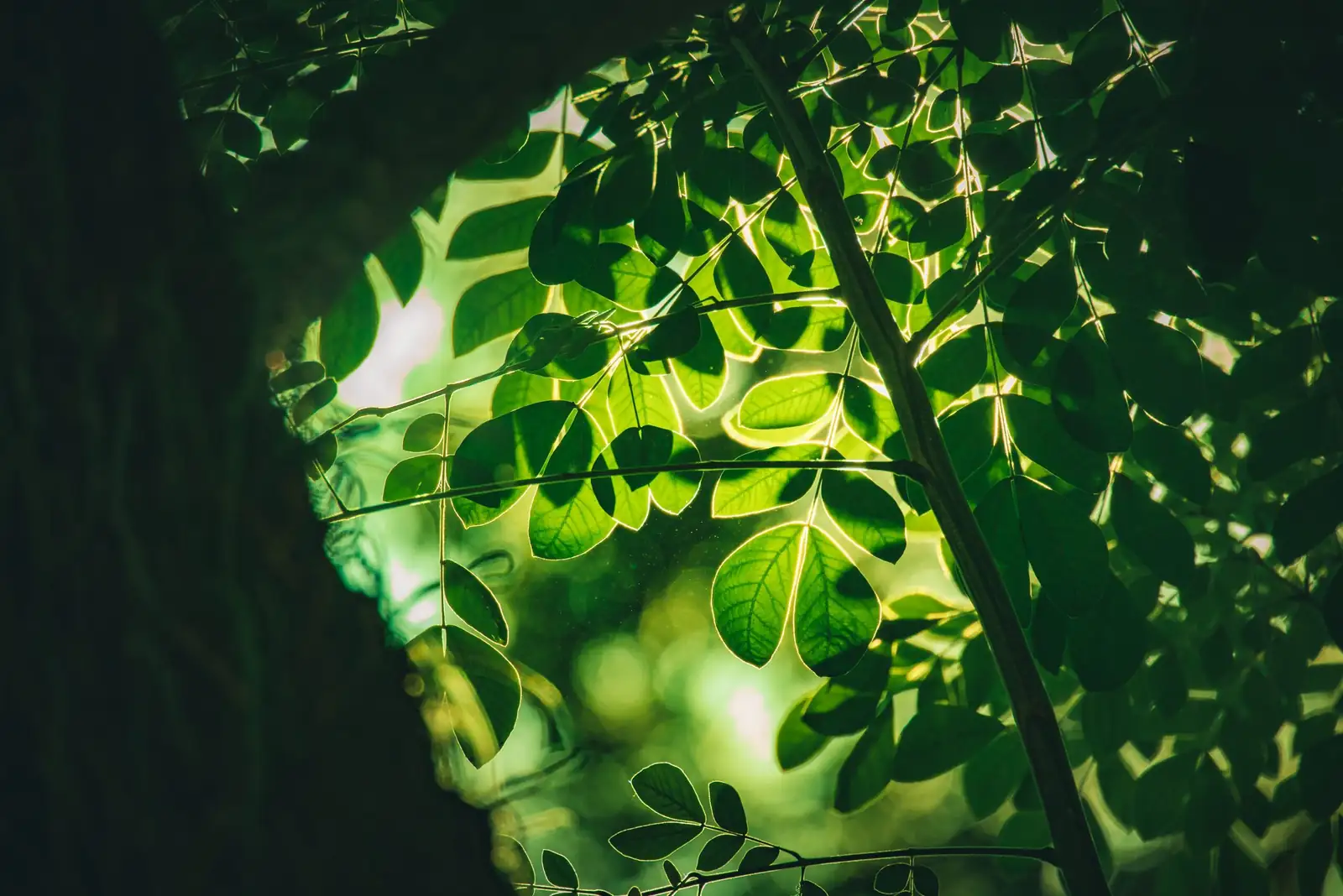
- Why it’s so graphic: The radial leaflet layout maximizes light capture from many angles, like a solar array.
- Leaflet count and shape: Commonly 7–9 obovate-to-elliptic “fingers,” glossy and slightly arched.
- Variegation note: Creamy patterns look boldest in brighter, filtered light; too little light can muddy the pattern.
Why it gets leggy in low light
When light’s weak, Heptapleurum goes into “reach” mode:
- Internodes stretch: Stems elongate faster than leaf and branch production to chase light.
- Sparse canopies: Fewer side shoots and smaller leaflets mean a thinner silhouette.
- Phototropism tilt: The plant leans toward its brightest source, worsening the lopsided look.

Fast fixes and long-term strategy:
- Upgrade the light: Bright, indirect is the sweet spot. Think an east window or a south window with a sheer curtain.
- Rotate the pot: Quarter-turn weekly for even exposure.
- Strategic pruning: In spring to early/midsummer (about May–July), cut back leggy stems by ~1/3 just above a node to spark branching. Repeat light shaping 2–3 times in the growing season to build density.
- Support for height: Use a stake or moss pole to keep eager stems tidy while they fill in.
The truth about flowers indoors
Heptapleurum arboricola can flower—but rarely inside. On mature plants (more common outdoors in warm climates), you’ll see small greenish flowers in branched clusters, followed by small berries. Indoors, most of us will never see a bloom, which is why this species is prized for evergreen foliage and form. Treat flowering as a botanical bonus, not a care goal.
Training tricks: from braided stems to moss-pole standards
This plant loves a makeover. Try one of these looks.
1) Full, bushy shrub (the classic)
- In late spring through early/midsummer, tip-prune or cut long stems back by ~1/3 just above a node.
- After new shoots emerge, do a light refinement prune.
- Repeat light shaping 2–3 times during the growing season for a dense canopy.
2) Single-stem “standard” (mini indoor tree)
- Choose one strong leader; gently stake to keep it upright.
- Gradually remove the lowest side branches to raise the “crown.”
- Tip-prune the top to encourage a rounded canopy; repeat as needed in the growing season.
- A heavier pot helps keep standards from tipping.
3) Braided stems (living sculpture)
- Start with 3 young, flexible stems of similar thickness (a multi-stem nursery plant works great).
- Loosely braid, spacing the crosses; secure with soft ties that won’t cut into bark.
- As they grow, adjust ties and continue the braid—never cinch tightly.
- Keep light bright and even to prevent the braid from pulling to one side.
4) Moss-pole column (sleek and vertical)
- Insert a moss pole or sturdy stake close to the main stems.
- Tie stems with soft, figure-eight loops.
- Prune lightly to encourage upright, evenly spaced leaders.
- Great for narrow spaces and modern interiors.
Pro tip: Whatever form you choose, time the heavier cuts for late spring to midsummer. Pruning in that window wakes up dormant buds and builds branching fast.
Care, fast and friendly
Light
- Best: Bright, indirect light. A bright east window or a filtered south window (sheer curtain) works wonders.
- Tolerates: Partial shade, but expect slower growth and leggier stems.
- Avoid: Harsh, direct midday summer sun that can scorch leaves.
Water
- Growing season: Water when the top 2–3 cm (about 1 in) of mix is dry; then soak thoroughly and let excess drain. Never leave it standing in water.
- Winter: Cut way back—often about once a month in many homes, or only when the pot is mostly dry.
- Why the fuss? A “bone-dry to soaking-wet” cycle can trigger leaf drop.
Soil and pot
- Mix: Free-draining is nonnegotiable. Try 2 parts quality potting mix to 1 part perlite/coarse sand; or include bark/leaf mold with coco coir/peat and perlite.
- Pot: Sturdy and a bit heavier to prevent tipping. Size to the root ball; don’t overpot.
Temperature and humidity
- Temperature: Warm suits it best—roughly 15–30°C (59–86°F). Avoid cold drafts and prolonged chill below ~10°C (50°F).
- Humidity: Adaptable to normal homes; looks extra-luxe around 60%. In dry air, try a pebble tray or humidifier. In winter, go easy on misting; focus on steady warmth and airflow.
Feeding
- Growing season: A balanced liquid fertilizer monthly at half strength is a safe baseline. If growth is vigorous and you’re on top of watering and light, every 2 weeks at label strength can work.
- Winter: Pause or greatly reduce.
Repotting
- Spring is ideal. Young, fast growers may like an annual step-up; established big plants are often fine every 2 years or when rootbound. Move one pot size at a time and keep the mix airy.
Seasonal rhythm
- Spring: Repot if needed, start feeding, and prune to set your shape.
- Summer: Shield from harsh sun, keep watering consistent, boost humidity/airflow.
- Autumn: Slow feeding; watch for drier indoor air as heating kicks on.
- Winter: Keep warm, water sparingly, and skip fertilizer.
Troubleshooting at a glance
- Sudden leaf drop: Often overwatering, cold drafts, or too little light. Let the mix dry more, warm it up, and move to brighter indirect light.
- Leggy growth: Upgrade light, rotate weekly, prune above a node in late spring/early summer, and consider a stake or pole.
- Variegation fading: Usually not enough light; brighten gradually.
- Pests: Spider mites (especially in dry air), scale, and mealybugs. Wipe leaves, improve humidity/airflow, and treat early with horticultural oil or insecticidal soap; repeat as directed.
- Spots or rot: Overwatering or stale, overly humid air. Refresh airflow, remove affected leaves, and fix drainage.
Propagation, made simple
- Stem cuttings (easiest): From April to September, take 10–12 cm (4–5 in) tip or semi-ripe cuttings. Remove lower leaves, root in moist perlite/sand or a very airy mix. Warmth around 25°C (77°F) and high humidity speed things along; rooting often takes about a month. Water propagation can work too.
- Seed (for the patient): Sow in spring; germination is best around 19–24°C (66–75°F) and often takes 3–4 weeks. Pot up seedlings at ~10 cm (4 in).
Safety and good manners
- Toxic if ingested; sap may irritate skin and mouth and can cause mild gastrointestinal upset in people and pets. Keep out of reach, and wash hands after pruning.
Symbolism and “flower language”
This species is often linked with protection, resilience, and good fortune—the arched, umbrella-like leaf spokes read as shelter and abundance in feng shui–style decor. Because it rarely flowers indoors, its “language” is less about blooms and more about form: a protective canopy over your space, evergreen tenacity through the seasons, and vigorous regrowth after pruning as a quiet emblem of bounce-back strength.
Quick style recipes
- Keep it compact: Bright, filtered light + spring prune above nodes + repeat light shaping 2–3 times through summer.
- Grow it tall, not floppy: Bright indirect light + moss pole or sturdy stake + tip-pruning to balance leaders.
- Show off variegation: Place in higher, filtered light; avoid dim corners.
- After purchase: Let it acclimate in bright shade with good ventilation. Keep the mix lightly moist (not wet). Move to its long-term bright spot after you see fresh new growth.
With the right light and a little shaping, Heptapleurum arboricola becomes living architecture—clean lines, glossy texture, and an indoor “umbrella” that always has your room covered.