

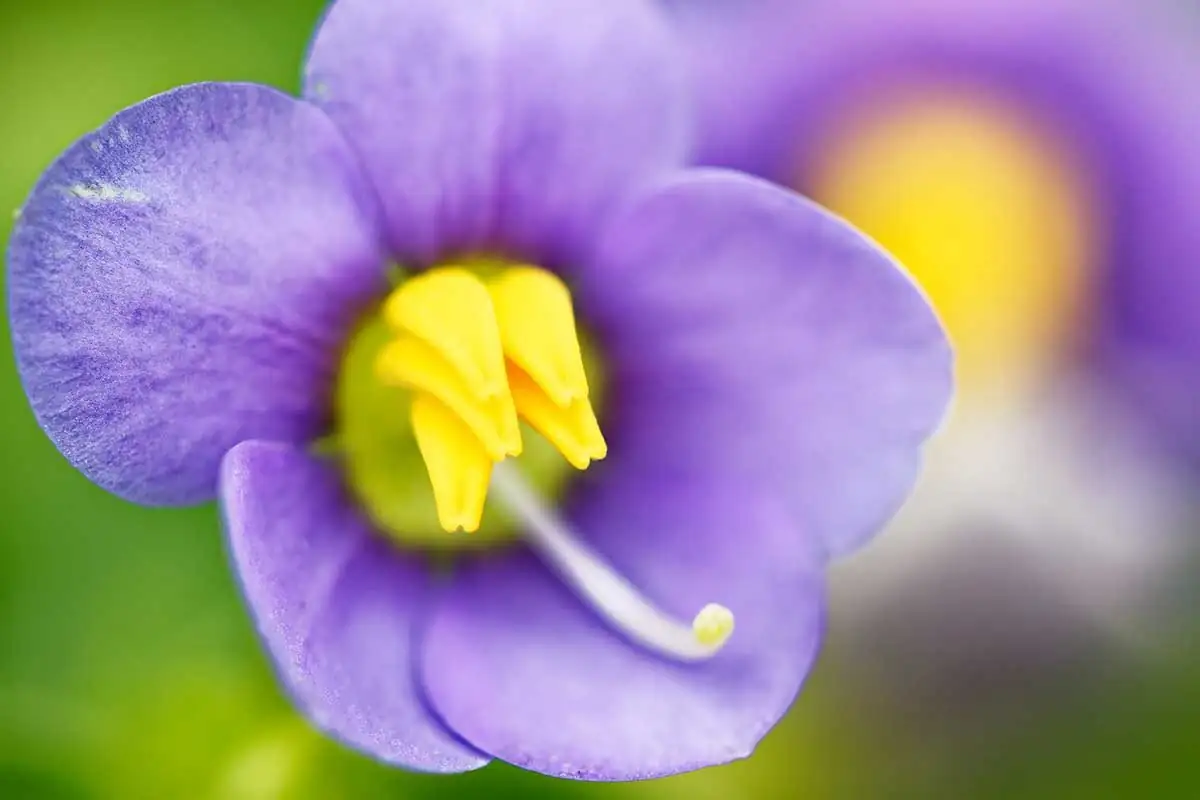
Think of Persian violet as the room-cooling jewel your space is missing: a neat dome of glossy leaves sprinkled with violet-to-lavender stars, each punctuated by a sunny yellow center. Style it by a gentle east or north window, set it in a matte white or stoneware pot, and surround it with cool hues and tactile, natural finishes—the plant will glow while your room feels calmer and fresher.
Meet Persian violet (Exacum affine)
- Botanical: Exacum affine (Gentianaceae); often sold as Persian violet, Arabian violet, German violet, or Mexican violet
- Origin: Native to Socotra Island (Yemen); now a beloved indoor flowering plant worldwide
- Habit and size: A compact, rounded mound 6–12 in (15–30 cm) tall and wide
- Look: Glossy, deep-green leaves; masses of small, lightly fragrant violet-to-lavender blooms with bright yellow anthers
- Season: Peak bloom late winter through spring, often for months if kept cool and bright
- Best room role: A “cool-season color” accent for shelves, bedside tables, coffee tables, and windowsills
Light that flatters (and doesn’t overheat)
Persian violet wants brightness without burn.
- East windows: Ideal. Gentle morning sun, then bright indirect light the rest of the day.
- North windows: Also excellent—steady, diffuse light with minimal heat.
- South/west windows: Possible only with distance or a sheer curtain. Direct midday sun leads to stress and faster flower fade.
Pro tip: A bright, white wall or matte backdrop opposite the plant can bounce light toward it without adding heat.

The perfect pot: matte white or stoneware
Think of the pot as your plant’s wardrobe and climate control in one.
- Material: Stoneware or thick ceramic buffers root-zone temperatures better than thin plastic.
- Finish: Matte white or chalky neutrals amplify the flower color without visual heat or glare.
- Color contrast: White and cool grays make violet petals and yellow centers pop crisply.
- Function first: Always choose a pot with a drainage hole and a saucer. Add a thin riser or feet so the base never sits in water.
Cool palette pairings that make blooms sing
Lean into restful hues that echo the plant’s palette and extend its “cool-season” mood.
- Blues: Lapis, indigo, and misty denim
- Greens: Sage, eucalyptus, and silvery olive
- Neutrals: Cloud gray, chalk white, ash, and soft pebble
- Metals: Brushed nickel or pewter over warm brass for less visual “heat”
- Stone: Honed marble, soapstone, limestone coasters or trays under the pot for a soft, cooling base
Tip: Keep any warm accents (tan leather, light oak) small and textural so they don’t visually warm the whole vignette.
Companion textures that flatter
Balance the glossy leaves and satin petals with materials that feel grounded and tactile.
- Soft textiles: Washed linen, stonewashed cotton, boucle throws
- Natural fibers: Woven seagrass, rattan, or cane (keep it light and airy)
- Ceramics: Unglazed or satin-glazed bud vases and bowls in cool whites or blue-gray
- Stone and clay: Unglazed clay trays, honed stone coasters, handmade ceramic catch-alls
Arrange the plant on a low stack of pale art books or a shallow stone tray—elevated slightly for airflow—with a small bud vase in indigo glass. It’s a quick, cooling vignette.
Companion plants (compatible light, lovely contrast)
Group with foliage that shares bright, indirect light and enjoys moderate humidity.
- Delicate fronds: Maidenhair fern (Adiantum) or a compact bird’s-nest fern for feathery softness
- Petite texture: Pilea glauca, baby tears (Soleirolia), or mossed stones for cushiony contrast
- Glossy foils: Peperomia obtusifolia ‘Mini’ or a small pilea for rounded leaves that echo Persian violet’s dome
Keep groupings airy—tight crowding can trap heat and humidity where airflow is needed.
Keep it cool to keep it blooming
Persian violet performs best when the room feels springlike.
- Temperature: 59–70°F (15–21°C). Prolonged heat shortens bloom time and overall vigor.
- Placement: Away from radiators, heat vents, fireplaces, hot electronics, and west-facing glass.
- Humidity: Moderate to high is appreciated, especially during heating season.
- Use a pebble tray with water (pot above the waterline), or a small room humidifier.
- Airflow: Gentle, not drafty. A light, indirect breeze helps prevent mildew and keeps temps even.
- Light rhythm: Gentle morning sun is welcome; avoid strong midday beams.
Watering and feeding, simplified
This plant is happiest when the root ball never swings from soaked to bone-dry.
- Watering:
- Keep evenly moist—never waterlogged, never dusty dry.
- Water thoroughly, then let excess drain. Don’t let the pot sit in water.
- If the top 0.5 in (1–2 cm) is just barely dry, water again. Allowing full dry-outs triggers rapid flower drop.
- Soil: A light, fertile, well-draining mix that still holds moisture.
- Try: 2 parts quality potting mix + 1 part fine bark or perlite for breathability.
- Feeding: Every 2–3 weeks while flowering with a diluted, balanced liquid fertilizer.
- Deadheading: Pinch off spent blooms to keep the dome tidy and encourage a longer show.
Styling recipes you can copy today
- East-window breakfast nook
- Matte white stoneware pot on a honed marble trivet
- Linen café curtain in sage; pewter spoon rest; indigo-striped napkins
- Add a tiny bud vase with one complementary violet stem for echo
- North-facing office shelf
- Persian violet beside a stack of pale gray notebooks
- A small rattan catch-all and brushed nickel task lamp
- Mini fern for airy texture; cool-blue coaster as color anchor
- Bedroom calm on a nightstand
- Cool-gray ceramic pot, cloud-white bedding, eucalyptus throw
- Low-profile pebble tray beneath the plant for humidity and style
- Frosted glass candle holder (unlit nearby to avoid heat)
Buying and expectations
- Choose plants with many unopened buds, firm glossy foliage, and no yellowing.
- This is a tender perennial but often grown as a short-lived houseplant; most people enjoy it through its main bloom and then replace it, as reblooming indoors is tricky—especially in heat.
Quick troubleshooting
- Sudden flower drop: Root ball dried out or room too warm; re-establish even moisture and move to a cooler, brighter spot.
- Leaves paling or stretching: Light too low; shift closer to an east or north window.
- Buds not opening well: Air too dry or too warm; increase humidity and keep in the 59–70°F range.
- Pests to watch: Aphids, spider mites, fungus gnats. Rinse gently, then treat with insecticidal soap if needed. Improve airflow and keep soil from staying soggy to deter gnats.
Safety and placement notes
- Non-toxic to humans and pets.
- Not frost-tolerant; best grown indoors or outside only in mild, frost-free conditions in bright shade.
Name and symbolism (and why it feels so calming)
Despite the common name Persian violet, Exacum affine is native to Socotra (Yemen). The “Persian” moniker nods more to the flower’s refined look than its true origin. Symbolically it’s linked with calmness, delicacy, and quiet beauty—qualities that pair naturally with a cool palette and soft textures. In Victorian-style “flower language,” meanings were cultural constructs, not botanical truths, yet the plant’s serene poise still makes it a perfect emblem for restful spaces.
Care-at-a-glance
- Light: Bright indirect; gentle morning sun is fine; avoid harsh midday rays
- Temperature: 59–70°F (15–21°C)
- Water: Evenly moist; never sodden or bone-dry
- Humidity: Moderate to high
- Feed: Diluted balanced fertilizer every 2–3 weeks in bloom
- Grooming: Deadhead regularly
- Repotting: Rarely needed; often replaced after the main flowering season
Styled with cool colors, tactile neutrals, and a pot that keeps roots comfortable, Persian violet becomes a tiny, living focal point—fresh as spring, and just as easy on the eyes.