

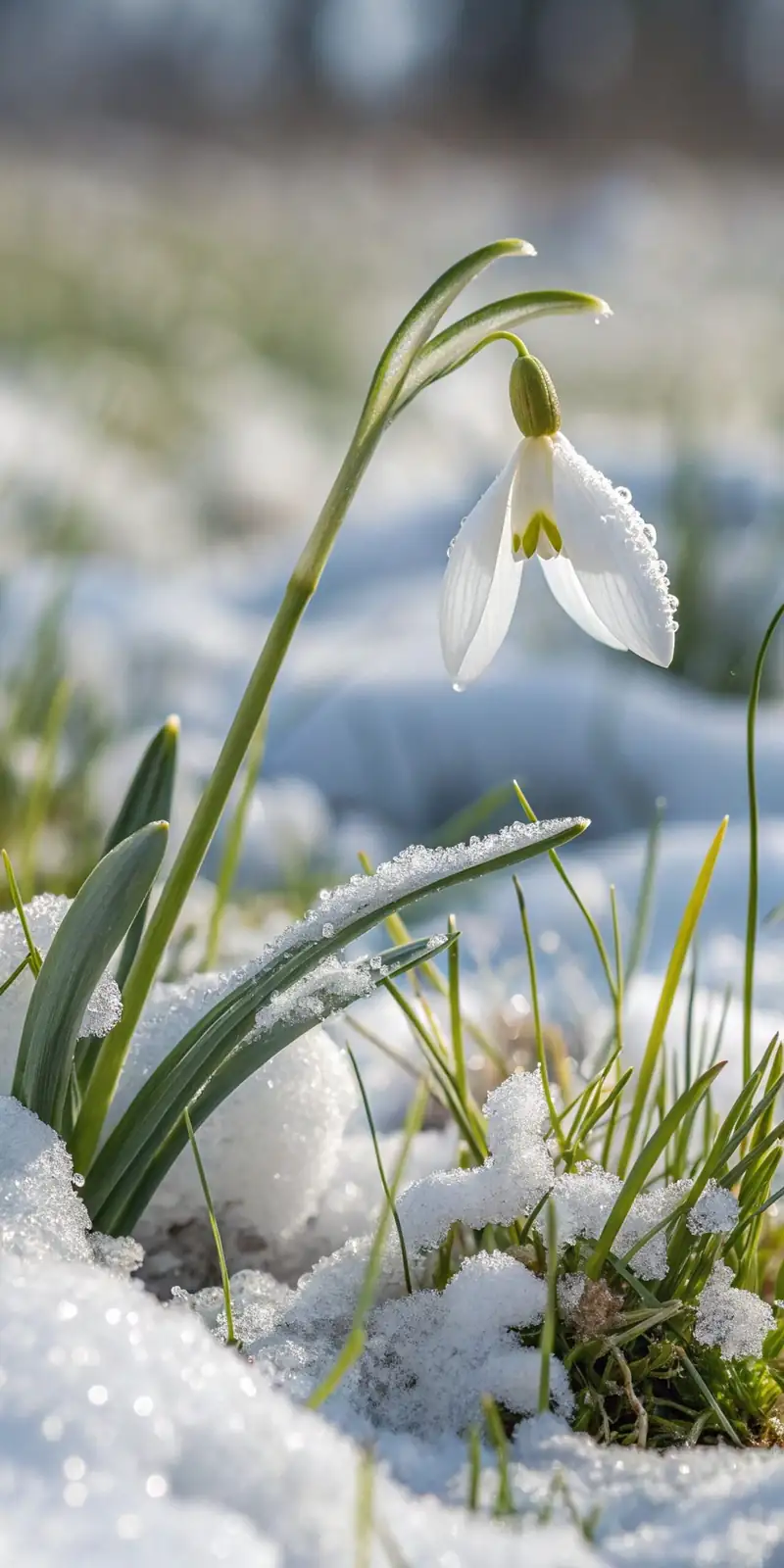
When the year still wears winter’s gray coat, a green spear splits the frost and lowers a tiny white lantern. That is Galanthus nivalis—the snowdrop—arriving when gardens seem most bereft to whisper the same message each year: hold on; spring is on its way.
What the Snowdrop Says: A Language of Hope, Renewal, and Consolation
Flower language is never born in a vacuum. It accumulates layer by layer—from sacred story to village superstition to the coded bouquets of the Victorian parlor. Today, snowdrops commonly speak of:
- Hope and renewal
- Purity and new beginnings
- Consolation and gentle sympathy
Why these meanings? Their timing is everything. Snowdrops push through frozen soil in late winter, often while snow still lingers, promising that winter will not last forever.
Candlemas Bells and Christian Legends
By February each year—Candlemas in the Christian calendar—snowdrops often bloom in drifts around churches and hedgerows, earning folk names like “February Fairmaids” and “Candlemas Bells.” In Christian symbolism, the flower’s immaculate white suggests purity and its nodding head reads as humility. Traditions also link snowdrops with the Virgin Mary; some older sources even call them “St. Agnes’ flower.”

A popular Christian legend tells of an angel transforming snowflakes into snowdrops to comfort Eve after the Fall—an image that fuses wintry sorrow with tender promise. In art, the bowed flower sometimes appears near scenes of mourning or purification, quietly underscoring grief answered by grace.
Churchyards, Sorrow, and the Comfort of Drifts
If you’ve wandered old churchyards, you’ve likely seen snowdrops brightening graves in late winter. Their presence there helped entrench a dual meaning in folk tradition: comfort and consolation on one hand, and an edge of somber omen on the other. In Victorian Britain, a single snowdrop plucked and brought indoors could be deemed unlucky, while great drifts outdoors were cherished—soft, shining blankets of reassurance at winter’s nadir. That paradox—private dread, public solace—fed directly into flower language.
The Victorian Code: Floriography’s Nuances
In the nineteenth-century “language of flowers,” snowdrops frequently signified consolation, hope, and purity. Bouquets hinted at fresh starts after hardship or loss. The tension between public admiration and private superstition (never bring a lone bloom into the house!) made snowdrops eloquent messengers: they acknowledged grief without surrendering to it, promising the smallest, truest kind of recovery—return.
New-Beginning Gifts Today
Modern gifting leans into that optimistic note:
- For milestones: Snowdrops make thoughtful tokens for new homes, career changes, or life-after-storm chapters. A small pot of living bulbs captures “renewal” better than cut stems.
- For sympathy: Their quiet beauty offers comfort without grandiose claims. Consider a potted clump for planting—something that returns each year as a remembrance.
- A gentle caution: Snowdrops are toxic to humans and pets if ingested. Keep away from curious children and animals.

Late-Winter Festivals and Walks
Snowdrops star in late-winter celebrations that greet the sun’s slow return:
- Candlemas (Feb 2) and the older seasonal festival of Imbolc (around Feb 1–2) arrive just as snowdrops open, symbolically sweeping out winter’s gloom.
- Across cooler parts of Europe and the British Isles—where the plant is widely naturalized—“snowdrop walks” draw visitors to woodlands and historic gardens sparkling with thousands of white bells.
How a Small Plant Earned Such Big Meaning
Symbolism sticks when botany makes it believable.
- Daring timing: Snowdrops flower in late winter to early spring (often January–March), braving frosts that fell tougher plants.
- A lantern of white: Each nodding, bell-shaped bloom has six tepals—three larger outer segments and three smaller inner ones lightly notched with green. That “little lamp” look is central to their aura of purity and hope.
- The winter spear: Leaves are narrow, glaucous gray-green, and tipped like tiny drills, helping shoots punch through compacted cold soil.
- Reliability: As hardy, perennial bulbs, snowdrops quietly multiply into clumps and naturalize in the right spot. They return, and return again—renewal you can set your watch by.
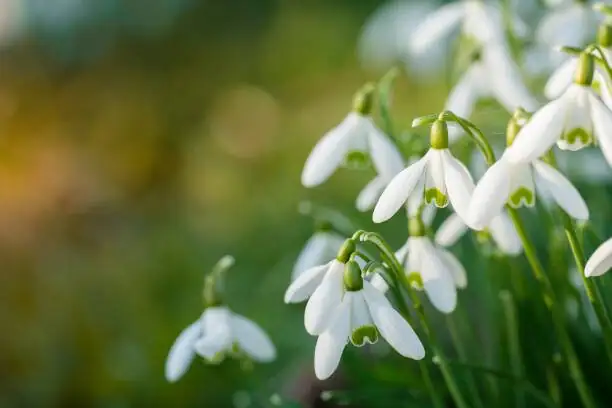
Even the name says so: Galanthus comes from Greek for “milk” (gala) and “flower” (anthos)—the milk-white bloom—while nivalis nods to snow. Their family, Amaryllidaceae, includes other winter-and-early-spring stalwarts that seem to know how to keep calm in cold weather.
Some folkloric strands reach beyond Christendom—late-winter tales across parts of Central and Eastern Europe often pair snowdrops with the triumph of spring over winter. And while scholars differ, later retellings sometimes link the mythic “moly” of classical literature to snowdrops, another echo of these flowers as protectors and guides through dark seasons.
Cultural Significance in Memorials
Because they bloom when grief often feels most wintry, snowdrops have become a tender memorial flower:
- In cemeteries: Drifts offer a living vigil—neither loud nor lavish, but steadfast.
- In remembrance gardens: Planted “in the green” after flowering, they return each year to keep the story going.
- In messages: Their language says, “The cold will pass; what is lost will be lovingly remembered.”
A poignant addendum: compounds in snowdrops include galantamine, used pharmaceutically in managing symptoms of Alzheimer’s disease. While cultivation and medicine occupy different worlds, the association with memory and its fragility only deepens their role in acts of remembrance.
A Quick Portrait for Gardeners and Gift-Givers
- Native range: Much of Europe from the Pyrenees through France and Germany to Poland, down into Italy and the Balkans, and west/north Turkey; naturalized widely, including the British Isles, the Netherlands, and parts of North America.
- Habit and size: Perennial bulbs, typically 7–15 cm (3–6 in) tall; one nodding white flower per stem.
- Where they thrive: Cool climates (USDA Zones 3–7); humus-rich, well-drained soil; full sun in early spring with part shade later—perfect beneath deciduous trees.
- Care notes:
- Plant “in the green” for best establishment (late winter/early spring after flowering), or set dry bulbs in fall about 7–8 cm (3 in) deep.
- Keep evenly moist in growth; avoid waterlogging; allow foliage to yellow naturally before removing.
- Low-fuss once settled; clumps can be divided after flowering every few years.
- Wildlife and resilience: Early nectar for pollinators; alkaloids mean bulbs resist browsing by deer and rabbits.
- Safety: All parts are toxic if eaten (including to cats and dogs). Handle sensibly, and site gifts thoughtfully.
- Sourcing: Choose reputable, cultivated stock. The Galanthus genus is listed under CITES Appendix II, and international trade is regulated to protect wild populations.
Reading the Snowdrop Today
If roses are operatic, snowdrops are chamber music—clear, spare, and piercingly expressive. Their flower language grew from Candlemas processions and village lore, from churchyards and Victorian parlors, from the simple miracle of blooming through cold earth. That is why they are perfect for:
- Memorials that ask for gentleness rather than grandeur
- New-beginning gifts that promise steady light instead of easy fireworks
- Late-winter festivals that mark the hinge between dark and bright
Each year, when the first white bell leans over the last of the snow, it speaks the same small, saving word in every language it has learned over centuries: hope.