

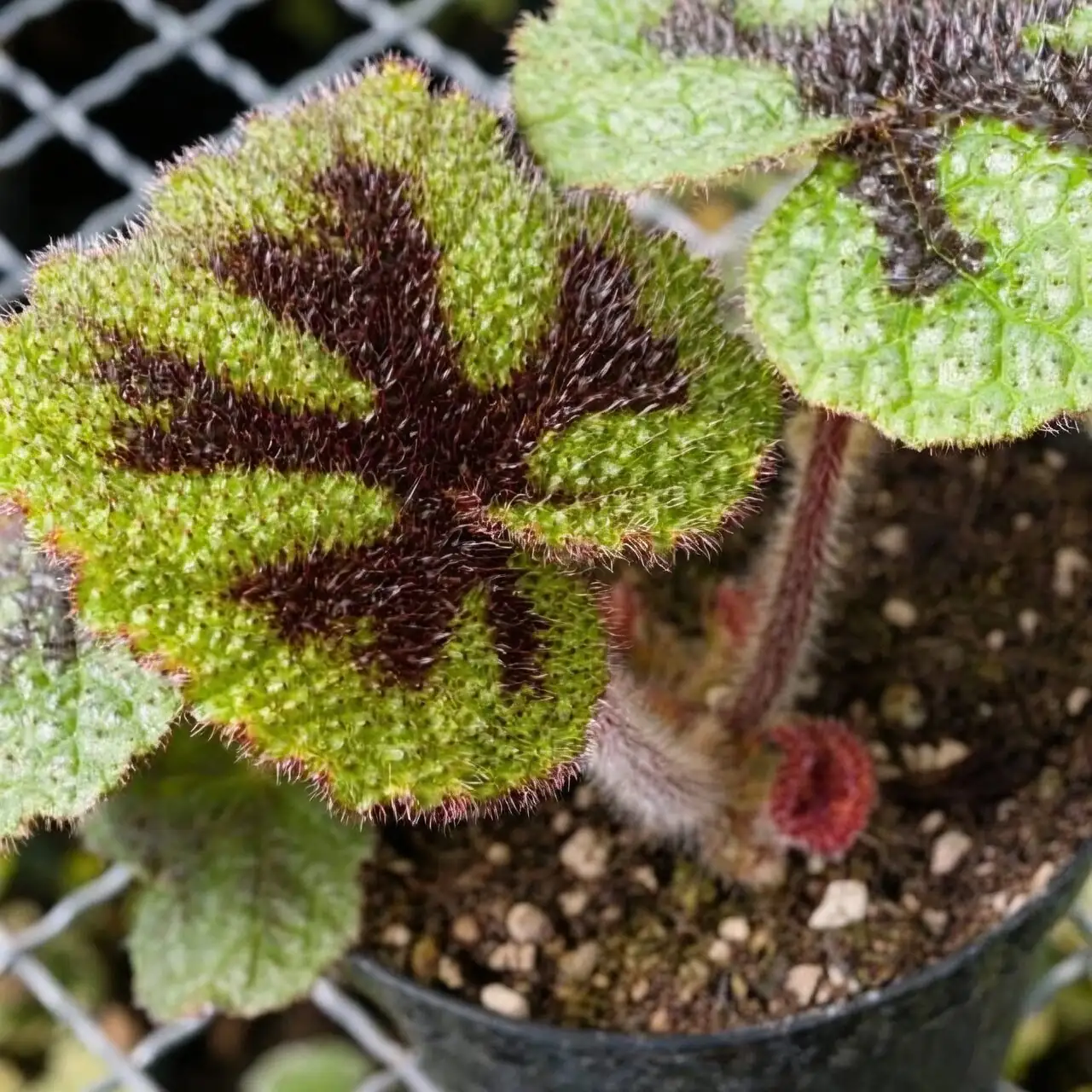
Run your fingertips across an Iron Cross Begonia and you’ll understand the nickname instantly: those bright green, heart-shaped leaves really do feel like fine sandpaper—stamped with a bold, wine-red “cross” for drama. But the secret to keeping Begonia masoniana beautiful is less about mystique and more about mechanics: give its surface-creeping rhizomes a wide, shallow home and an airy mix, and rot rarely gets a foothold. Come spring, a gentle repot sets the stage for a lush, healthy year.
Meet Begonia masoniana, a rhizome that loves to sprawl
- Common names: Iron Cross Begonia; also sold as Mason’s Begonia or Brazilian Begonia (a trade nickname—its wild origins trace to southern China to Vietnam)
- Habit: Rhizomatous, compact, and more horizontal than tall in a pot
- Size: Typically 30–45 cm (12–18 in) tall and wide
- Foliage: Heart-shaped, rough-textured leaves with a dramatic dark cross on a bright green field
- Flowers: Small, pale pink to whitish sprays—pretty but secondary
- Light: Bright, indirect light (tolerates medium); avoid harsh midday sun that can crisp and fade leaves
- Comfort zone: 18–27°C (64–81°F), with moderate to high humidity (ideally 50–70%), and steady airflow
Why wide, shallow pots win (and deep ones can doom a rhizome)
Rhizome anatomy 101
Begonia masoniana grows from a creeping rhizome that sits at or just above the soil surface. Unlike deep, fibrous root systems, these rhizomes:
- Prefer oxygen-rich, quick-drying conditions at the top layer
- Store some moisture but rot if kept soggy or buried
- Spread sideways, not downward—so horizontal space beats depth
The physics of pots: banishing the soggy “perched” layer
All pots hold a saturated zone at the bottom after watering. In deep, narrow pots, that soggy zone:
- Lingers longer, starving roots of oxygen
- Encourages fungus gnat breeding and rot
- Puts a surface-hugging rhizome closer to trouble
A shallow, wide pot shrinks that saturated layer and speeds drying where the rhizome lives. Bonus points for unglazed terracotta, which breathes and helps wick moisture away. The “wide plate, not a tall glass” approach mirrors how this begonia grows in nature: creeping and branching along the surface.
The right airy mix (and why it matters)
Think scaffolding, not sponge. You want a fast-draining, oxygen-rich blend that dries predictably without compacting.
- A reliable recipe:
- 1 part coco/peat-based houseplant mix
- 1 part small orchid bark (about 1/8–1/4 in)
- 1 part coarse perlite (or pumice)
- Good add-ons (optional): a handful of horticultural charcoal to help keep the mix sweet and open
Key technique: keep the rhizome at or just above the surface—do not bury it. Backfill loosely and resist the urge to pack the mix down; you’re preserving air pockets that roots crave.
A gentle spring repot walkthrough
Spring is prime time. Repot every 1–2 years or when the rhizome crowds the rim. If you’ve just brought one home, let it settle for a few weeks before any surgery.
You’ll need
- A shallow, wide pot with a drainage hole (terracotta is excellent), just one size wider than the current pot
- Your airy mix, pre-moistened so it’s evenly damp, not wet
- Clean shears or a sharp knife
- A soft brush or chopstick for nudging mix into place
Step-by-step

- Water lightly the day before to ease removal.
- Slide the plant out, supporting leaves with your palm. Don’t yank on stems.
- Gently tease away old, compacted mix. Inspect the rhizome—it should feel firm, never mushy.
- Trim away any rot (soft, blackened bits) with sterile tools. Allow cut edges to dry for 15–20 minutes.
- Set a thin layer of your airy mix in the new pot.
- Position the plant so the rhizome sits on top of the mix, just kissing the surface. Give it room to creep forward.
- Backfill loosely around roots, leaving the rhizome visible. Do not mound mix over it.
- Tap the pot to settle; avoid compressing by hand.
- Water thoroughly to flush air voids, then let all excess drain—never leave the pot standing in water.
- Aftercare: Bright, indirect light, steady warmth, and gentle airflow. Let the top 2–3 cm (about 1 in) dry before watering again. Hold fertilizer for 2–3 weeks.
Pro tip: For greenhouse growers, moss-lined wire baskets are nearly ideal for air/water exchange. Indoors, a shallow terracotta pot is a practical star.
Watering, light, and humidity that keep rot at bay
- Watering rhythm: Water when the top 2–3 cm (1 in) feels dry. Then water thoroughly and drain completely. Reduce frequency in winter as growth slows, but keep the plant warm.
- Technique: Water at the base, not over the leaves—wet foliage can invite spotting or mildew, especially late in the day.
- Light: Bright, indirect light makes the cross pattern pop without scorching.
- Humidity: Aim for 50–70% with airflow. Use a humidifier or a pebble tray (pot above the waterline). Avoid parking it beside drying vents.
Troubleshooting: reading the leaves and rhizome
- Mushy rhizome or blackened leaf bases
- Likely cause: overwatering, cold, or a buried rhizome
- Fix: Unpot, trim rot, refresh into an airy mix, keep rhizome at the surface, move to warmth, and space waterings
- Brown, crispy leaf edges
- Likely cause: low humidity, underwatering, or hot direct sun
- Fix: Raise humidity, resume a steady water rhythm, and shift to bright, indirect light
- Pests (spider mites, thrips, mealybugs; fungus gnats if soil stays wet)
- Prevention: Airy mix, let the top layer dry, and keep airflow steady
- Treatment: Insecticidal soap or horticultural oil, repeat applications as needed; isolate affected plants
Safety note
Begonia masoniana is toxic to pets if chewed (insoluble calcium oxalates). Keep out of reach of curious cats, dogs, and small children.
Propagation nudge (when you’re ready to share)
- Rhizome division: Cut a firm segment with at least one growth point; set it on a moist, airy medium with the rhizome on top
- Leaf cuttings: Sections can root with warmth (about 21–24°C / 70–75°F) and high humidity
- Keep the medium just moist and the air moving to prevent rot
A brief word on symbolism
While Victorian floriography painted begonias broadly (and inconsistently), modern houseplant culture celebrates the Iron Cross Begonia for individuality and the appreciation of unique beauty—its bold cross and tactile leaf surface make it a living emblem of standing out with style.
Quick care snapshot
- Light: Bright, indirect; avoid harsh sun
- Water: When the top 2–3 cm (1 in) dries; drench and drain; reduce in winter
- Temperature: 18–27°C (64–81°F); avoid below 13°C (55°F)
- Humidity: 50–70% with airflow
- Soil: Loose, airy, fast-draining (coco/peat + bark + perlite)
- Feeding: Spring to early autumn, balanced fertilizer at 1/4–1/2 strength every 2–4 weeks
- Pruning: Remove tired leaves; pinch to keep it compact
- Repotting: Every 1–2 years in spring; choose wide, shallow pots and keep the rhizome at the surface
With the right pot shape and a mix that breathes, Begonia masoniana trades drama for reliability—its handsome “iron cross” thriving above a rhizome that stays firm, happy, and rot-free.