

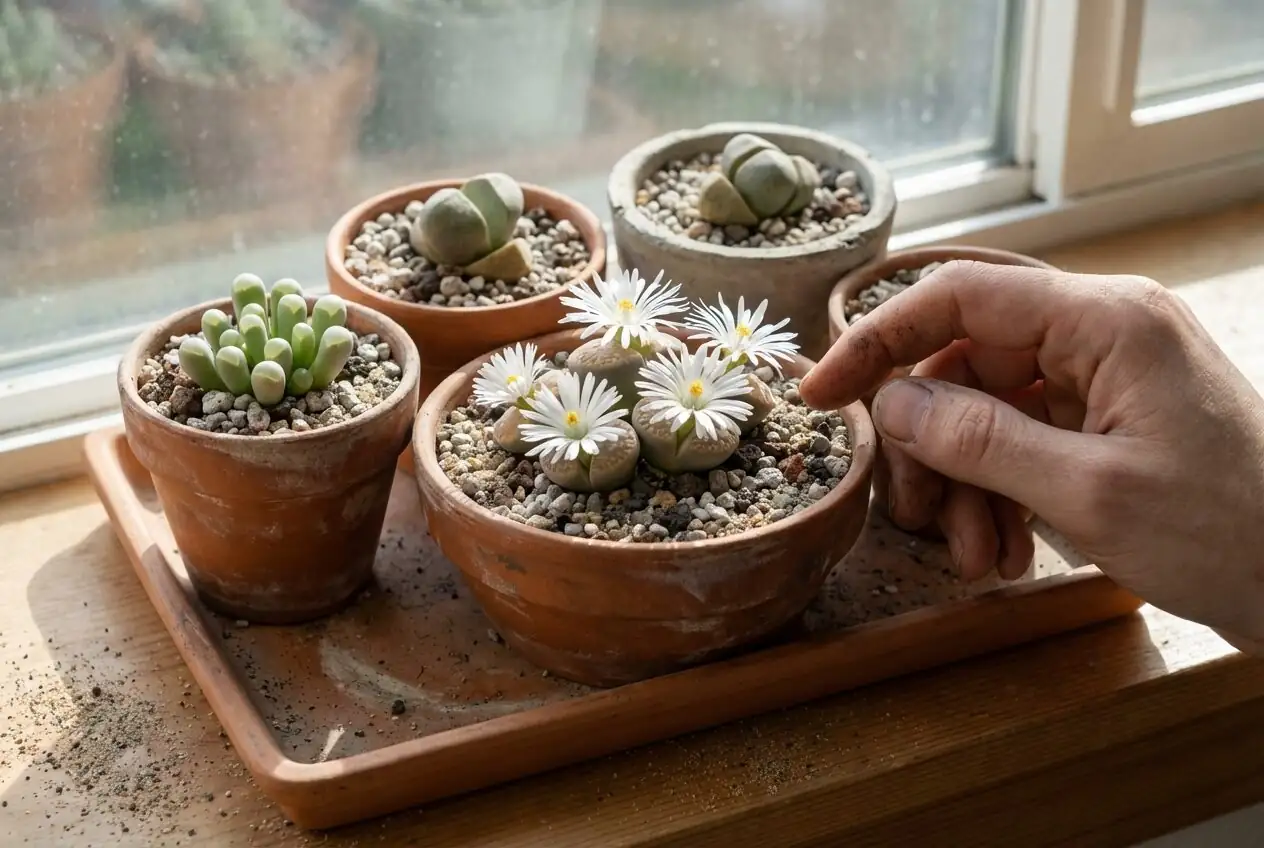
Picture a bowl of river stones on your windowsill—then watch one of the “pebbles” split and unfurl a daisy. That’s the magic of Lithops, the living stones. With a mineral-styled display, you can showcase their camouflage while keeping watering foolproof, using a tray to group separate pots, a shared palette of gritty substrates, and a rhythm that respects the quirks of each mesemb companion.
Meet the star: Living Stones (Lithops spp.)
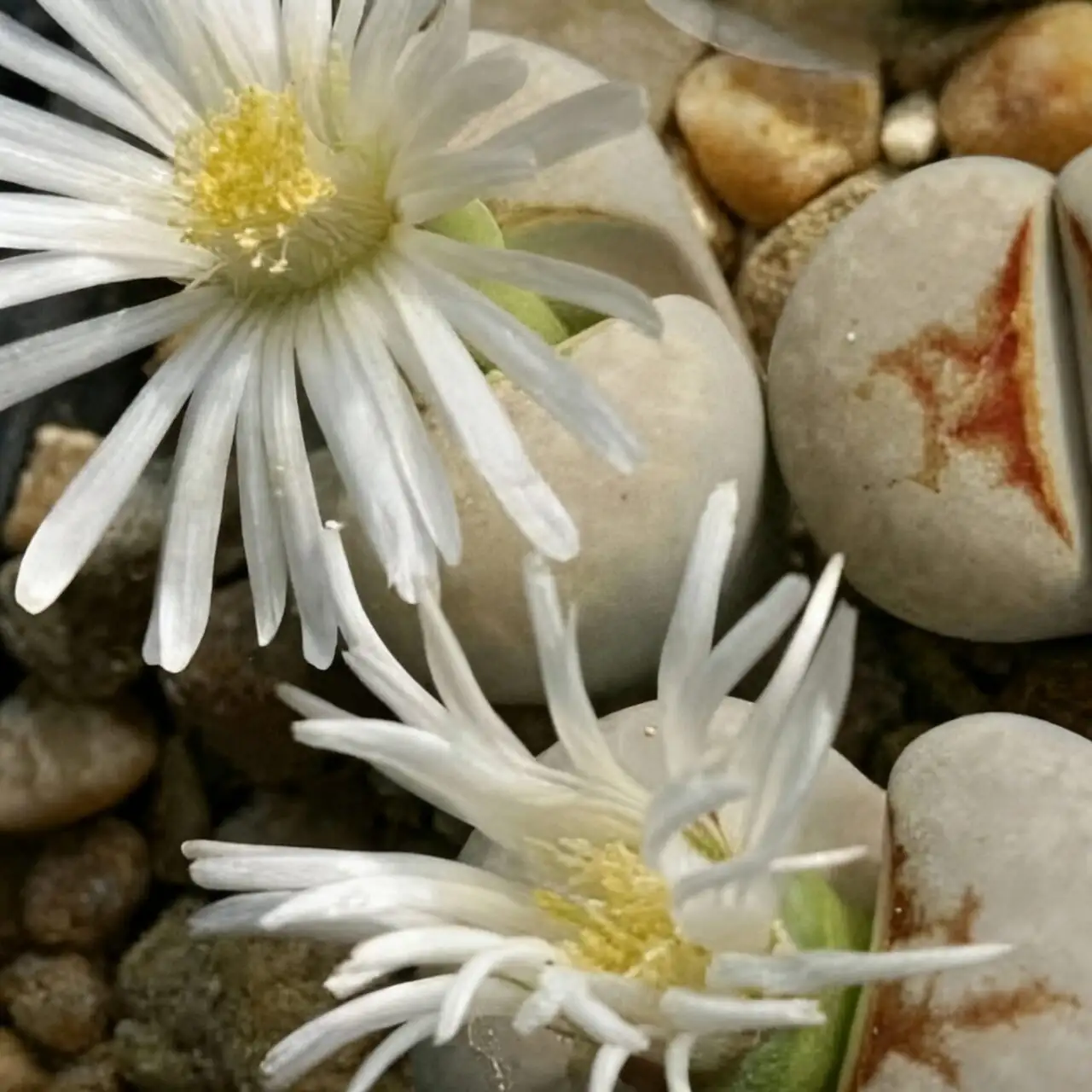
- Origin: Southern Africa, especially South Africa and Namibia—rocky, sandy, lean soils and fierce sun.
- Look: Two thick, fused leaves with a neat central slit, tops marbled in greys, tans, and browns, often with translucent “windows.”
- Size: Miniature. Individual heads are typically about 1–4 cm across; plants stay very low and may clump slowly over time.
- Flowers: Late summer to autumn; daisy-like, usually white (some yellow), popping from the central fissure.
- Light: Bright light to full sun—aim for 6+ hours daily. Indoors, south or west windows excel; acclimate gradually to avoid scorches behind glass.
- Temperatures: Best around 15–26°C (59–79°F). Protect from frost; prolonged cold near 5°C (41°F) is risky.
- Personality: Easy—once you follow the golden rule: very fast drainage and extremely cautious watering.
The design vision: a cohesive, mineral-styled mesemb tray
Create a “desert vignette” that looks unified but waters smart:
- A flat, decorative tray holds multiple individual pots. The look stays seamless; each plant keeps its own watering schedule.
- Use one cohesive mineral palette—think pumice, lava rock, coarse sand, and neutral-toned top-dress gravel—so everything reads like one landscape.
- Place Lithops center stage, with compatible mesemb cousins (Pleiospilos, Titanopsis, Fenestraria, Conophytum) in their own pots around them. Similar soils, different rhythms—no accidental drownings.
Materials and palette
- Tray: Ceramic, stoneware, zinc, or sealed wood. Add a thin layer of dry gravel purely for aesthetics and drip-catch. Never let water pool in the tray.
- Pots: Small and shallow.
- Single Lithops: 7.5–10 cm (3–4 in) pot.
- Small groups: 10–12 cm (4–4.7 in) often holds 3–5 heads; shallow vessels are preferred.
- Terracotta breathes and helps quick dry-down; unglazed stoneware works, too.
- Substrate (shared palette): Very fast-draining, gritty, high-mineral mix with only a small organic component. Pumice, lava rock, coarse sand/grit are your core; keep it lean.
- Top-dress: Match the body colors—buff, grey, russet—to make the plants “disappear” into the scene. It’s both beautiful and stabilizing.
The desert under your display: substrate that dries fast
Lithops and many mesembs hate lingering moisture. Build a mix that:
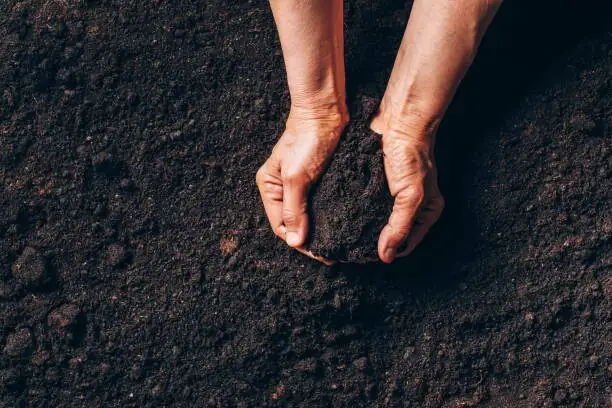
- Dries completely between waterings.
- Is low in organic material and nutrients.
- Stays structurally open (pumice, lava, coarse sand) for excellent airflow to roots.
Two practical routes:
- Ultra-mineral commercial mesemb mix (often pumice/lava/sand with trace organics).
- DIY: Start with a very gritty cactus/succulent base and increase mineral content until the pot dries rapidly. If it still stays damp, add more pumice/grit and less organic matter.
Pro tip: Top-dress with clean gravel but don’t pack it tightly. You want beauty without trapping moisture.
Potting strategy: separate pots for separate rhythms
Why separate pots on one tray?
- You’ll water each plant according to its needs without soggy neighbors.
- Roots stay in the substrate they prefer.
- If one plant needs quarantine (mealybugs, root mealy), it lifts out cleanly without disturbing the whole scene.
Spacing and scale:
- Leave air gaps between pots for ventilation.
- Use the rule of “tiny heads, tiny pots”: Lithops heads are only 1–4 cm across, so resist oversized containers that hold extra water.
Watering choreography: cue-based, not calendar-based
Water by plant signals and full dry-down—never by weekly habit.
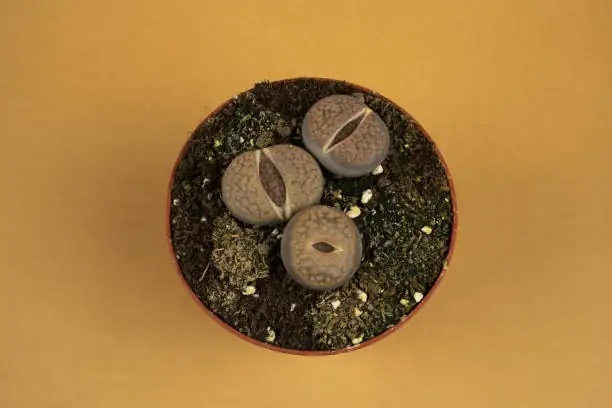
Lithops rhythm (the star of your tray):
- General rule: Let the mix go bone-dry; wait for slight wrinkling/shriveling; water lightly; then let it dry quickly again.
- Summer heat: Many slow down or rest—sharply reduce watering, give light midday shade and strong airflow.
- Late summer to autumn: Growth and flowering time; water a bit more cautiously (still allowing full dry-down), never keeping the mix wet.
- Winter leaf replacement: A new pair forms and consumes the old pair. Hold water until the old leaves have largely dried—watering now can cause splitting and rot.
Mesemb companions (broad pointers for why separate pots help):
- Conophytum: Often active in the cooler months; many rest dry in summer. Separate pot lets you water when they wake without disturbing resting Lithops.
- Pleiospilos (split rock) and Titanopsis: Generally like a similar lean, fast-draining mix; growth often peaks in cooler bright seasons. Still, exact timing may differ from Lithops—easy to adjust when potted alone.
- Fenestraria (baby toes): Likes very gritty soil too; watering frequency can diverge from Lithops, another reason for its own pot.
Label each pot with simple icons (sun, drop, moon) or a color code to remind you who drinks when.
Light, temperature, and airflow: where to place your tray
- Light: Bright south or west windows with 6+ hours of direct sun. Acclimate new plants steadily to prevent scorch behind glass.
- Heat: Best at 15–26°C (59–79°F). On scorching days, give light midday shade and push airflow.
- Air: Low humidity and excellent ventilation are your friends. Avoid steamy rooms and stagnant air.
- Outdoors in mild climates: Keep under cover from heavy rain; these are tender and not frost-hardy (roughly USDA 10–11 for outdoor culture).
Build the display: a fast, foolproof sequence
- Choose the tray and lay a thin scatter of dry gravel for aesthetics (not a water reservoir).
- Pot each plant in its own shallow container with an ultra-gritty, low-organic mix.
- Add a matching mineral top-dress to each pot for stability and a cohesive look.
- Arrange by height and texture: tight-clumping Lithops in the visual center, flanked by a larger-textured Pleiospilos or a knobbly Titanopsis.
- Tuck in blank “rocks” (actual stones) to complete the camouflage—just don’t crowd leaves.
- Place the tray in strong light, start with conservative watering, and observe.
A seasonal cheat-sheet for Lithops in your tray
- Spring: Light watering only after full dry-down. Watch the leaf replacement; keep water minimal until the old pair dries to papery sheaths.
- Summer: Many rest in heat; cut water way back, add airflow and slight midday shade.
- Late summer to autumn: Careful, slightly increased watering if actively growing/flowering. Still: soak and let dry fast—never damp for days.
- Winter: Keep warm and bright, mostly dry.
Never leave water sitting in the tray or saucers.
Feeding, repotting, and companions’ soil harmony
- Feeding: If you feed at all, keep it very light and infrequent—some growers give a single, very dilute balanced feed in autumn; others use a very dilute, low-nitrogen cactus fertilizer only during active growth, then stop in summer rest and winter. Avoid splashing fertilizer on the plant bodies.
- Repotting: Infrequent. Every ~2 years (or longer if the mix stays open), refresh the gritty substrate. Late winter to early spring is a common window. Remove only truly dry, papery old leaves.
- Soil harmony across the tray: Keep all mesembs in fast-draining, mineral-heavy mixes. You can fine-tune organic content per pot, but a lean baseline unifies the look and speeds dry-down.
Troubleshooting the mineral tray
- Mushy base or sudden collapse: Overwatering or slow-draining mix. Increase mineral content, improve airflow, lengthen dry times.
- Stretching/elongation: Not enough light. Move to a brighter window and acclimate.
- Leaf splitting out of season: Watered during leaf replacement or too frequently. Hold water until old leaves are mostly dry.
- Fungus gnats: Mix staying damp. Dry longer between waterings; consider more pumice/lava.
- Mealybugs (including root mealies): Quarantine, treat, and consider repotting into clean, gritty substrate.
Safety and placement notes
- Lithops are generally considered non-toxic to humans and pets, but they’re not food. The firm, marble-like bodies are a choking risk—keep the tray out of reach of small children and curious pets.
- Birds/rodents may peck plants near open windows or outdoors; provide a screen if needed.
The quiet poetry: symbolism and “flower language”
Lithops embody resilience and “beauty in disguise.” In harsh, stony deserts they survive by masquerading as pebbles—an artful reminder that strength can look understated. There’s no ancient “flower language” tradition tied to living stones, but modern growers often read their autumn blooms as a wink from a minimalist soul: spare all year, then suddenly generous. It’s a lovely metaphor for patience, timing, and thriving with less.
Why the tray method wins
- Cohesive design: One mineral palette makes separate pots read as a single landscape.
- Watering sanity: Each plant keeps its own schedule; no one gets soaked by a thirstier neighbor.
- Health first: Gritty mixes, airflow, and dry trays stack the odds against rot—the true enemy of living stones.
With a sunlit window, a handful of pumice and lava, and the restraint to “water by wrinkles,” your miniature desert will not just survive—it will bloom right out of the rocks.