
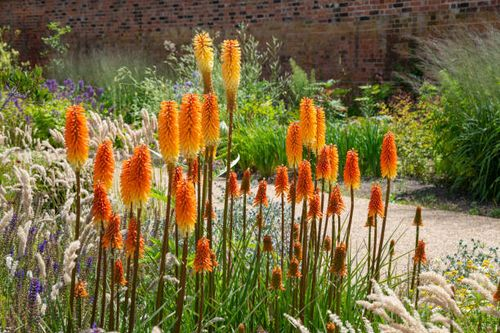
If your borders could hold a bonfire, this would be it. Red hot poker (Kniphofia uvaria) throws up glowing “torch” spikes that change color as they bloom, drawing hummingbirds and bees like a neon sign that reads Free Nectar, All Day. Add its beach‑ready salt tolerance and you’ve got a plant that looks like a party and performs like a pro.
Meet Red Hot Poker, the Torch That Blooms Upward
- Botanical: Kniphofia uvaria (family Asphodelaceae)
- Also called: Poker Plant, Torch Lily, Tritoma
- Roots: Native to eastern and southern Africa, especially South Africa
- Look: Narrow, sword‑like leaves in a fountain at the base; upright stems topped with dense, bottlebrush-like clusters of tubular flowers
- Size: About 60–180 cm tall (2–6 ft) and 30–90 cm wide (1–3 ft); dwarf forms are 45–60 cm (18–24 in)
- Season: Early summer through fall (often June–October, climate and variety depending); some rebloom if deadheaded
- Colors: Natural ombré of red, orange, coral, apricot, peach, yellow, chartreuse, and cream—sometimes nearing white as blooms age
The Bottom‑to‑Top Bloom Trick (and Why It’s Brilliant)
Each torch is actually a tight city of tiny tubular flowers, and they don’t all open at once. They start at the bottom, then work steadily upward—like an elevator stopping floor by floor.
Why that helps:
- Longer show: Only a slice of the spike is “in peak bloom” at any time, stretching the display for weeks.
- Fresh nectar, always: There’s nearly always a band of newly opened florets offering the best nectar reward.
- Efficient pollination: Pollinators can work their way up a spike (or jump to a neighbor) instead of returning to spent flowers.
How the Ombré Happens
Those famous red‑to‑yellow torches aren’t two plants in one—they’re a living color gradient created by aging flowers. New florets at the top often open in warmer reds and oranges; older, lower florets mellow toward yellows and creams. As pigments shift with age, you see a natural color fade that looks like a sunrise sliding down the spike.
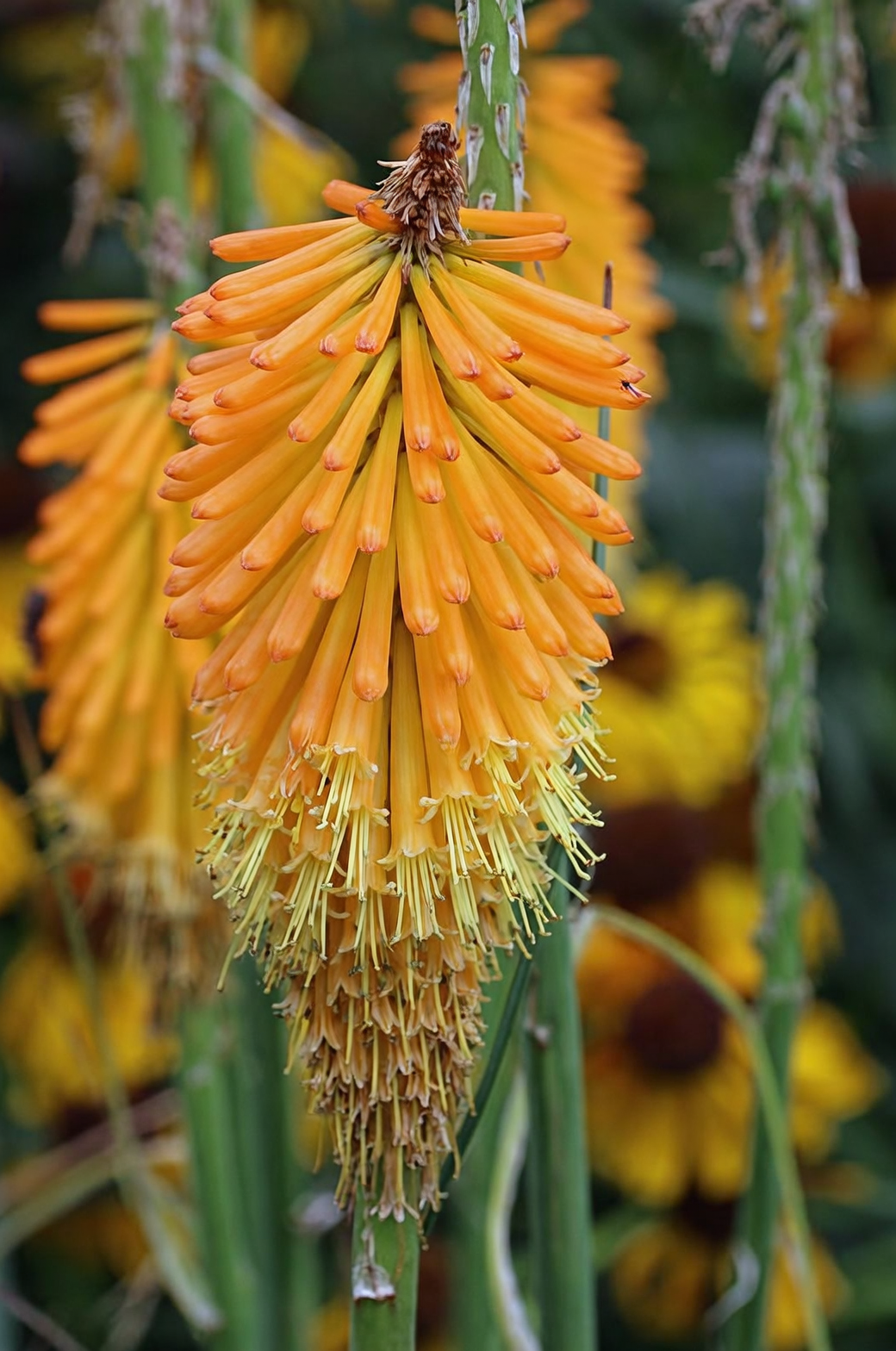
Why Pollinators Go Wild
- Nectar buffet: Spikes are generously nectar‑rich, and sequential opening keeps the buffet restocked.
- Perfect fit: Tubular florets suit hummingbird bills and long‑tongued bees and butterflies.
- High‑contrast cues: Bold, warm colors are easy to spot from the air—a vertical billboard in full sun.
- Efficient foraging: The “fresh zone” of blooms moves predictably from bottom to top, helping visitors focus where the reward is richest.
Expect hummingbirds, bees, and butterflies to find it fast—and keep coming back.
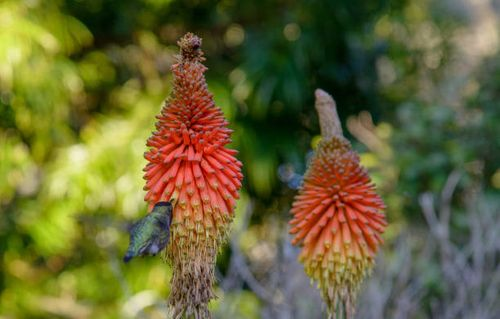
300+ Tiny Flowers on One Spike? Yep.
What looks like a single “torch” is actually a dense, bottlebrush-like cluster of individual tubular blossoms—often 100 to 300+ per spike. That micro‑architecture is the secret to:
- Weeks of bloom: Hundreds of buds open in sequence.
- Heavy pollinator traffic: Many small flowers mean many sips without switching plants.
- Great cut flowers: Harvest when the lower third begins to open; spikes typically last about 5–7 days in a vase.
Beach‑Ready Beauty: Built for Coastal Gardens
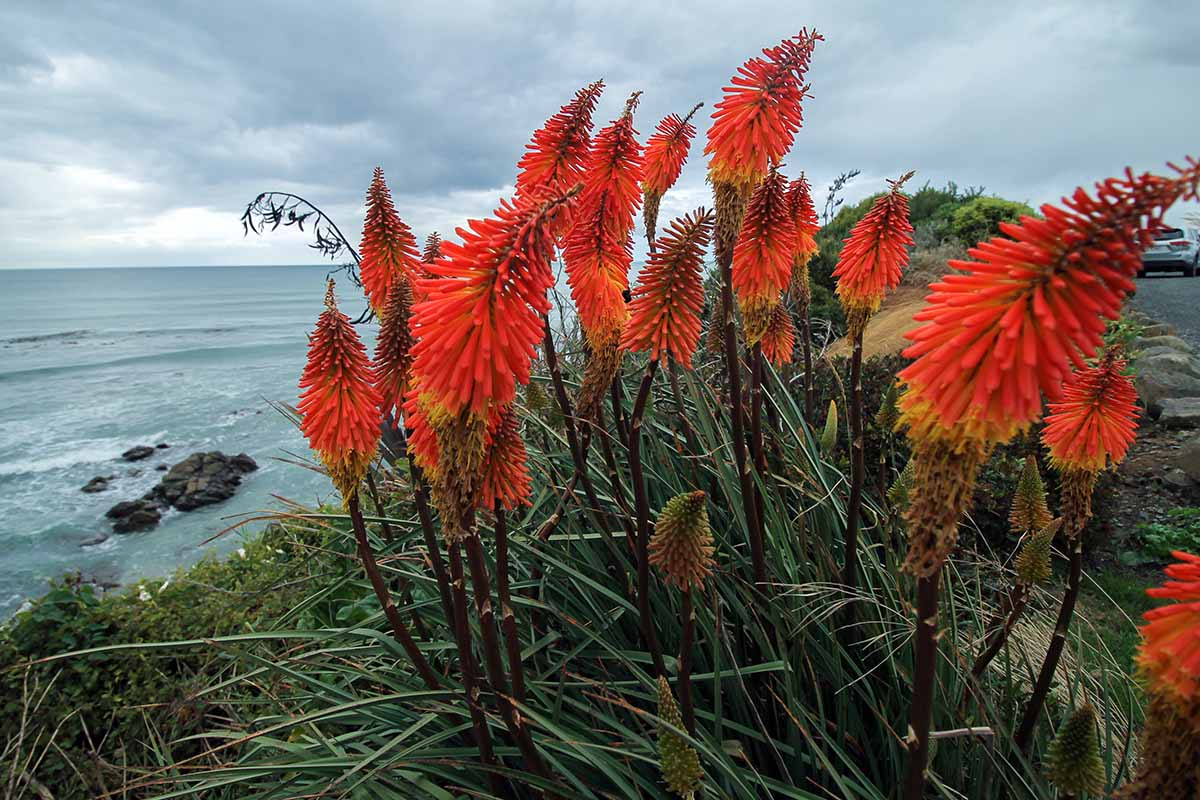
Red hot poker is notably salt‑tolerant, making it a natural for seaside plantings, windswept slopes, and near walkways that get the occasional splash. Practical perks that help it cope:
- Firm, narrow leaves that shed spray and dry quickly
- A robust, rhizomatous root system that anchors plants and favors sharp drainage
Tip: Salt tolerance isn’t the same as loving soggy soil. Drainage still matters—especially at the crown.
Grow It Like a Pro: A Quick Guide
- Sun: Full sun is best (aim for 6–8 hours daily). In very hot regions, a bit of light afternoon shade can help.
- Soil: Well‑drained is non‑negotiable. Moderately rich soil with compost is ideal; pH about 6.0–7.5.
- Water: About 2.5 cm (1 in) per week during establishment and active growth; more frequent checks in containers. Avoid waterlogged crowns.
- Feeding: Often minimal—mix compost at planting. If needed, use a balanced, slow‑release fertilizer in spring; skip high nitrogen.
- Deadheading: Remove spent spikes at the base to tidy and encourage rebloom in varieties that repeat.
- Division: Every few years in early spring—or fall after flowering in mild climates—to prevent overcrowding and boost bloom.
- Wintering: Commonly hardy in USDA Zones 5–9. In colder areas (especially Zones 5–6), keep the crown drier, mulch with a loose, dry material, and consider tying foliage to shield the crown from freeze‑thaw.
- Containers: Choose a pot with excellent drainage, at least about 22 cm (9 in) wide. Divide/repot every 2–3 years.
Size, Season, and Setting at a Glance
- Height/Spread: 2–6 ft tall, 1–3 ft wide
- Bloom Window: Early summer into fall; many cultivars offer waves of color with deadheading
- Best Placements:
- Sunny borders and mixed beds
- Slopes (drainage!)
- Cottage and wildlife gardens
- Waterside features with sharp drainage
- Coastal gardens (salt‑tolerant)
- Containers (especially dwarf selections)
Flower Language and Lore
Red hot poker’s modern symbolism leans into what you see: passion, strength, confidence, and standing out—fitting for a flower that looks like a flaming torch. While it doesn’t have a deep role in classic Victorian floriography, gardeners and designers often use it as a visual shorthand for bold energy. In some folklore, its fiery colors are linked to protection and warding off negativity—a living “lantern” that brightens and guards the garden.
A bit of history: Native to South Africa, K. uvaria reached European and American gardens in the 1800s. The genus honors German botanist Johann Hieronymus Kniphof.
Design Pairings That Make It Pop
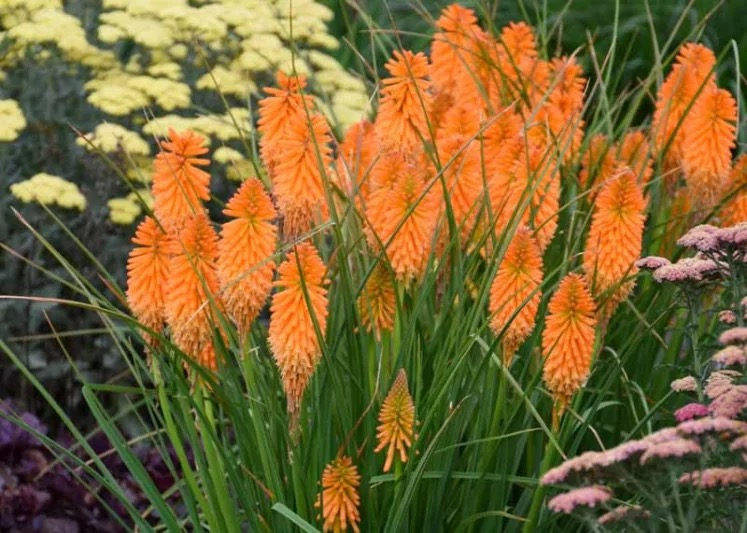
- Sun‑loving daisies (like coneflowers) for shape contrast and a pollinator highway
- Silver or gray foliage (artemisia, for example) to cool the heat of the torches
- Thread‑leaf companions (grasses, coreopsis) that echo the strappy leaves but offer finer texture
- Coastal combos with other salt‑tolerant stalwarts where drainage is sharp
Quick FAQ
- Does it come back every year?
- Yes. It’s a perennial in many climates (commonly USDA Zones 5–9). Foliage may stay evergreen in mild winters.
- Why isn’t mine blooming?
- Usual causes: not enough sun, a crowded clump needing division, too much nitrogen, waterlogged soil, or youth (seed‑grown plants can take a couple of years).
- Will it take over?
- It enlarges slowly by rhizomes into bigger clumps rather than running. It can naturalize in some regions—divide every few years to manage size and vigor.
- Is it safe around pets and kids?
- Generally considered non‑toxic to people and pets. As with many ornamentals, nibbling can cause mild stomach upset in sensitive individuals.
Bottom line: If you want a plant that turns heads, feeds pollinators for weeks, shrugs off coastal conditions, and paints the garden in a built‑in ombré, the red hot poker is your show‑stopping, science‑savvy star.