

If you’ve ever fallen for a Heptapleurum arboricola with splashes of cream or lemon—often sold as Dwarf Schefflera ‘Trinette’ or simply “variegated umbrella tree”—you know the thrill: one bright window, and the whole plant looks like sunlight caught in its leaves. The trick is keeping that color. Variegation needs plenty of light to stay bold, yet those pale sectors scorch easily. The sweet spot is bright but softened light, steady routines, and a little choreography with your pot. Here’s how to keep the cream bright, the green crisp, and reversion at bay.
Meet your plant, meet its needs
- Botanical name: Heptapleurum arboricola (often sold as Schefflera)
- Common names: Dwarf Umbrella Tree, Dwarf/Hawaiian Schefflera
- Origin: Southern China (including Hainan) and Taiwan; now a beloved, easy houseplant worldwide
- Habit: Fast-growing, woody, highly responsive to pruning; can be trained as a compact bush or small indoor tree on a stake or moss pole
Variegated forms carry less chlorophyll in cream/yellow zones. That’s why they:
- Need brighter light than solid-green types
- Stretch in low light and may “revert” to greener leaves to compensate
- Sunburn more easily under harsh rays
The light formula: bright, indirect, and thoughtfully diffused
Think “sunglasses for a sun-lover.” Give the plant lots of photons without the midday sting.
- Best windows
- East: Ideal morning sun that’s gentle and bright.
- South: Excellent with a sheer curtain or light diffusion (thin blinds), or set a few feet back.
- Bright west: Works with filtering during hot months to dodge afternoon scorch.
- Distance and diffusion
- A sheer curtain, frosted film, or a light-diffusing blind keeps variegation sharp without crisping leaf edges.
- If a beam of sun hits leaves for hours at midday in summer, move the plant back or diffuse it.
- Grow light option
- Bright, indirect-quality LEDs can maintain sharp variegation. Hang high enough or use a diffuser to prevent hotspots, and run 10–12 hours daily.
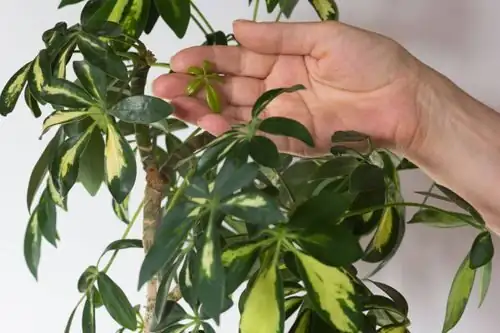
Seasonal light tuning
- Spring–summer: Increase diffusion and watch for sun scorch as the sun strengthens. Acclimate any move toward brighter light over 1–2 weeks.
- Autumn–winter: Bring the plant nearer to the window (still out of harsh direct beams). Lower sun angles are kinder; you can reduce diffusion.
Rotate to keep the canopy even (and the variegation uniform)
Heptapleurum grows toward its strongest light. Without rotation, one side hogs the rays—color fades and internodes stretch on the shady side.
- Best practice: Rotate the pot a quarter-turn every 2–3 weeks.
- Visual cue: When one side leans or leaves on the back half dull compared to the front, it’s time to turn.
- Bonus: Rotation helps prevent lopsided plants that cast their own shade and reduce variegation inside the canopy.
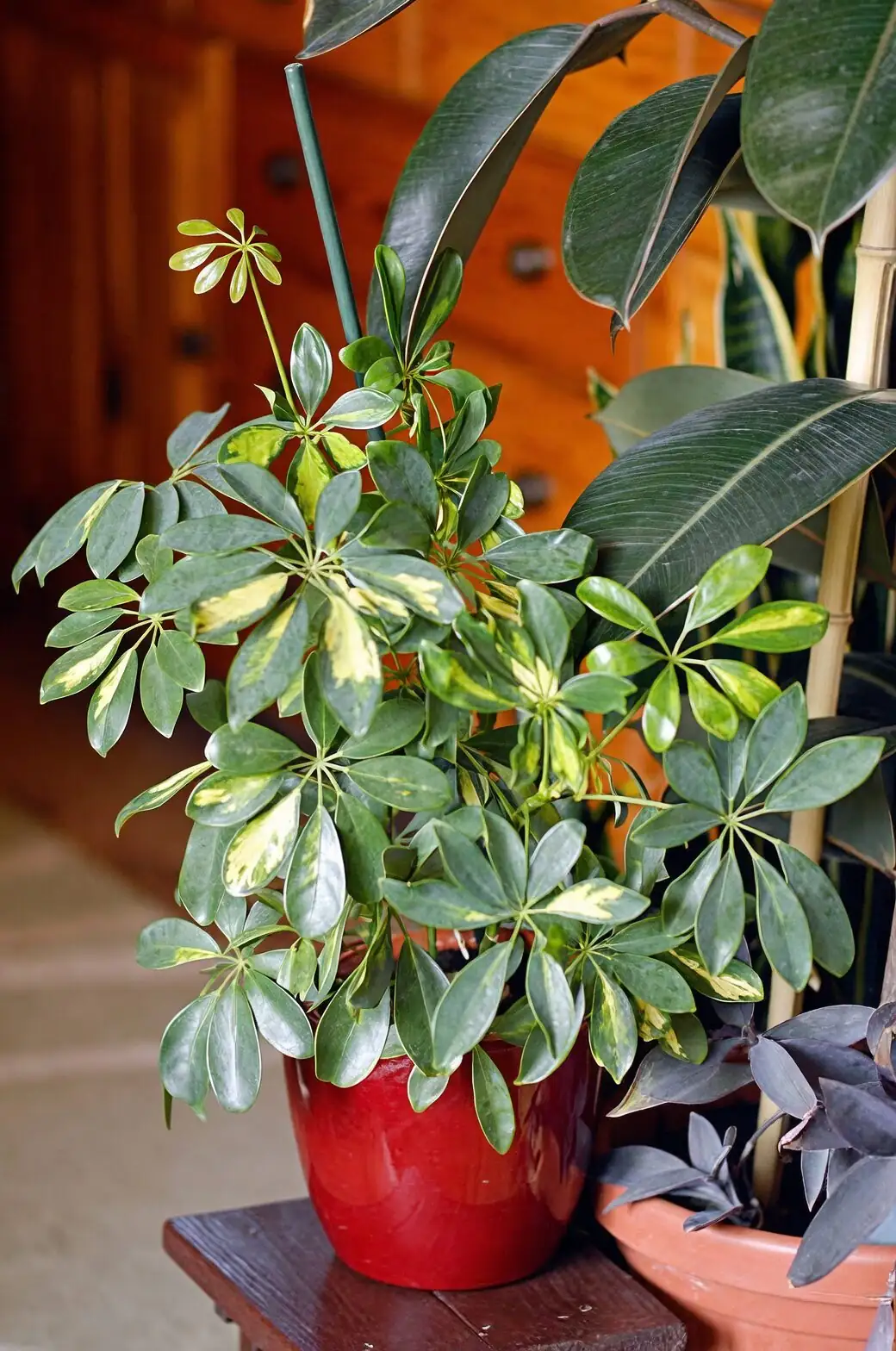
Preventing sun scorch versus preserving color
Learning to “read” the leaves lets you fine-tune light quickly.
- Too much direct sun
- Symptoms: Brown, crispy patches or rims; washed-out cream sectors; rough texture.
- Fix: Add a sheer, move back from the glass, or shift to morning light.
- Too little light
- Symptoms: Long gaps between leaves (legginess), smaller new leaves, dull or greener patterns.
- Fix: Slide closer to the window, thin inner foliage to let light filter in, or add a diffused grow light.
- Just right
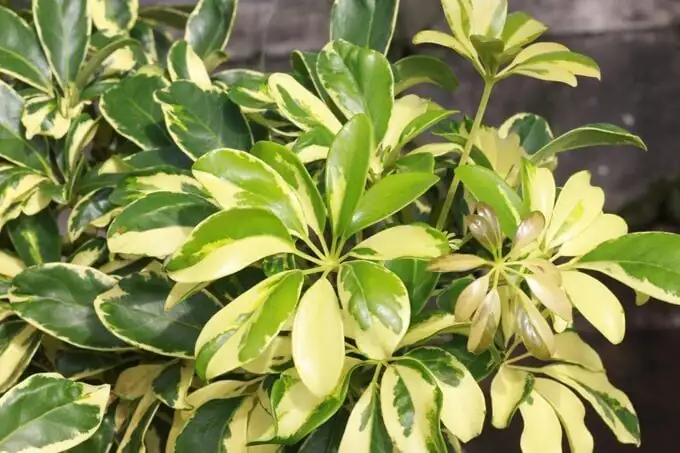
- New leaves unfurl with clear cream/yellow marbling, internodes tighten, and the canopy looks evenly lit front-to-back.
Stopping reversion before it takes over
Reversion is when shoots produce mostly or entirely green leaves. Those greener shoots photosynthesize more and can outgrow the variegated parts.
- Spot it early
- Reverted leaves are often larger, solid green, and arise from one particular shoot.
- Prune decisively
- Trace the reverted stem back to its origin and cut just below the last node that carried variegation. Use clean, sharp pruners.
- Restore the balance
- Move the plant to brighter (still diffused) light and keep growth steady but not forced.
- Propagation tip
- Take cuttings only from strongly variegated shoots if you’re making new plants; green cuttings tend to stay green.
Water, nutrition, and humidity that protect the pattern
Brilliant foliage needs stable, not soggy, roots and measured feeding.
- Watering
- Spring–autumn: Water when the top 2–3 cm (about 1 in) feels dry, then soak thoroughly and drain. Never leave it sitting in water.
- Winter: Reduce sharply; in many homes, watering can be as infrequent as about once a month—only when the pot is mostly dry.
- Avoid extremes: Fluctuating from bone-dry to sopping-wet can trigger leaf drop and stress, which indirectly dulls variegation.
- Fertilizing
- During active growth, feed modestly with a balanced liquid fertilizer.
- A safe rhythm: monthly at half strength; increase slightly only if growth is vigorous and light is strong.
- Pause or greatly reduce in winter. Overfeeding can push soft, leggy growth that’s more prone to scorch.
- Humidity and airflow
- Adaptable to normal indoor humidity; looks its best with moderate-to-higher humidity around 60%.
- In dry air, use a pebble tray or humidifier and keep gentle airflow—especially valuable for variegated foliage that’s prone to crisping.
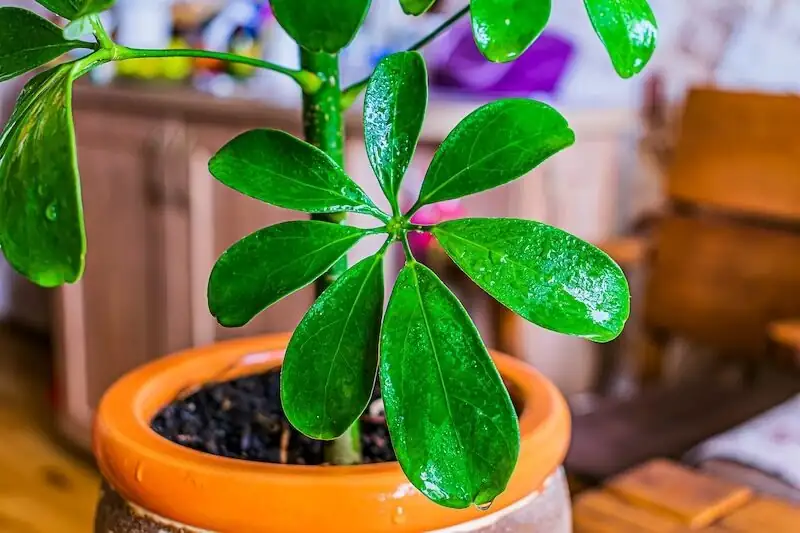
Pruning and shaping for a fuller, brighter plant
- Timing: Best in spring to early/midsummer.
- How: Cut back long stems by roughly a third just above a node to spark branching. Lightly refine after new shoots appear.
- Goal: Repeat light shaping 2–3 times in the growing season to build a dense, well-lit canopy that maintains variegation inside and out.
- Support: A stake or moss pole keeps upright growth tidy in bright rooms.
The right pot and mix (so roots breathe and leaves glow)
- Mix: A free-draining base potting substrate plus extra aeration—try 2 parts quality mix to 1 part perlite or coarse sand. A bit of fine bark or coco chips adds structure.
- Pot: Choose a sturdy container sized to the root ball to reduce tipping and waterlogging. Ensure excellent drainage.
- Repot: In spring—annually for young, fast growers; every 2 years or when rootbound for established plants.
Ideal environment snapshot
- Light: Bright, indirect; avoid harsh midday sun. East windows or filtered south exposures are excellent.
- Temperature: Warm suits it best—about 15–30°C (59–86°F). Avoid cold drafts; prolonged chill below ~10°C (50°F) can stress; ~5°C (41°F) risks injury.
- Placement: Indoors near a bright window out of direct scorch; let new purchases acclimate in bright shade with airflow before moving into stronger light.
Troubleshooting: quick reads from the leaves
- Brown, crispy patches: Sun scorch or very dry air. Diffuse light; improve humidity/airflow; water evenly.
- Pale, washed variegation but not crispy: Too intense light without scorch or a plant needing more nutrients—soften light slightly and resume modest feeding in season.
- Dull, greener new growth; long internodes: Light is too low. Move closer, increase diffusion rather than distance, or add a grow light.
- Sudden leaf drop: Often overwatering or a cold draft. Let the top layer dry more, check drainage, and keep warm.
- Green-only shoots: Reversion. Prune back to variegated wood and brighten diffused light.
Pests, safety, and leaf care
- Pests: Watch for spider mites (especially in dry air), scale, and mealybugs. Wipe leaves, then treat early with horticultural oil or insecticidal soap; repeat as directed.
- Clean leaves: Dust blocks light—gently wipe with a damp, soft cloth so your plant can “breathe” and keep its color.
- Toxicity: Sap can irritate; plant is toxic if ingested by people and pets. Keep out of reach and wash hands after pruning.
A simple seasonal routine for standout variegation
- Spring: Repot if needed; start modest feeding. Begin structural pruning for branching. Nudge the plant closer to bright windows and acclimate.
- Summer: Diffuse strong sun; rotate every 2–3 weeks; keep watering consistent. Watch for mites in dry, hot rooms.
- Autumn: Ease off fertilizer; maintain rotation. As outdoor light wanes, inch the plant nearer the window (still filtered).
- Winter: Pause feeding; water sparingly; keep warm and away from cold drafts. Clean leaves to maximize limited light.
Symbolism: the “umbrella” as shelter and good fortune
Heptapleurum’s canopy has long been read as a symbol of protection, resilience, and prosperity—ideas echoed in feng-shui-style placements where a green “umbrella” suggests safety and abundance. While this symbolism is cultural rather than botanical, it captures the plant’s spirit indoors: a steady presence that, with the right light touch, returns more brightness than it takes.
—
With bright, diffused light, regular rotations, and early pruning of green-only shoots, your variegated Dwarf Umbrella Tree won’t just keep its cream—it will flaunt it. Think of yourself as its lighting designer: soften the glare, keep the spotlight even, and watch the pattern stay picture-perfect.