

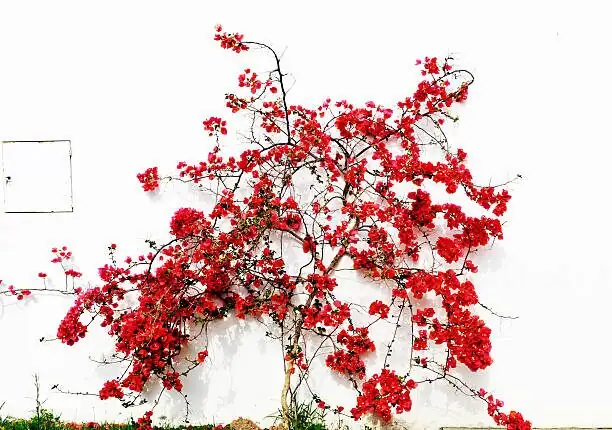
Step onto a creaking wooden deck in 1760s Rio de Janeiro. The air is salt-sweet, the light almost tropical white—and a riot of papery color tumbles over a garden wall. French naturalist Philibert Commerson, traveling with Admiral Louis Antoine de Bougainville on a global voyage, pauses. Those brilliant “petals” aren’t petals at all. He notes the marvel; later, the plant takes the admiral’s name. From that moment on, a Brazilian native would voyage farther than any ship—over warm walls from Cartagena to California—becoming one of the world’s most loved climbers: Bougainvillea glabra and its prolific, party-ready hybrid cousins like Bougainvillea × buttiana.
From a Brazilian shoreline to a name in lights
- Origin story: Bougainvillea glabra hails from Brazil, where bright sun and heat write the rules of growth. Commerson first recorded bougainvillea on Bougainville’s circumnavigation, and the genus entered botanical literature in 1789.
- The hook: people fell for what looked like neon blossoms—but those splashes of magenta, coral, white, or red were actually bracts, thin and papery, spotlighting a trio of tiny, creamy-white true flowers inside.
- The personality: a woody, often thorny scrambler that can be trained to behave—over a trellis, hoop, wires, fence, or the sun-warmed stucco of a courtyard wall.
Meet the star species: Bougainvillea glabra, the “paperflower”
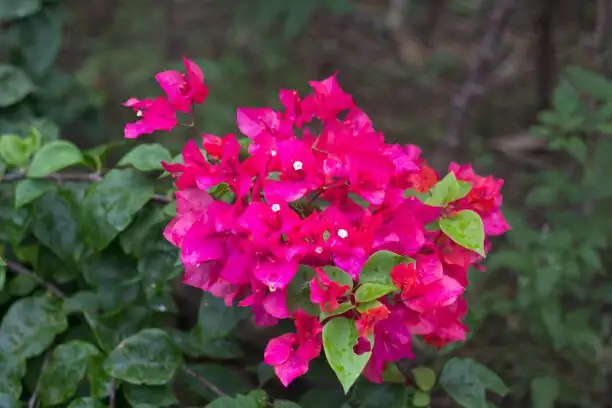
B. glabra is the lean, light-loving athlete of the group. Given strong sun, it pushes out long, flexible stems with small, deep-green leaves (sometimes crisply variegated in select cultivars). In containers and with training it often holds at about 1.5 m × 1.5 m (5 ft × 5 ft); outdoors in warm climates, it ambles to 1.5–6 m (5–20 ft) when supported and pruned.
- Showtime: Mainly spring through autumn; in frost-free, very bright spots it can flower in cycles much of the year.
- The illusion: Papery bracts in saturated shades surround the understated true flowers. More sun and bloom-leaning feeding equals more bracts, more drama.
When garden alchemy met a Brazilian native: the rise of × buttiana
Travel does funny things to plants. As bougainvilleas spread via gardens and imperial plant exchanges, species rubbed shoulders—and hybrid sparks flew.
- The Cartagena spark: A crimson beauty turned up in a Spanish garden and caused a sensation. Later detective work revealed it as a natural hybrid between B. glabra and B. peruviana. In homage to its finder, it became Bougainvillea × buttiana.
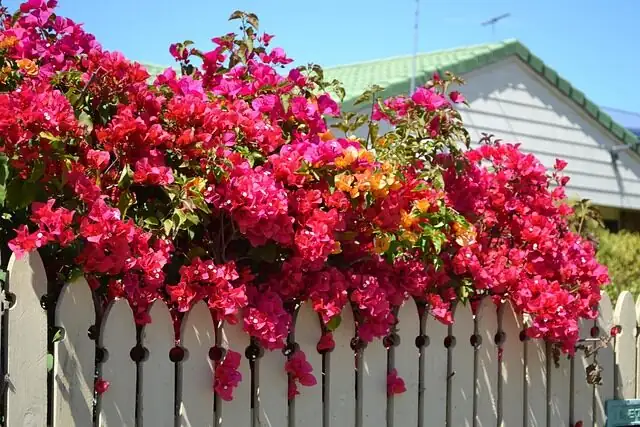
- Why that mattered: × buttiana lines handed gardeners bigger, brasher color palettes and heavier blooming. Breeders selected forms that flowered more freely, branched more densely, or boasted variegated foliage—traits that made them irresistible on patios and pergolas.
Today, many of the bougainvilleas draping balconies from the Mediterranean to subtropical Asia are South American-derived garden hybrids, with × buttiana among the most influential.
Why bougainvillea conquered the world’s warm walls
- Sun-synergy: These plants love full sun—ideally 6+ hours daily—and reward it with months-long color. Too shady? They sulk into leaf and skimp on bracts.
- Heat harmony: Warmth suits them; they’re right at home on sun-baked masonry and shimmering patios.
- Color economy: Few plants deliver so much saturation for so long with so little fuss—pink, red, magenta, white, salmon, and more, depending on cultivar.
- Training magic: Give them a trellis, hoop, or taut wires, and you can sculpt espaliers, arches, standards, hanging cascades—even bonsai-like mini trees.
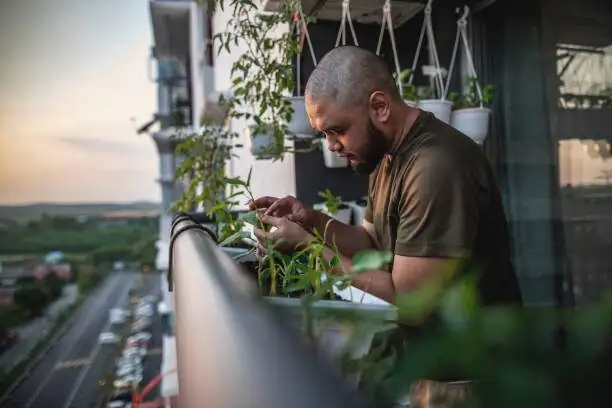
- Container-friendly: They often bloom better slightly root-restricted, so small-city balconies can host a sky of color.
- Global charisma: From Spanish courtyard fantasies to the Mission Revival landscapes of early 20th-century California, bougainvillea became place-making color. By the late 1800s, cuttings and seeds had already arrived in places like Australia and California; by the 1930s they were icons of sunny-climate architecture.
Growing bougainvillea like a pro
Give them what they adore—bright sun, warmth, and sharp drainage—and they’ll do the rest.
Light and placement
- Full sun is non-negotiable: aim for 4–6+ hours direct, with 6+ ideal.
- Outdoors: sunny balcony, patio, pergola, or warm wall.
- Indoors: brightest south- or west-facing window or a sunroom. Airflow helps keep leaves healthy and pests at bay.
Temperature and hardiness
- Happy range: roughly 15–30°C (59–86°F). Growth and flowering perform best with consistent warmth.
- Overwintering: protect from frost; keep above about 7–10°C (45–50°F).
- Best outdoors year-round in USDA Zones 10–11; warm pockets of Zone 9 can work with protection.
Soil and pots
- Use a fast-draining, well-aerated mix—quality potting soil cut with coarse sand, grit, or similar drainage materials.
- Don’t over-pot. Being slightly root-bound often boosts blooming. Good drainage holes are essential.
Watering rhythm
- Water deeply, then let excess drain completely.
- In active growth (spring–early autumn): allow the top layer to dry and the mix to trend toward “nearly dry” before the next deep soak. Constant dampness causes leaf/bract drop and root rot.
- To nudge buds: a brief, controlled “dry-down” can spark flowering—do it carefully; don’t let the plant severely wilt.
- Winter: go sparing. Keep brighter, warmer, and drier between waterings.
Feeding for fireworks
- During the growing season:
- Option 1: feed monthly with a balanced-to-bloom formula leaning higher in potassium (e.g., a 15-15-30 style ratio).
- Option 2: feed every 2 weeks with a balanced liquid, switching every third feed to a higher-potassium bloom fertilizer.
- At peak bloom, one timely boost with monopotassium phosphate can intensify bract color.
- Rule of thumb: too much nitrogen = leaves galore, bracts not so much.
Training and pruning
- Tie in new canes to trellises, hoops, bamboo canes, wires, fences, or pergolas for a tidy, sculpted look.
- Pinch or trim soft, overlong shoots to encourage branching and compactness; flowering often follows on new growth (on a weeks-to-months timeline, depending on warmth/light).
- After main flowering, prune to shape and remove dead, weak, or congested stems. Autumn pruning of side shoots helps maintain form.
- Older, woody plants (5–6+ years): an occasional, firmer rejuvenation prune can restore vigor.
- Avoid heavy pruning during peak bloom if you want to keep the show.
Repotting and top-dressing
- Young plants: repot about every 2 years, stepping up one size at a time.
- Mature plants: often better top-dressed in spring—refresh the top mix instead of leaping to a larger pot.
- Container notes: a single starter might go in a 15–18 cm (6–7 in) pot; hanging baskets around 20–25 cm (8–10 in). Some growers combine multiple young plants in one pot for instant fullness.
Propagation pathways
- Cuttings:
- Softwood in early spring, semi-ripe in summer, or hardwood in autumn/warm weather.
- 15–20 cm (6–8 in) pieces in a loose, free-draining medium.
- Warm rooting zone (about 21–27°C / 70–81°F). IBA rooting hormone improves success. Expect ~1 month under good conditions.
- Layering and air-layering: start in early summer; rooting often in ~2 months.
- Grafting: commonly done in spring once temperatures settle above about 15°C (59°F).
A simple care calendar
- Spring–early autumn: maximum sun; deep water with partial drying between; regular feeding; train and tie new growth.
- Autumn: dial back watering slightly to encourage buds; prune side shoots after flowering.
- Winter: keep very bright, above 7–10°C (45–50°F), and water sparingly.
- Spring tune-up: repot young plants if needed; top-dress mature ones; graft if you’re building a special specimen.
Design playbook: how to dress a wall in color

- Espalier elegance: run galvanized wires across a warm wall and fan stems out like a chandelier of color.
- Courtyard cascade: hoop or arch a plant over an entry. Let bracts drape like festive streamers.
- Balcony brilliance: choose a compact cultivar for a 20–25 cm basket and let it spill in magenta waves.
- Standard or bonsai: stake a single trunk for a lollipop standard, or prune and wire into a petite, gnarled “tree.”
- Foliage flair: variegated-leaf cultivars add interest even between bloom flushes.
- Pairings: silvery olives, succulents, and gravelled beds echo its heat-loving roots; white walls amplify color into neon.
Troubleshooting: turning green back into glorious color
- Leaves but few bracts?
- Increase direct sun.
- Let the mix dry more between deep waterings.
- Shift feeding toward higher potassium; back off nitrogen.
- Sudden leaf/bract drop?
- Often from overwatering, low light, or cold drafts. Correct placement and watering rhythm.
- Pests to watch:
- Scale, mealybugs, aphids on soft growth, caterpillars, and spider mites (especially in hot, very dry indoor air).
- Response: improve airflow and light; use horticultural oil or insecticidal soap as labeled; fix watering to prevent rot.
- Leaf spot or root rot?
- Usually a drainage or air-stagnation issue. Refresh soil to a sharper-draining mix and improve airflow.
Safety and sensible handling
- Low to moderate concern: the sap can irritate skin and eyes; ingestion may upset the stomach.
- Thorns are real. Wear gloves when pruning or training, and site plants away from narrow pathways used by kids and pets.
Flower language, symbolism, and what it really means
Bougainvillea often symbolizes exuberance, welcome, and celebration—like throwing open the shutters and hanging a bright banner for guests. In many places, these meanings are modern, popular culture rather than ancient lore: marketers and garden writers latched onto the plant’s carnival colors and long-blooming habit to suggest hospitality and festivity. Still, the symbolism fits. Few plants say “come in, the sun’s out” as convincingly as a wall veiled in bougainvillea.
A brief voyage timeline
- Late 1760s: Bougainville’s expedition documents the plant near Rio de Janeiro; the genus later enters botanical literature in 1789.
- 19th century: B. glabra (and close South American relatives) circulate through European gardens and onward across the world.
- Hybrid moment: a crimson form discovered in Cartagena proves to be B. glabra × B. peruviana—christened Bougainvillea × buttiana—ushering in a wave of garden hybrids.
- By the late 19th–early 20th century: bougainvillea becomes a signature presence across warm regions, from Mediterranean courtyards to California’s mission-style facades, thriving on heat, sun, and stuccoed walls.
Why B. glabra and × buttiana still win today
- They’re honest plants: give them sun, warmth, and a pot that drains, and they’ll repay you with months of vivid bracts.
- They fit human spaces: from tight balconies to grand pergolas, they can be sculpted to scale.
- They’re expressive: few species offer such a spectrum of color, form, and growth habit—especially when breeding leans into compactness, repeat blooming, and variegation.
In other words, a Brazilian native plus a century of garden matchmaking made a world superstar. Train the canes, temper the water, feed for flowers—and let bougainvillea write its bright, generous story across your wall.