
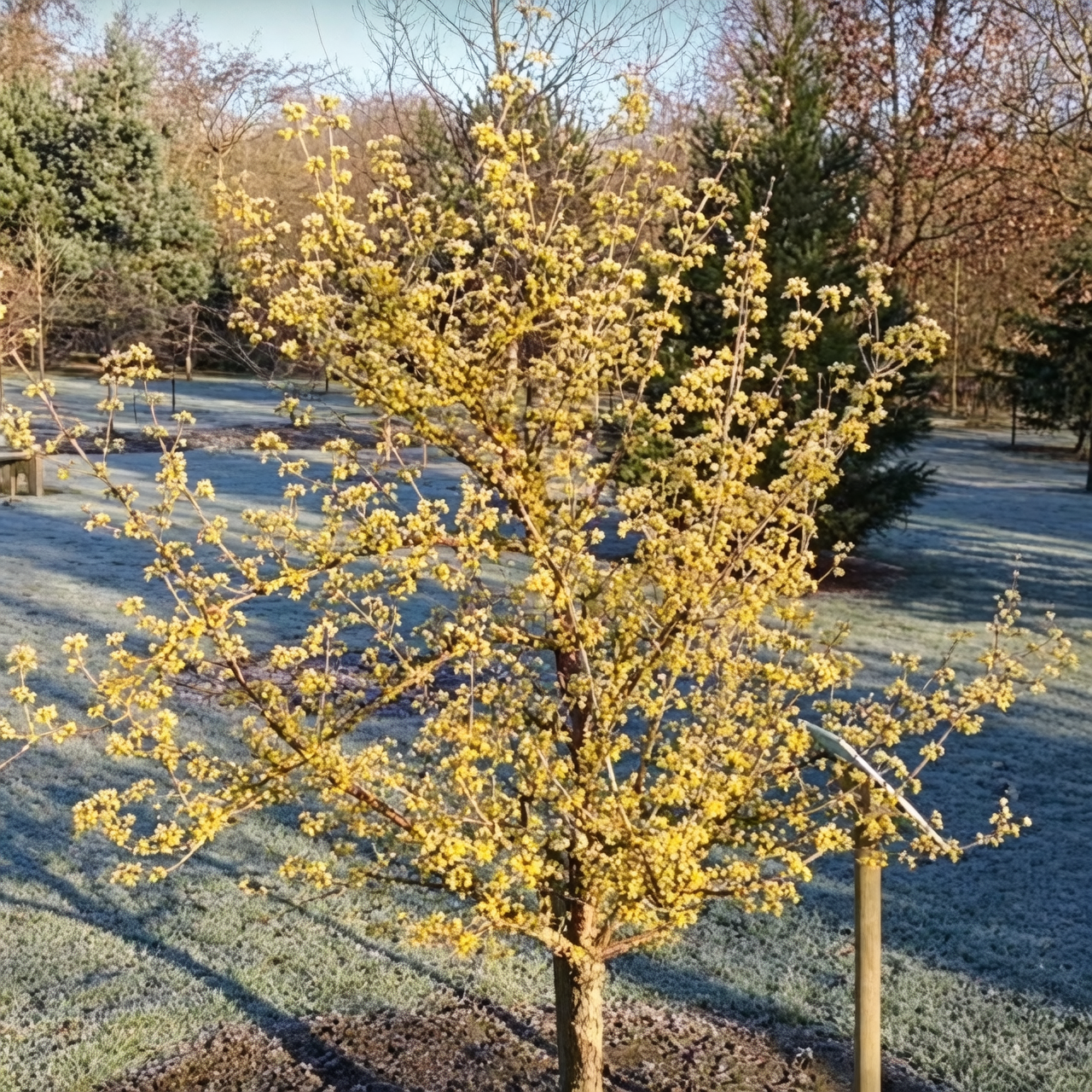
On a raw February morning in a Chinese mountain village, when fields still crunch under frost and roofs wear sugar-dust snow, a haze of yellow rises from the thickets. The flowers are small—no bigger than a lentil—but they come by the hundreds, igniting bare branches like sparks. Apothecaries once watched these branches as closely as farmers watched the sky: the red fruits that followed held a valued place in their jars. From those slopes and storerooms, the plant voyaged—adopted into temple grounds and town alleys in Japan, lining village lanes in Korea—and today, it lights up parks and backyards across temperate regions of the world.
That traveler is Cornus officinalis Siebold & Zucc.—Japanese Cornel, also known as Japanese Cornelian cherry, Asiatic dogwood, or Chinese Cornelian dogwood—a four-season stalwart with roots deep in East Asian culture and medicine.
From mountain medicine to garden muse
China: the original hillside glow
- Native range: north-central and southeastern China, often in forests, forest margins, and on mountain slopes. In many locales, you’ll find it between about 400–1500 m in elevation, with especially robust growth commonly noted around 600–1200 m.
- The apothecary connection: The epithet “officinalis” means “of the shops,” a nod to the traditional pharmacopeia. In Chinese it’s 山茱萸 (shānzhūyú)—the tart, glossy red fruits have been valued in Chinese herbal practice for well over two millennia, commonly associated with supporting liver and kidney function.
- A plant of timing: Blooming in late winter to early spring, it delivers color precisely when spirits wane and gardens feel longest asleep—one reason it became both a symbol of vitality and a pragmatic orchard-and-garden companion.
Across the sea to Japan and Korea
- Introduced to Japan and Korea long ago, it found a welcome in temple precincts, scholar’s gardens, and village streets. In Japanese it’s called sanshuyu (さんしゅゆ); in Korean, sansuyu (산수유)—names that echo the Chinese original.
- Gardeners there honed its ornamental virtues: pruning for layered, multi-stem silhouettes; selecting for flower density; admiring the winter bark that peels in painterly patches. In Japan, the cultivar ‘Kintoki’—noted for abundant bloom—has charmed many a winter-weary eye.
- From these cultural gardens, nurseries carried Japanese Cornel into modern landscapes worldwide, where it quietly excels as an early-season beacon and a year-round presence.
Meet Japanese Cornel (Cornus officinalis)

- Family: Cornaceae (the dogwoods)
- Habit and size: A deciduous, multi-stemmed large shrub or small tree, typically 4.5–8 m (15–26 ft) tall and about 3–4.5 m (10–15 ft) wide, with an open oval-to-rounded crown.
- Leaves: Opposite, simple, oval to elliptical, 5.5–12 cm (2.5–5 in) long; dark green above, paler beneath. Look closely and you may spot tiny tufts of reddish-brown hairs along the veins on the undersides.
- Flowers: Hundreds of very small, bright yellow blooms gather in tight clusters (umbels roughly 2.5 cm / 1 in across). Individual flowers (~3 mm) have four narrow, tongue-like petals. They open on bare branches from late winter to early spring—February to April—often lasting up to about a month.
- Fruit: Glossy, olive-shaped red drupes in late summer to fall; beautiful on the branch, tart on the tongue, and cherished by birds.
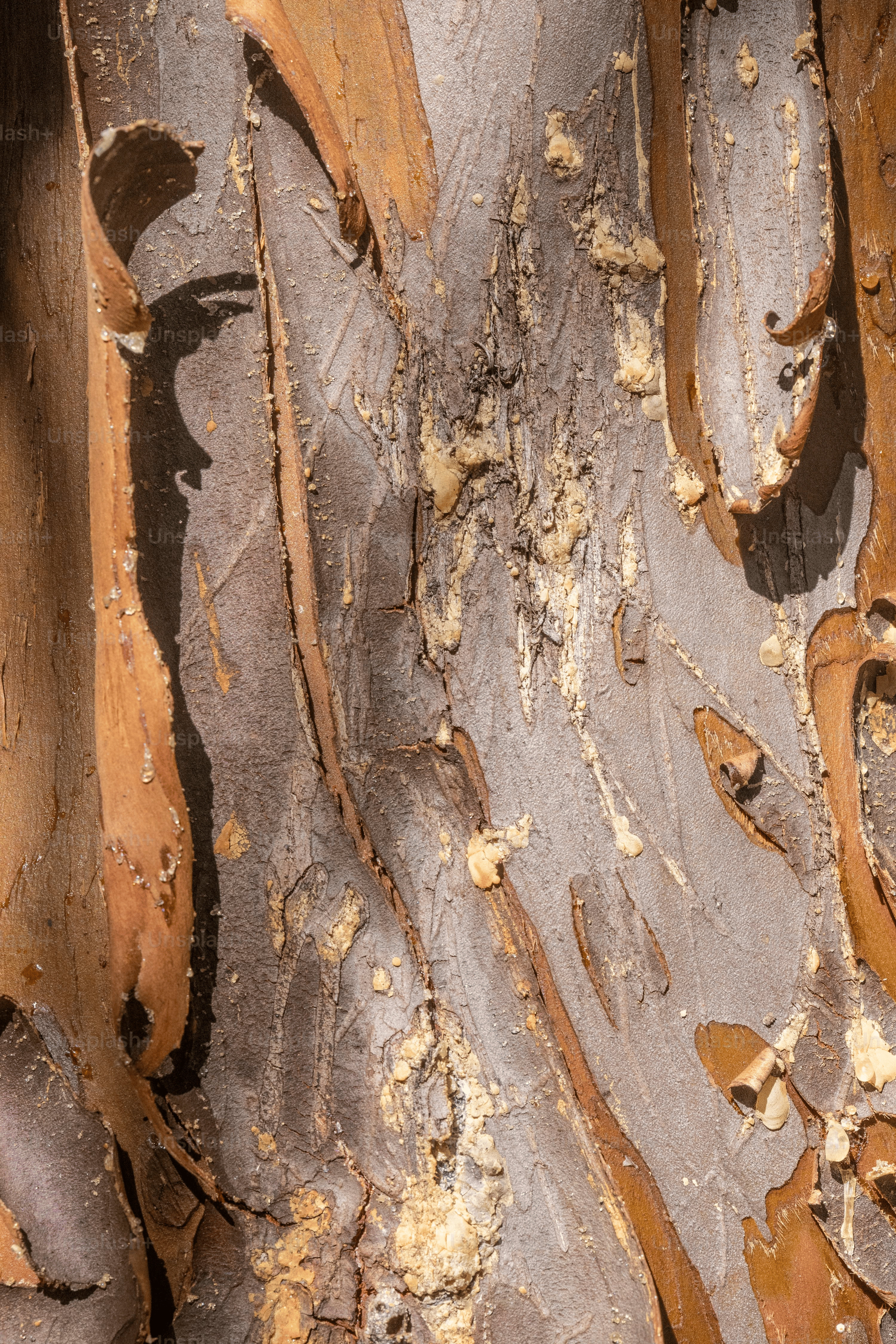
- Bark: Grayish-brown and exfoliating with age, peeling in attractive patches that carry the show through winter.
- Four-season interest: Gold mist in late winter; a neat, dark-green canopy in summer; a flamboyant autumn of reds, purples, and oranges with dangling scarlet fruits; sculptural, exfoliating bark in winter.
A year in color: a quick vignette
- Late winter: Buds erupt into constellations of yellow on leafless wood—gardeners swear the whole plant glows.
- Spring: Fresh foliage unfurls beneath the fading bloom clusters.
- Summer: A cool, orderly canopy casts dappled shade; green fruits swell discreetly.
- Fall: Foliage turns ember-red to plum-purple to orange; fruits gloss over to red and catch the light like glass beads.
- Winter: Bark peels in mosaic patches, a tactile counterpart to quiet skies.
Growing it where you live
- Hardiness: USDA Zones 5–8. Not well-suited to frost-free tropical climates. Once established, it is cold-hardy and tolerates brief dips to around -18°C (0°F).
- Sunlight: Full sun to partial shade. For the best bloom and fruit, give it plenty of light; in hotter regions, a touch of afternoon shade reduces stress.
- Temperature and chilling: Thrives in 15–24°C (60–75°F) growing-season conditions. Like many temperate dogwoods, it benefits from winter chilling around 3–7°C (37–45°F) for roughly 60–75 days to set strong flower buds.
- Soil: Fertile, well-drained loam or sandy loam that retains moisture without staying waterlogged. Slightly acidic to neutral soils are ideal (about pH 6.5–7.5).
- Water: Keep evenly moist while establishing. Thereafter, water deeply but less frequently; allow the top ~2.5 cm (1 in) of soil to dry between waterings. In many gardens, every 2 weeks in summer is a good baseline—adjust for rainfall, heat, and soil type.
- Humidity: Prefers moderate to fairly high humidity; steady soil moisture is key.
- Placement: Woodland-style borders, mixed hedges, naturalized edges, and as a specimen near paths or windows where winter bark and early bloom can be savored. Excellent in home gardens, parks, and broader landscapes.
- Containers: Possible in a large container with sharp drainage; repot in early spring while dormant and refresh the mix.
Care made simple
- Mulch: A 5–8 cm (2–3 in) organic mulch ring keeps roots cool and evenly moist; keep it a few centimeters off the trunk.
- Feeding: Light, balanced feeding in spring is usually sufficient. Avoid heavy fertilization that pushes soft, sappy growth.
- Pruning: Prune just after flowering, before setting next year’s buds. First remove dead, diseased, or crossing wood; then lightly shape. Make clean cuts just above outward-facing buds; reserve hard renovation for necessity.
- Training: It can be left as a multi-stem large shrub or thinned and lifted into a small tree with picturesque, layered branching.
- Pests and diseases: Usually trouble-free. Watch for dogwood borers, scale insects, and occasional leaf spots. Good airflow, correct watering (never perpetually soggy), and timely removal of suckers and dead wood prevent most issues. If suckers appear, remove them at the base.
- Buying guide: Choose young, vigorous plants with firm buds, exfoliating bark free of cankers, and a strong, balanced framework. Specialty nurseries often carry the best selections.
- Garden calendar:
- Spring: Enjoy bloom; prune after flowering; keep moisture consistent.
- Summer: Deep-water in dry spells; maintain mulch; monitor for scale or borer activity.
- Fall: Admire foliage; harvest ripe red fruits if desired.
- Winter: Minimal care; protect very young plants from harsh wind and avoid salt spray.
Propagation paths
- Seed: Often double-dormant and benefits from stratification with warm and cold periods. Soak seeds about 24 hours before sowing; then provide the recommended warm/cold cycles. Patience is rewarded.
- Cuttings: Softwood to semi-ripe cuttings (10–15 cm / 4–6 in) in spring root best with a light wounding, rooting hormone, and steady humidity.
- Layering: A patient, beginner-friendly method—peg a low branch to moist soil; roots usually form by the following season.
- Grafting: Used in nurseries to perpetuate choice forms and cultivars.
Edibility, safety, and the apothecary thread
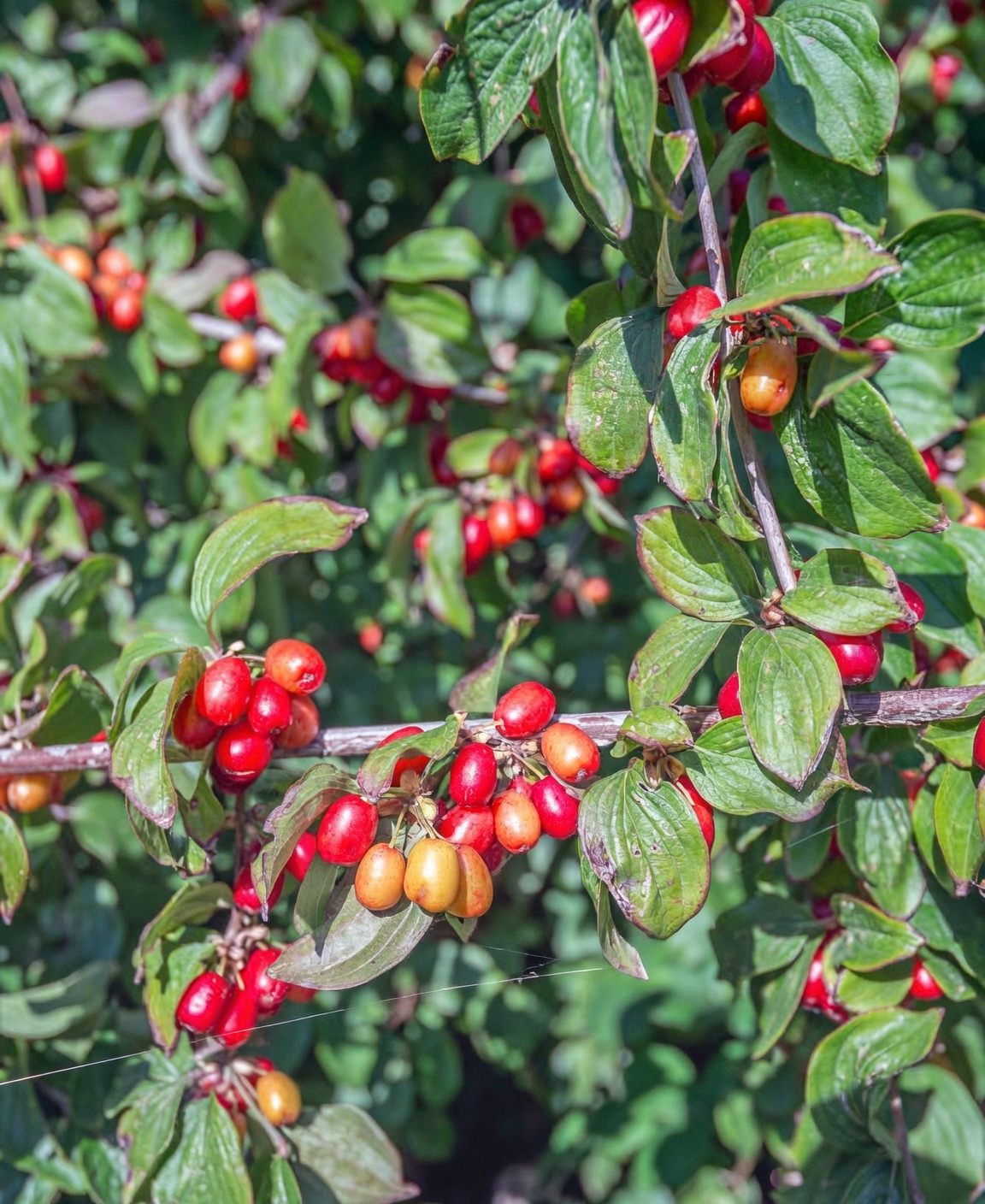
- The fruit: Technically edible but distinctly tart/astringent when raw. Better cooked into jams, syrups, preserves, and spiced drinks; in East Asia, it’s central to traditional preparations.
- Tradition: In Chinese herbal practice, the fruit (often referred to as shānzhūyú or Fructus Corni) is a key ingredient in classic formulas and is associated with supporting vitality.
- Safety: Not known to be toxic to people or pets. As with any unfamiliar fruit, avoid large quantities unless you’re confident in identification and preparation.
Design notes and companions
- Place it where winter light catches the bark and where you’ll notice those first late-winter blossoms—near an entry path or kitchen window.
- Companions for an early-season chorus: witch-hazels (Hamamelis), wintersweet (Chimonanthus), hellebores, snowdrops, and early crocus.
- Summer partners: ferns and shade-tolerant perennials beneath its canopy; autumn companions like sassafras, fothergilla, or black gum echo its fiery fall palette.
- Uses in layout:
- Specimen: multi-stem accent with layered branching.
- Hedge or screen: informal, wildlife-friendly structure.
- Woodland edge: dappled light, moisture-retentive soils.
Look-alike check: Cornus officinalis vs. Cornus mas
Close cousins that can be confusing. A few gardener’s cues:
- Bark: Cornus officinalis usually peels more noticeably in handsome patches on mature wood.
- Phenology: Japanese Cornel often flowers a touch earlier; its fruits typically ripen a bit later.
- Overall effect: Both offer yellow late-winter bloom and red fruit, but C. officinalis tends to deliver a slightly finer “gold mist” due to the density and texture of its flower clusters.
Flower language, symbolism, and what they really mean
In East Asian contexts, Japanese Cornel is linked with longevity, health, vitality, and prosperity—fitting for a plant that wakes the garden before most others and whose fruit has long been kept in apothecary jars. Unlike Victorian “flower language” lists that assigned tidy sentiments to bouquets, this symbolism grows from lived culture: seasonal timing that lifts winter spirits, practical value in traditional preparations, and a century-spanning presence in gardens and medicine chests. In other words, its “meaning” wasn’t invented to sell postcards; it was earned in kitchens, clinics, and courtyards.
Conservation and sourcing
Japanese Cornel has been reported as Near Threatened (NT) on the IUCN Red List. When possible, choose nursery-propagated plants rather than wild-dug material, and consider contributing to its story by planting it where it will thrive, bloom, fruit, and be noticed—meaningfully increasing appreciation and cultivated populations.
Quick FAQ
- When does it bloom?
- Late winter to early spring (February to April), before leaf-out. In many regions it’s among the first woody plants to flower.
- How big does it get?
- About 4.5–8 m (15–26 ft) tall and 3–4.5 m (10–15 ft) wide, depending on site and training.
- Is it easy to grow?
- Yes. Give it sun to light shade, well-drained soil, and steady moisture while it establishes. It’s generally resilient with few serious issues.
- Are the fruits edible?
- Yes, but quite sour fresh. Cook them into preserves, syrups, or beverages if you want the best flavor.
Fun facts
- Each swelling bud opens into a whole cluster of tiny flowers, which is why the plant can look “dusted with gold.”
- It can bloom as early as February—an instant morale boost in a gray garden.
- Birds relish the red drupes; the plant’s branching offers excellent shelter.
- Its bark peels decoratively with age, so even winter has texture.
- Known in Chinese as 山茱萸, it bridges ornamental and traditional uses—truly a “four seasons” classic.
From China’s misty slopes and old apothecaries to Japanese and Korean gardens and onward to neighborhoods across the globe, Cornus officinalis carries its own quiet sun—opening the year in a burst of yellow, closing it with a tapestry of bark, and never wasting a season in between.