

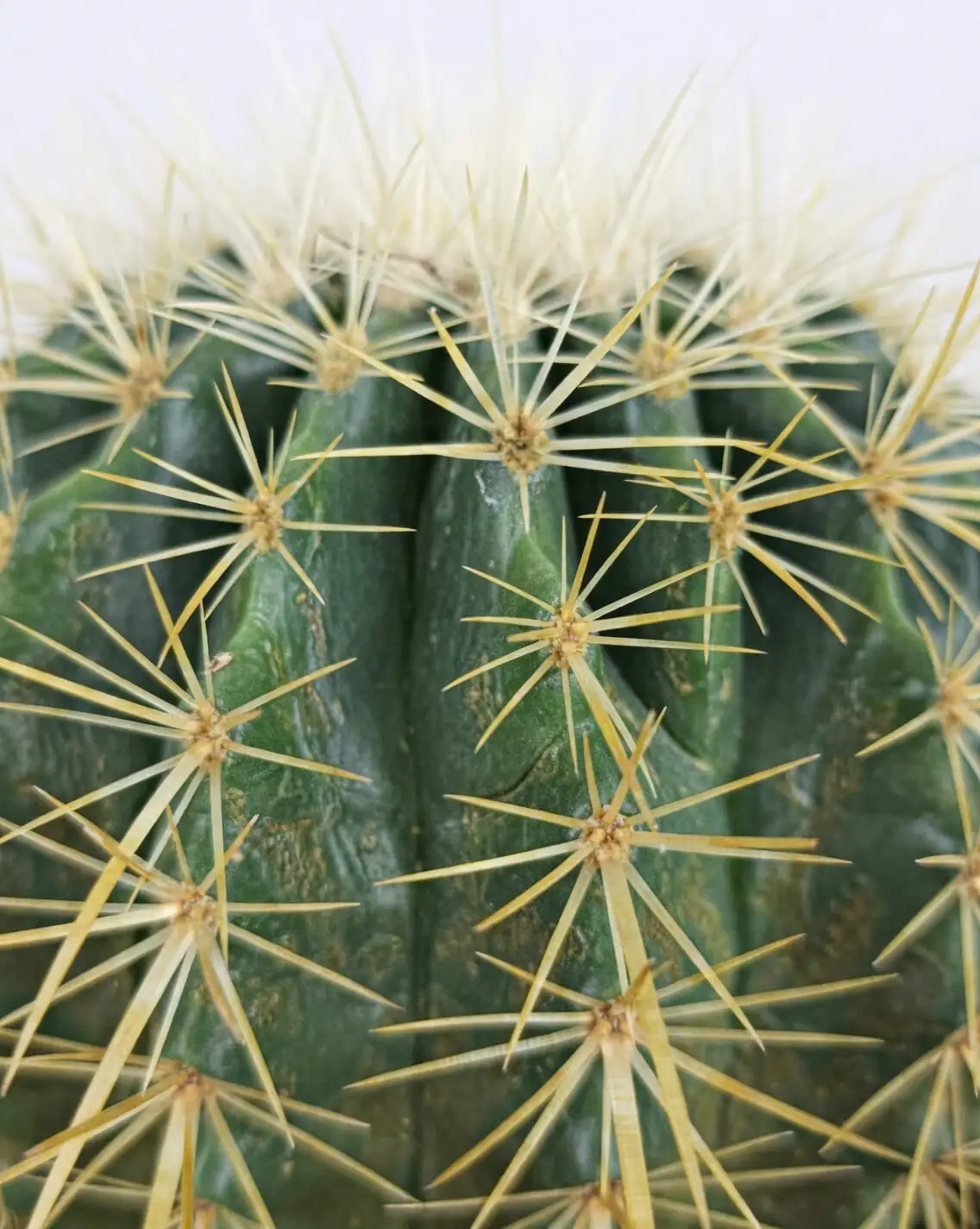
At sunrise in central Mexico, the canyon walls catch fire—glowing copper, then gold. Tucked among those rocks, a globe of green and gilded needles holds its ground like a lit beacon. This is Echinocactus grusonii, the Golden Barrel Cactus—born of lava, lifted by highland sun, and now a global design icon gracing courtyards, hotel lobbies, and bright windowsills from Palm Springs to Palermo.
Where the golden barrels were born
High on the dry slopes of central Mexico, Echinocactus grusonii grows where water runs off fast and the wind is a constant sculptor.
- Landscape: Semi-desert scrub (matorral) broken by volcanic and calcareous rock, with plants scattered on medium to steep slopes.
- Elevation: Roughly 1,400–1,900 meters (4,600–6,200 ft).
- Climate rhythm: Sunny, arid most of the year; quick pulses of rain send the cactus’ ribbed body expanding like an accordion—those deep ribs are a living bellows for water storage.
- Microhabitat: Rocks cradle seedlings, buffering heat, funneling precious drips, and offering critical shade at the hottest, highest-light angles.
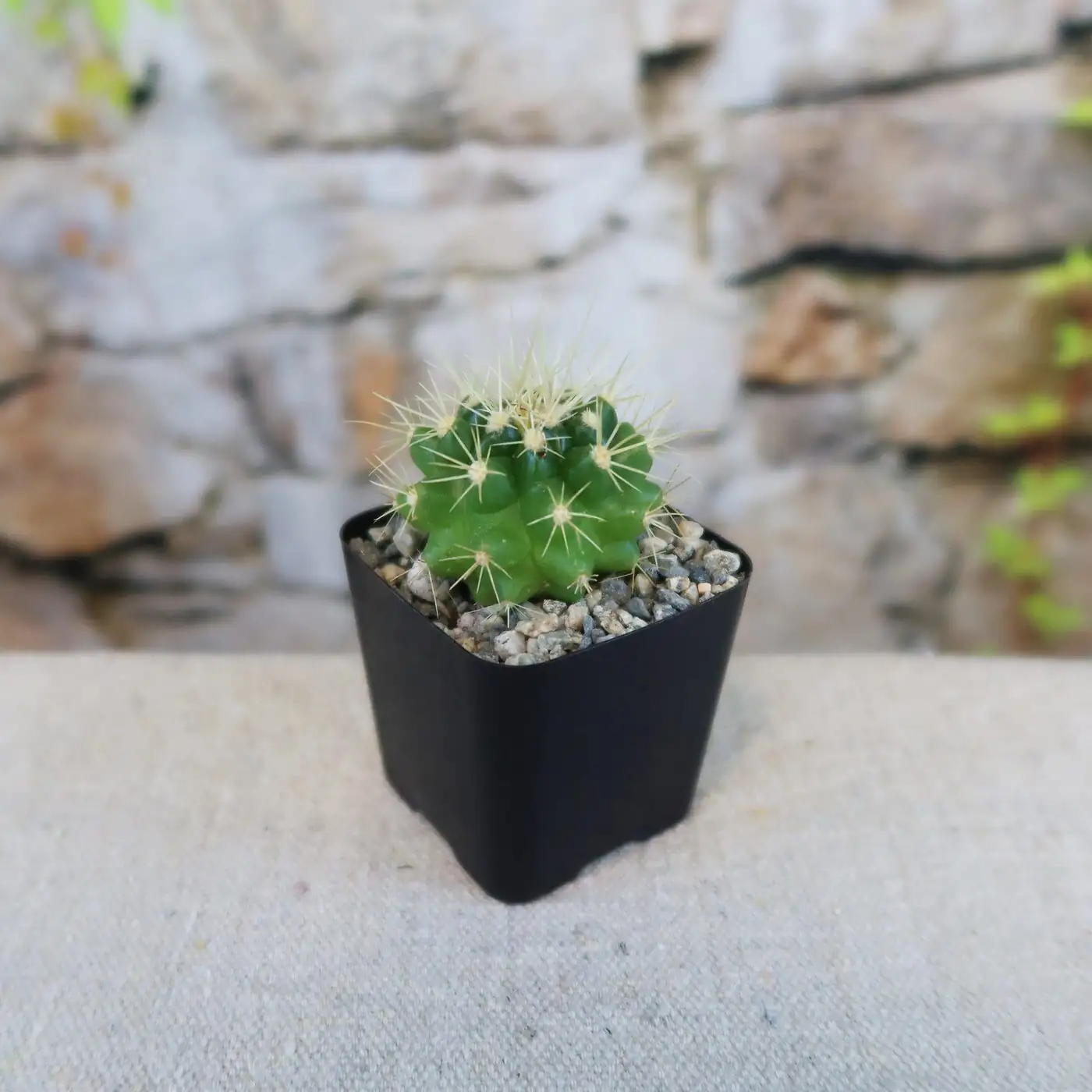
- Form and armor: A bright-green, spherical to short-barrel body lined with bold ribs and areoles, wrapped in dense, golden-yellow spines that glow in full sun. No true leaves here—the stem does all the photosynthesis.
In a world of extremes, this geometry isn’t just beautiful—it’s survival.
Discovery, naming, and the long road to fame
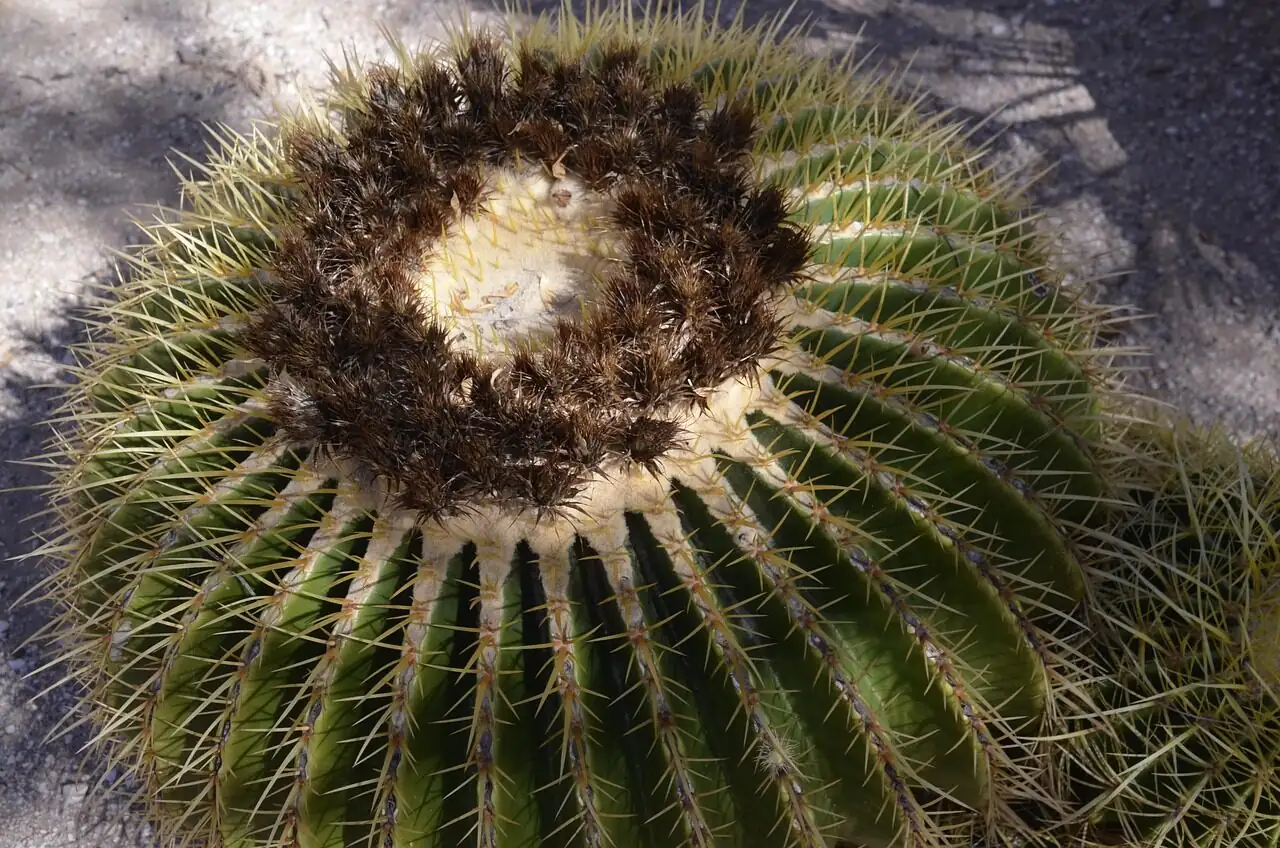
In the late 19th century, as cactus fever spread through European collections, plantsmen scoured Mexico’s mesas and canyons for novelties. Among the finds was a near-perfect globe of thorns and symmetry, formally described in 1886 and named Echinocactus grusonii. Its balance, order, and improbable glow made it an instant darling of conservatories and private collections.
That early love came at a cost. Overcollection pressed on wild populations even as nurseries multiplied it by seed. With time, though, its story broadened—nursery propagation accelerated, botanic gardens championed ex situ conservation, and what began as a collector’s prize became a cultural object.
An ecology of light, patience, and precision
Golden barrel cactus is slow—measured in decades, not seasons. Most plants remain solitary for years, occasionally producing offsets (“pups”) with age and forming dignified clumps.
- Size and tempo: Commonly 30–90 cm (12–35 in) tall and wide over many years; larger with exceptional light, warmth, and time.
- Summer crown-ring: Mature plants in bright, warm conditions produce a ring of small yellow flowers near the apex—more wreath than bouquet.
- Color alchemy: Spines are richest gold in high light; shade softens the hue and can stretch the plant’s shape.
- Strategy: A thickened stem stores water; ribs expand after rain; dense spines shade tissue, slow wind, and help the plant radiate heat.
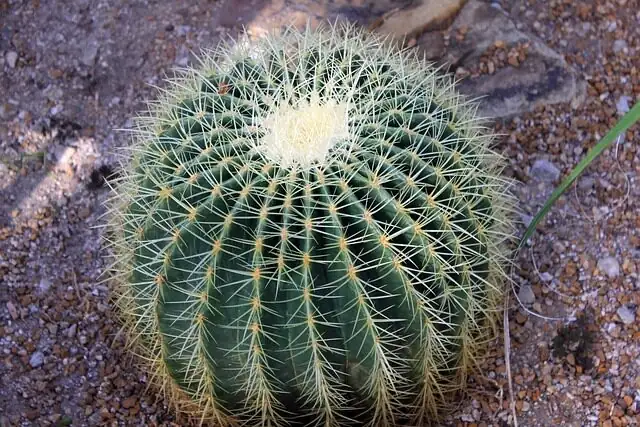
Everything about Echinocactus grusonii whispers economies: spend slowly, defend well, wait for the right moment.
From canyon walls to global design icon
Few plants translate wild logic into modern design so effortlessly. The golden barrel’s exacting geometry reads like sculpture: an orb that paints shadows on gravel, a rhythm that syncs with architectural lines.
- Desert modernism: Grouped in threes against pale decomposed granite, it’s a hallmark of mid-century palettes and contemporary xeriscapes alike.
- Minimalist containers: In a heavy clay pot, one perfect sphere becomes a focal punctuation on steps, entries, or sunlit shelves.
- Tactile contrast: Pair with austere forms—Agave, Dasylirion, or low, silver Artemisia—or with vertical cacti for kinetic contrasts of height and curve.
- Indoors, it’s an “architect’s plant”: clean silhouette, luminous spines, and presence without fuss—provided you give it a south- or east-facing window and airflow.
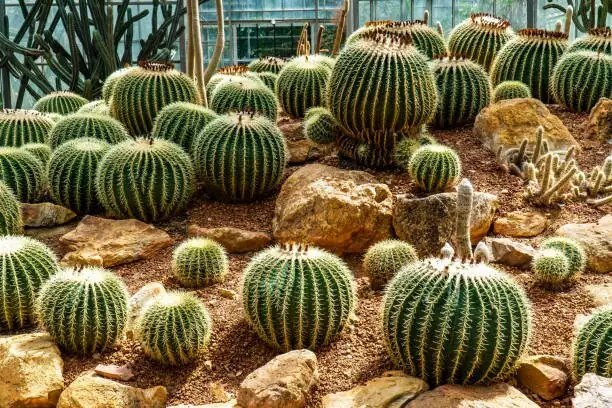
What makes it iconic isn’t only beauty; it’s the way it brings the logic of aridity into human spaces—calm, resilient, exact.
Conservation: a bright star with a fragile home
The wild story of Echinocactus grusonii took a dramatic turn in the Rio Moctezuma Valley of Querétaro, where a dam project slated key habitat for flooding. In response, Mexican botanists raced to rescue plants, and large-scale nursery propagation took root around the world. Even so, wild populations remain fragmented, with additional subpopulations known from Zacatecas. Illegal collection still nips at recovery.
- Status: Endangered in the wild, despite being common in cultivation.
- Threats: Habitat loss, fragmentation, and poaching for the specialty trade.
- The good news: Off-site conservation and nursery propagation have made the species widely available. Responsible purchasing—always nursery-grown, never wild-collected—helps keep pressure off wild plants.
In short: own the icon, safeguard the origin.
Bringing one home: how to help it thrive
Think “sun, stone, and a patient hand.” This cactus loves abundance of light and scarcity of water.
Light
- Bright light to full sun. Indoors, a south- or east-facing window is ideal.
- Acclimate to intense midsummer sun—especially behind glass—to prevent scorch.
- Avoid prolonged low light; it dulls spine color and leads to stretched growth.
Temperature and hardiness
- Best growth: 13–24°C (55–75°F); nights around 10–13°C (50–55°F) are fine in season.
- Winter: keep above about 8°C (46°F) and the soil dry; protect from frost.
- Outdoors long-term only in warm, dry climates (roughly USDA Zone 10–11).
Watering
- Rule one: Water thoroughly only after the mix has dried well.
- Spring: often about every 2 weeks in bright homes.
- Summer: about weekly in very warm, bright conditions—still let it dry between waterings and never let the pot sit in water.
- Autumn: reduce as growth slows.
- Winter: keep almost completely dry; if kept cool, you can stop watering until spring.
- Avoid pouring water onto the crown/body.
Note: Hydroponic culture is possible but riskier—requires immaculate hygiene, frequent water changes, and strong aeration.
Soil and containers
- Use a very free-draining cactus mix: loam-based soil plus leaf mold/compost heavily amended with coarse sand/grit.
- Avoid heavy, water-retentive mixes; if adding organic matter, use it sparingly.
- Pots with excellent drainage; heavy containers help prevent tipping.
Feeding and maintenance
- Feed once per month in the growing season with a cactus or low-nitrogen fertilizer at half strength. Do not fertilize in winter.
- Repot every ~2 years in spring or when rootbound; keep dry a few days after repotting to let roots callus.
Pests, diseases, and safety
- Watch for rot (from excess moisture), spider mites, mealybugs, and scale. Strong light, airflow, and gritty drainage are your best defenses.
- Treat pests with insecticidal soap or horticultural oil as needed.
- Not poisonous, but spines are serious—keep away from curious hands and paws; handle with thick gloves or tongs.
Flowering and propagation
- Flowers in summer on older, well-lit plants.
- Propagate by seed (20–25 days to germinate in warm conditions), by carefully rooting offsets, or by grafting in late spring to mid-summer.
Symbolism, myths, and the “flower language”
Golden barrel cactus is widely gifted as a talisman of resilience, endurance, and protective strength—the spines read as guardianship, the longevity as steadfastness. While traditional Victorian “flower language” didn’t center on cacti, modern plant culture has elevated this species as a stay-strong emblem for new jobs, new ventures, and hard seasons. It’s an apt symbol: a luminous sphere that thrives by conserving resources and keeping its cool.
Field notes for the curious
- Common names: Golden Barrel Cactus, Golden Ball Cactus, Mother-In-Law’s Cushion.
- Family and form: Cactaceae; a slow-growing, globose to short-barrel cactus, typically solitary but capable of offsetting with age.
- Bloom ring: Small yellow flowers form near the crown in warm, bright summers on mature plants.
- Longevity by restraint: It lives a long time with warmth, strong light, and a dry-leaning routine.
Why it endures in design—and in memory
Echinocactus grusonii is a lesson in essentials. It gathers light, parcels out water, and answers chaos with order. On a windowsill or set like pearls across a gravel garden, it turns vacancy into intention. Own one long enough and you notice: it doesn’t demand attention; it rewards it—slowly, brilliantly, like sunrise over stone.