

It begins in a flicker of early light beneath oaks and olives on a Mediterranean hillside: a breath of sweetness, a wink of purple from the leaf litter, and suddenly winter loosens its grip. This is Sweet Violet—Viola odorata—low to the ground, humble in stature, yet audacious in perfume and history. Follow it from myth-lit woodlands to Victorian shopfronts and Bonaparte’s legend, and you’ll see how a tiny flower won the world by charm alone.
From dappled Mediterranean woods to the wider world
Native to Europe, North Africa, and West Asia—including the Mediterranean coast and southern Europe—Sweet Violet made itself at home in the gentler corners of temperate climates. Gardeners welcomed it under shrubs and orchard trees; monks doted on it in cloister gardens; and by the time Victorian nurseries were in full swing, it had slipped into shady borders and rock gardens from Edinburgh to New England. It spreads not by bluster but by quiet persistence—creeping runners knit soft mats, and the plant sometimes tucks away self-pollinating flowers to ensure a future generation.
Also known as English Violet, Common Violet, Florist’s Violet, Garden Violet, and Wood Violet, Viola odorata remains a quintessential shade companion: modest, fragrant, and faithful.
Myths that shaped its aura
- In Greek lore, spring’s drama unfolds around violets: Persephone was gathering them when Hades carried her to the underworld—an ancient story explaining the seasons and fixing violets forever to the idea of return and remembrance.
- Classical poets and playwrights reached for violets when they needed a symbol of tenderness and renewal; centuries later Shakespeare nodded to their woodland haunts, entwining them with romance and transience.
So early on, the flower gathered meanings—devotion, modesty, and the sweet ache of memory—that still cling to its petals.
Bonaparte’s little flower
History gives Sweet Violet an unexpected cameo on the imperial stage. Napoleon and Josephine were famously fond of violets; it’s reported that pressed violets from Josephine’s grave were found in Napoleon’s locket. Around that affection grew a thicket of legend—among them the tale that, exiled to Elba, he vowed to “return with the violets” in spring. Whether or not every story is literal, the association stuck: violets as tokens of loyalty, longing, and the promise of return.
The Victorian violet fever
In the 19th century, violets became a phenomenon. City sidewalks saw vendors hawking nosegays; milliners and perfumers chased the bloom’s romance; and the “language of flowers” crowned violets with meanings that had been budding for millennia:
- Purple violets: loyalty, faithfulness, modesty
- White violets: innocence and purity
They were the sweetheart’s bloom—small enough for a secret message, fragrant enough to be remembered.

A perfume that plays hide-and-seek
Lean closer, breathe in—then… where did the fragrance go? Sweet Violet’s scent contains beta-ionone, a compound that briefly “switches off” the nose’s ability to perceive floral notes. After a minute, your sense of smell resets and the perfume returns, a botanical magic trick that helped make violets irresistible to perfumers.
True violet fragrance is also famously costly to obtain, so many modern perfumes recreate that elusive aroma with carefully crafted synthetics while still capturing the bloom’s signature tenderness.
Meet the plant up close
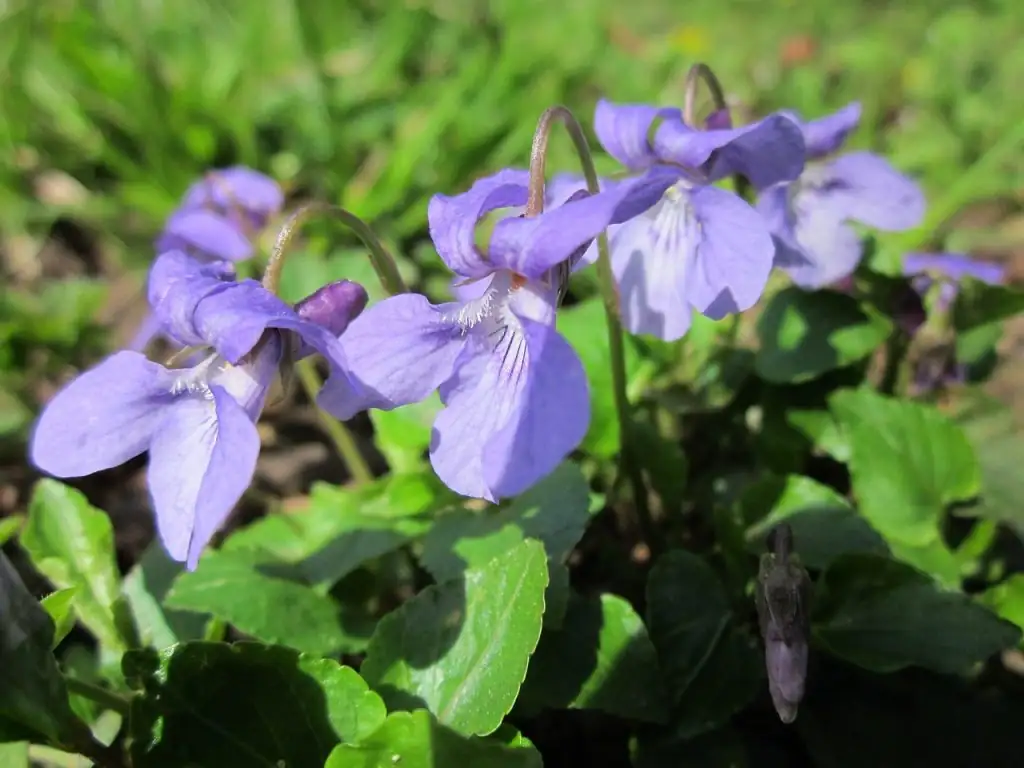
- Habit: Low-growing perennial forming dense clumps and gentle mats via creeping stolons and short rhizomes
- Size: Typically 5–15 cm (2–6 in) tall
- Leaves: Heart-shaped to rounded, deep green, softly hairy, scalloped edges, forming a basal rosette
- Flowers: Small, nodding, five-petaled blooms about 1.5–2 cm across; usually deep purple to violet-blue with darker veining, but sometimes white or pale lavender; many forms strongly fragrant; each flower shows the classic violet spur
- Season: Early spring (March to May), with occasional autumn encore
Growing Sweet Violet today
Where they’re happiest
- Light: Partial to full shade; dappled woodland light is ideal. Avoid harsh, hot sun.
- Temperature: Cool-growing, happiest around 15–20°C (60–70°F); hardy to about -15°C (5°F)
- Hardiness: USDA Zones 3–9
- Soil: Fertile, humus-rich, well-draining; neutral to slightly acidic (pH ~6.0–7.0)
- Moisture: Evenly moist with moderate to high humidity; dislikes prolonged drought
Care, the easy way
- Watering: Keep soil consistently moist but never soggy; let the surface dry slightly between waterings. Water at the soil line (or bottom-water in pots) to keep foliage dry and reduce mildew.
- Feeding: In spring, top-dress with compost or use a balanced slow-release fertilizer. During active growth, a diluted liquid feed every 10–15 days boosts vigor; a touch more phosphorus/potassium encourages bloom.
- Grooming: Deadhead to tidy and prolong flowering. In autumn, thin crowded patches and trim old foliage for airflow.
- Propagation: A breeze to multiply. Divide clumps in spring or fall, or peg down runners to root. Seed also works—sow at 15–20°C (60–70°F) with light cover and steady moisture. Note: the plant also makes cleistogamous (non-opening) flowers that quietly self-pollinate and set seed.
- Containers: Repot every 1–2 years in early spring into a rich, free-draining mix, taking care with the fine roots.
Seasonal rhythm
- Spring: Peak bloom—keep evenly moist and feed lightly
- Summer: Provide shade and cooler conditions; plants may go semi-dormant in heat—reduce (but don’t stop) watering
- Autumn: Prime time to divide; some plants rebloom
- Winter: Top growth may thin or die back; mulch in very exposed cold sites
Pests and gentle fixes
- Usual suspects: Aphids, spider mites, slugs, and snails
- Diseases: Powdery mildew and leaf spots in still, damp conditions
- Good habits: Improve airflow, avoid overhead watering, remove affected leaves; insecticidal soap/neem for aphids; appropriate fungicides or mild baking-soda solutions for mildew if needed
In the kitchen and the stillroom
Sweet Violet brings beauty you can taste:
- Culinary: Use fresh or candied flowers on cakes and confections; scatter into salads; float in teas or freeze into ice cubes. Young leaves can be eaten fresh or briefly cooked like tender greens.
- Herbal tradition: Long used in gentle syrups and tisanes to soothe the throat and calm inflammation.
- Safety: Generally non-toxic to people and pets. Enjoy flowers and young leaves—but avoid the roots, which can cause nausea or vomiting.
Flower language, decoded (and why it stuck)
Violet meanings—modesty, faithfulness, remembrance, and pure love—grew from both habit and history. The plant hides its blooms beneath heart-shaped leaves and picks the earliest moment of spring to appear; poets noticed, lovers noticed, and Victorians codified those observations into floriography. Still, the “language of flowers” was never a single rulebook: meanings varied by place and period. What endures is the feeling—violets whisper rather than shout, and that quietness became a symbol of sincerity.
How a tiny violet travels
Viola odorata spreads close to the ground by stolons, slips seed where it can, and even hedges its bets with hidden, self-fertilizing blossoms. Given a cool, moist nook, it naturalizes with grace. No wonder violets—across the whole genus—were eventually chosen as state flowers in several U.S. states; they feel both wild and neighborly.
Quick violet lore-and-leaf notes
- The “vanishing scent” effect is real: beta-ionone temporarily numbs certain olfactory receptors.
- Natural violet perfume is rare and pricey, so many modern fragrances emulate it with synthetics.
- Medieval households sometimes used violets as simple deodorizers.
- Shakespeare’s pages are dotted with violets—from Hamlet to The Winter’s Tale.
- Sweet violets contain soothing mucilage and flavonoids like rutin, part of their long gentle-use tradition.
- The plant’s cleistogamous flowers set seed without ever opening—a secret garden within a garden.
Why we still plant them
For a gardener, Sweet Violet is the best kind of time machine. Plant a drift under the apple tree or by a shady path and you’ll inherit an ancient perfume, a page of classical myth, a Victorian love note, and a whisper from Malmaison—all from a plant that asks only for cool shade, leaf mold, and a little steady moisture. In spring, when a purple-blue gleam glows from the shadows, you’ll understand why history keeps bending down to inhale.


