

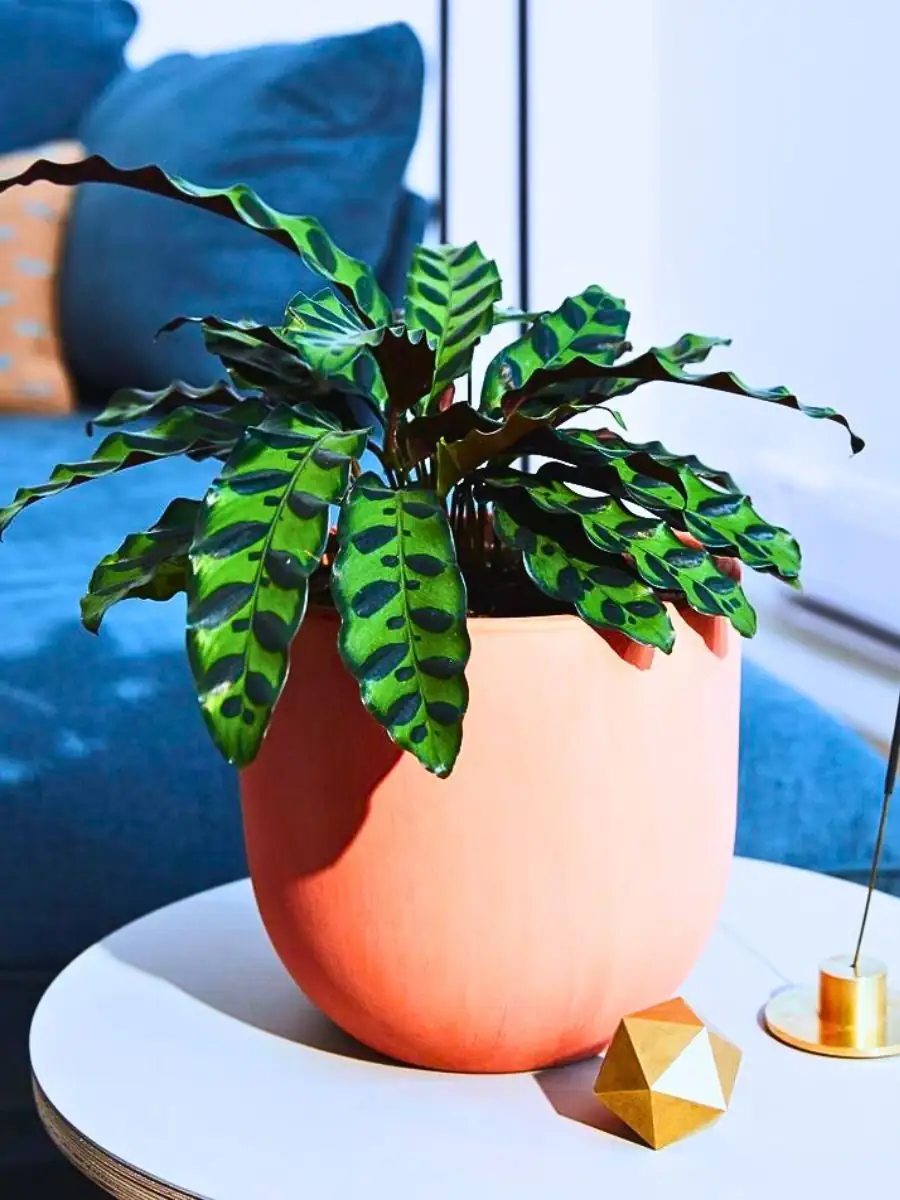
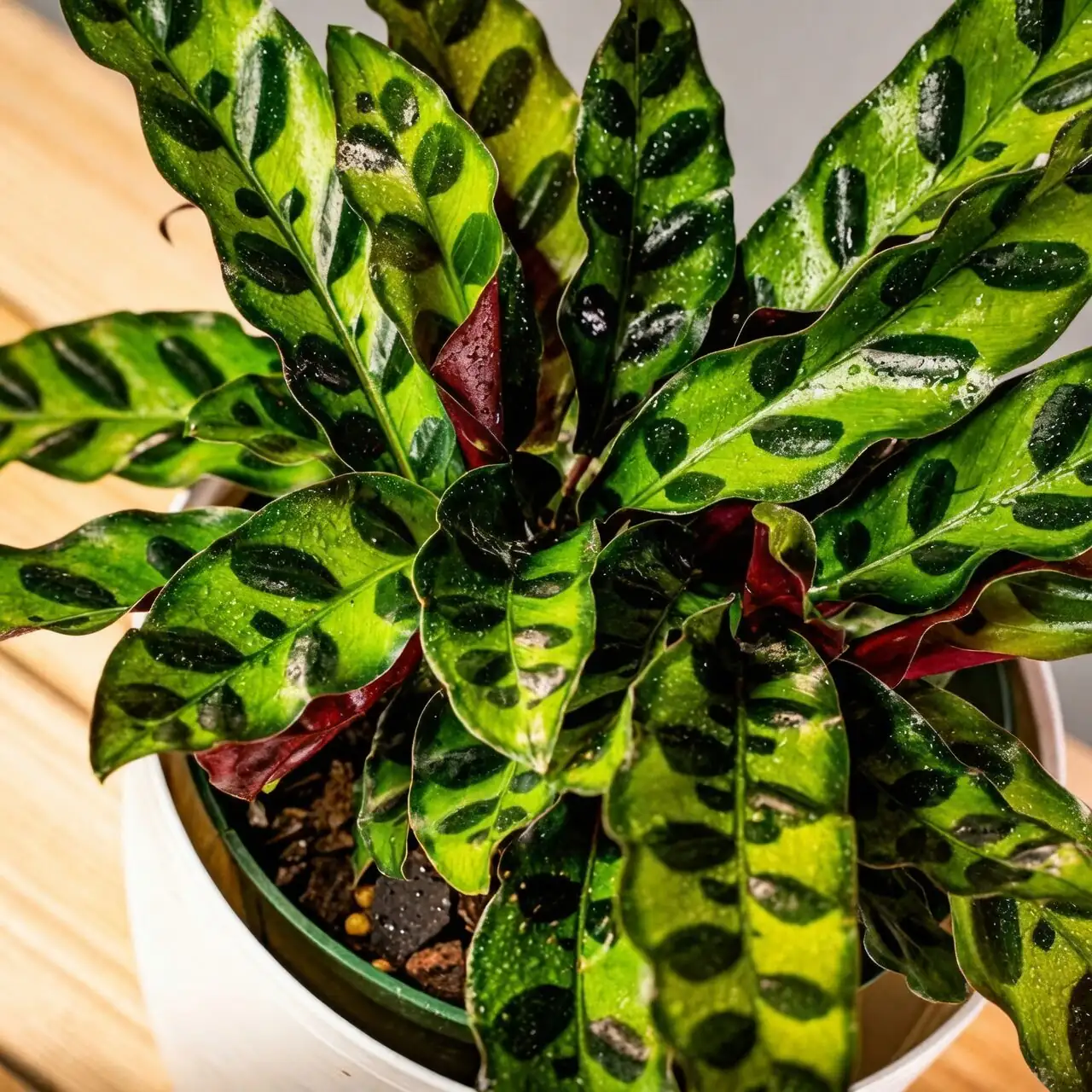
Think of Goeppertia insignis as a living mood ring. By day, its long, snakeskin-patterned leaves lounge outward in lime and deep green. By night, they lift and overlap like hands at prayer, flashing their burgundy undersides. This is more than plant theatrics—it’s nyctinasty, a daily leaf movement powered by plant hydraulics. Add in those wonderfully wavy margins and that wine-red glow, and you’ve got a rainforest native that doubles as a home-friendly science demo.
Meet Goeppertia insignis (aka Rattlesnake Plant)
- Origin: Native to Brazil’s warm, humid rainforest understory
- Family: Marantaceae (the “prayer plant” family)
- Look: Long, lance-shaped leaves with distinct wavy edges; snakeskin-like yellow-green and dark green markings on top; rich burgundy undersides
- Habit and size: Clump-forming, upright to gently arching; typically around 75 × 45 cm (30 × 18 in) as a houseplant
- Flowers: Rare indoors and modest compared to the foliage
The nightly leaf dance: nyctinasty
Nyctinasty is a daily sleep–wake rhythm in leaves. In Goeppertia insignis, leaves open flatter by day and lift toward evening.
What actually moves—and how
- The hinge: At the base of each leaf is a pulvinus—a tiny, flexible “joint” swollen with specialized motor cells.
- The engine: Those motor cells shift ions (especially potassium) across membranes. Water follows the ions, changing the cells’ internal pressure (turgor).
- The choreography: A built-in circadian clock and light signals cue the pulvinus to swell on one side and shrink on the other, rotating the leaf without bending the blade.
- The why: In low, filtered forest light, raising leaves at night may minimize exposure to cool night skies, shed water, protect tender surfaces, or simply sync with the plant’s energy economy. In other words: it’s adaptive—and elegant.
Try this at home: three easy nyctinasty experiments
1) Time-lapse in a day
- Morning: take a photo.
- Late afternoon: photo again.
- Late evening: one more.
- Next morning: compare. You’ll see a reliable lift-and-lower cycle.
2) The “pulse of light” check
- After dusk, switch on room lights for 10–15 minutes near the plant (no harsh direct sun).
- Watch for a subtle “opening” response as the leaf angle lowers slightly. It’s a glimpse of the light-sensitive control system.
3) The dry vs. well-watered test
- On a day when the top 1–2 cm of mix is just starting to dry, note the evening leaf lift.
- Water evenly, wait an hour, compare lift again at night. Better hydration often restores fuller motion.
Tip: If the plant stops “dancing,” suspect one of three Ds—dehydration, drafts, or dim light.
Why the leaves are wavy: the physics of ruffles
The undulating edge isn’t a random flourish—it’s a direct outcome of growth and geometry.
The science of a ruffled rim
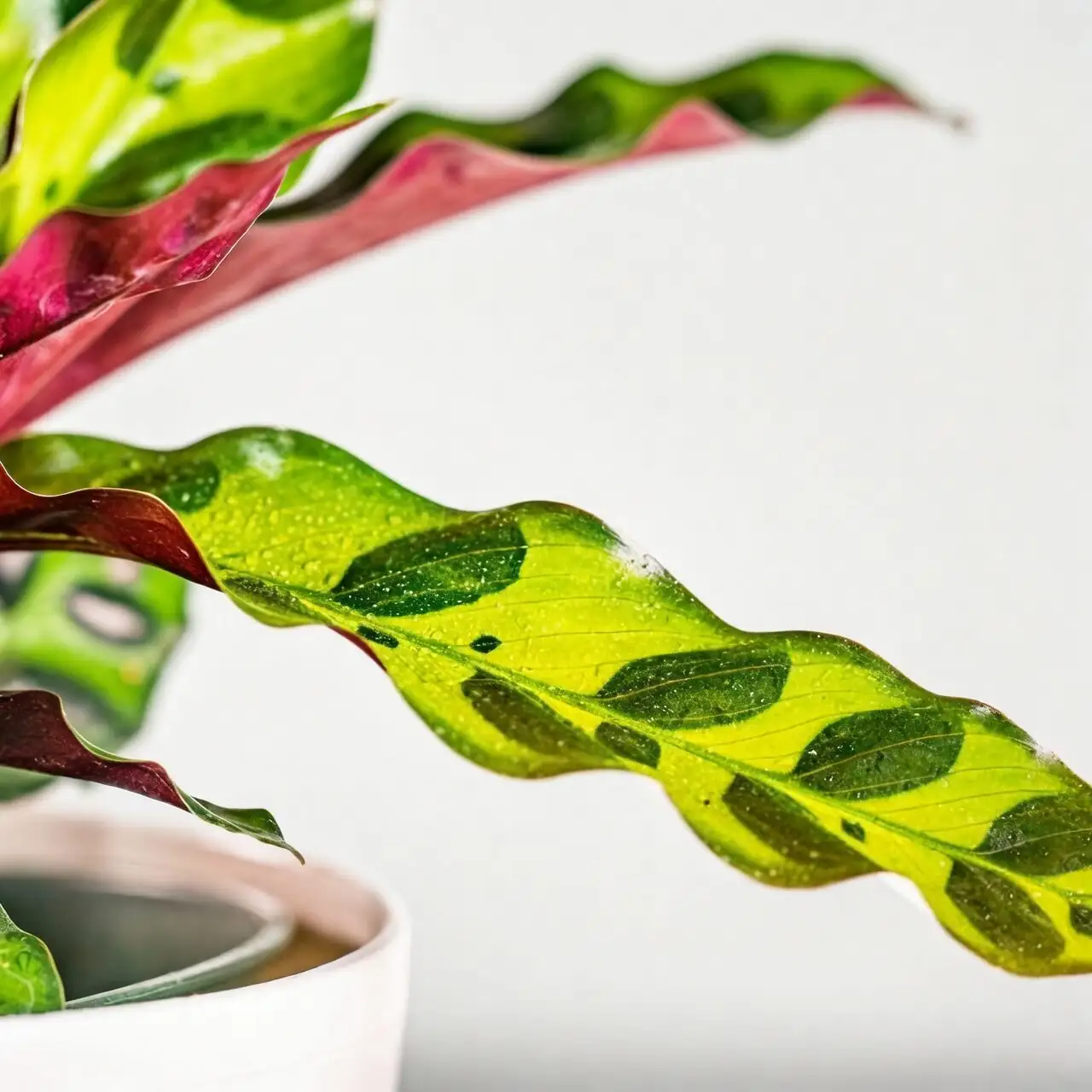
- Differential growth: Tissues along the leaf margin grow just a bit more (or differently) than inner tissue. The mismatch can’t lie flat, so the margin buckles into waves—like a naturally ruffled ribbon.
- Built-in engineering: Those ripples subtly stiffen the blade (think of how a crinkled chip resists bending), helping the long leaves hold form without being thick or heavy.
Possible rainforest perks
- Light sampling: Wavy edges catch soft, angled light from more directions in shaded understories.
- Water management: Micro-ridges help beads of water migrate and roll off.
- Boundary-layer tweaks: Ripples affect the thin layer of still air on the leaf surface, which can nudge gas exchange in calm, humid air.
Quick hands-on: Cut a paper strip and glue a slightly longer edge to a slightly shorter one. It will buckle into gentle waves—your desktop version of marginal growth.
Burgundy undersides: not just a fashion statement
Flip a leaf and you’ll find a glow of burgundy to wine-red. That color comes from anthocyanins, pigments famous for reds and purples in many plants.
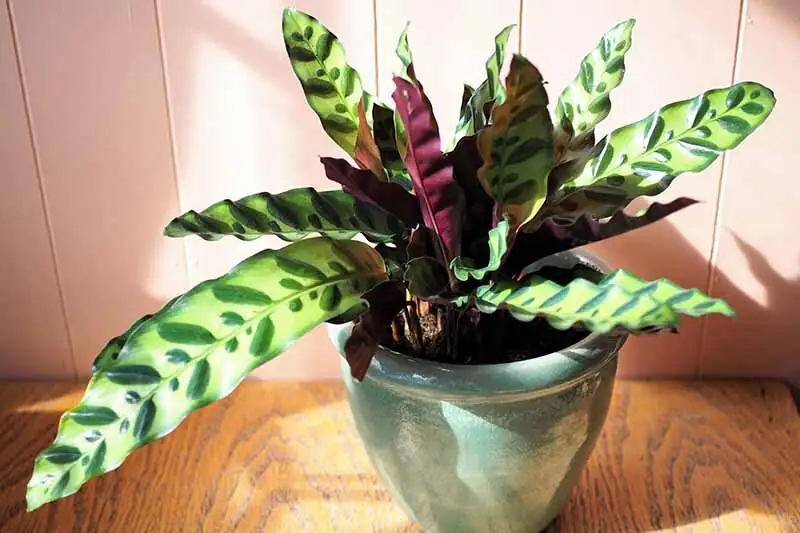
Anthocyanins 101 (and why they might help)
- Gentle sunscreen: In bright, indirect light, anthocyanins can help screen excess wavelengths before they hit delicate tissues.
- Light recycling (the “back-scatter” idea): In shade, a red underside may reflect or filter useful wavelengths back through the chlorophyll-rich top layer, squeezing a little more out of soft light. Evidence varies by species, but it’s a leading hypothesis for understory plants.
- Multi-tool pigment: Anthocyanins may also deter herbivores and buffer oxidative stress.
See the science with simple tests
- Backlight the blade: In a dim room, place your phone flashlight behind the leaf. The transmitted light glows ruby-red—anthocyanins at work.
- Paper reflect test: Hold a white card under an evening-lifted leaf in bright, indirect light. You’ll notice a faint burgundy blush on the paper.
Care, in science-sound bites
Think rainforest edge: bright but filtered light, steady warmth, and humidity that kisses rather than crisps.
Light and placement
- Bright, indirect light to light shade; avoid harsh direct sun that can scorch or fade patterning.
- Ideal near east- or north-facing windows, or a bright bathroom/kitchen.
- Keep away from cold drafts and strong airflow from vents.
Temperature and humidity
- Temperature: 15–24°C (59–75°F). Avoid prolonged dips below about 13°C (55°F).
- Humidity: Aim for 50%+; higher is even better. Bathrooms and kitchens are great; otherwise, use a pebble tray or humidifier. Misting helps briefly but doesn’t replace steady humidity.
Water and soil
- Watering rhythm: Spring–autumn, keep the mix evenly moist but never soggy—water when the top 1–2 cm (0.4–0.8 in) just starts to dry. In winter, let the surface dry a bit more before watering.
- Water quality: Prefer rain or distilled water; minerals in tap water often cause brown tips.
- Potting mix: Moisture-retentive yet airy—try 2 parts high-quality houseplant mix to 1 part perlite (2:1). Ensure a pot with drainage.
Feeding and grooming
- Fertilization: Spring–autumn, feed every 2 weeks with a balanced liquid fertilizer at 1/2 strength. Reduce or pause in winter if growth slows.
- Pruning: Remove yellowing or damaged leaves by cutting at the base with clean scissors. You can trim brown tips for looks, but fix the cause (humidity, drafts, minerals).
Repotting and propagation
- Repotting: Often starts in a 12.5–15 cm (5–6 in) pot. Repot every 2–3 years or when root-bound, ideally in spring, using a fresh airy mix.
- Propagation: Best by division during repotting—split a healthy clump so each section has roots attached and pot individually.
Health, pests, and safety
- Common pests: Spider mites, mealybugs, and scale—most likely when air is dry. Rinse foliage, raise humidity, and treat with insecticidal soap or horticultural oil if needed.
- Disease: Root rot if soil stays constantly wet or drainage is poor.
- Toxicity: Generally considered non-toxic to cats and dogs (any nibbling can still cause mild stomach upset).
Quick fixes to common questions
- Brown leaf edges? Usually low humidity or mineral-heavy water. Boost humidity to 50%+ and switch to rain or distilled water; keep away from vents.
- Direct sun? Not a friend—patterns wash out and leaves can scorch. Stick with bright, filtered light.
A note on names (and why it “prays”)
For years this plant was sold as a Calathea; these days it’s correctly placed in Goeppertia. It’s in the Marantaceae—the prayer plant family—named for those nightly, prayer-like leaf lifts (nyctinasty). That daily motion plus its spa-loving vibe have linked it symbolically with calm and renewal—meanings grown from observation and culture rather than old floristry codes.
Your 7-day field notebook challenge
Turn your plant into a mini research partner:
- Day 1: Record the time of first evening “lift.”
- Day 2: Measure light at the pot (phone light meter) and note leaf angle morning vs. night.
- Day 3: Water when the top 1–2 cm is just dry; note any change in movement amplitude that night.
- Day 4: Move it a half-meter closer to bright, indirect light (no direct sun). Observe patterns for 24 hours.
- Day 5: Run a humidifier to 55–60%. Check for crisper, fuller leaf angles.
- Day 6: Do the backlight anthocyanin test after dusk.
- Day 7: Compare photos from each morning and evening. You’ve just mapped nyctinasty and seen pigment physics in action.
When a plant is this expressive, care becomes a conversation. Keep the light bright but gentle, the air warm and humid, the soil airy and evenly moist—and let Goeppertia insignis show you its nightly waltz and burgundy encore.