

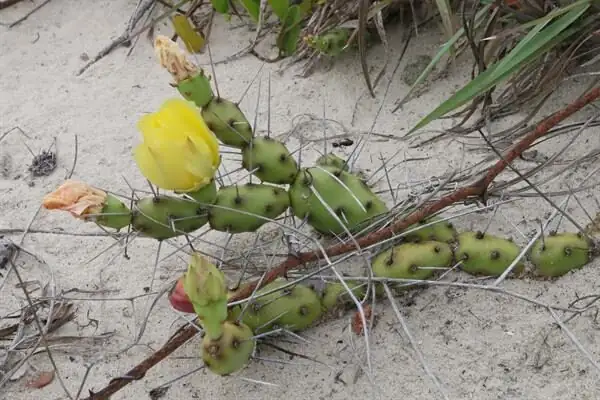
When summer turns punishing and sea wind tastes like salt, most plants beg for mercy. Not Opuntia dillenii. This coastal prickly pear—sculptural paddles armed with spines and sunburst-yellow flowers—loves the furnace and shrugs at salt spray. Used smartly, it’s the backbone of resilient, pollinator-rich landscapes that sip water, glow in high sun, and hold their own on hot, exposed sites.
Meet Opuntia dillenii: the coastal character with staying power
- Form and habit: A low, spreading, thicket-forming prickly pear that commonly stands about 0.5–1 m tall, often wider than high. Over time, older clusters can mound up and broaden into impressive, living sculptures on dunes and rocky ground.
- Paddles and spines: Flat, green cladodes (pads) studded with areoles that bear stout spines and tiny hairlike glochids—beautiful but not to be trifled with. Give it respectful placement away from high-traffic paths.
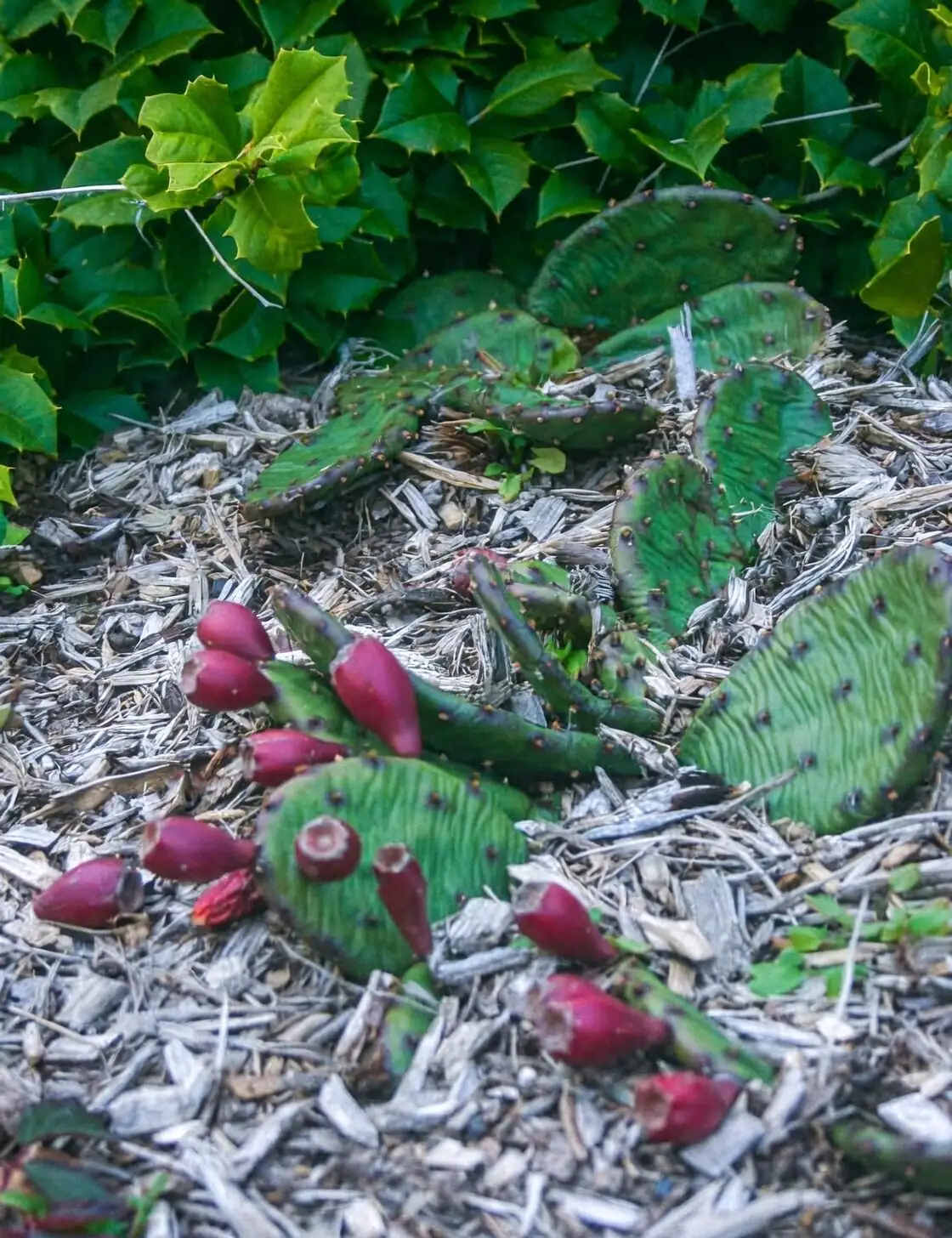
- Flowers and fruit: Typically yellow, bowl-shaped blooms that are short-lived but spectacular. Vivid reddish-purple fruits follow and add late-season color.
- Superpowers: Excellent drought and heat tolerance, with a knack for windy, coastal, salt-laden environments—so long as the soil drains fast.
Native to the Americas, Opuntia species are icons of arid and semi-arid landscapes. O. dillenii brings that desert poise to gardens, from inland heat islands to sand-swept shorelines.
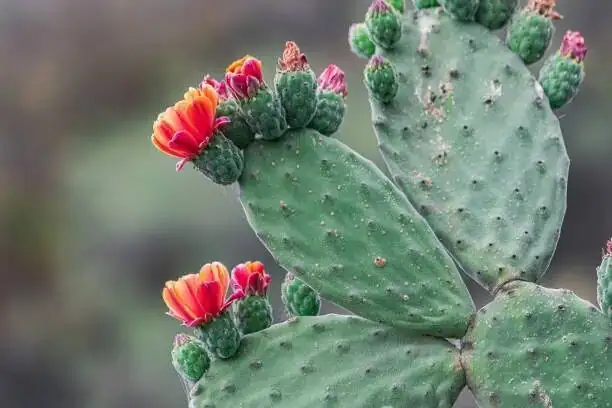
Sun, heat, wind: setting the scene
- Light: Give it bright, direct sunlight—at least 4–6 hours daily. More is usually better. In extreme desert heat, a splash of afternoon shade can prevent superficial sunburn on pads.
- Temperature: Thrives around 20–30°C (68–86°F) and handles hot spells at 30–40°C (86–104°F). It is generally not frost hardy; aim to keep winter temps above about 5°C (41°F).
- Hardiness: Best outdoors in warm climates, typically USDA Zones 9–11. In colder regions, use containers you can shelter for winter.
- Wind and salt: Made for coasts—salt spray and gritty onshore winds are no problem. Just don’t confuse “salt tolerant” with “water tolerant”: roots must never sit wet.
Soil engineering: fast drainage or bust
Think “dry feet, airy roots.” Right soil is the difference between a cactus that thrives and one that sulks.
- In-ground mix (target 60–80% mineral):
- 1 part native sandy soil (or a lean topsoil, not clay-heavy)
- 1 part coarse sand or decomposed granite
- 1 part 3–6 mm (1/8–1/4 in) pumice or crushed lava
- Optional: up to 10% well-aged compost for microbial life (keep it light)
- Shape the site:
- Plant on slight mounds or berms 10–20 cm (4–8 in) high to shed water.
- On slopes, position plants on the shoulder of a terrace where water passes by, not where it pools.
- Mulch the mineral way:
- Top-dress with 3–5 cm (1–2 in) gravel. It speeds drying at the crown, suppresses weeds, and highlights the plant’s architecture.
- Avoid:
- Peat-heavy mixes, water-holding gels, and compacted clay basins—these trap moisture and risk rot.
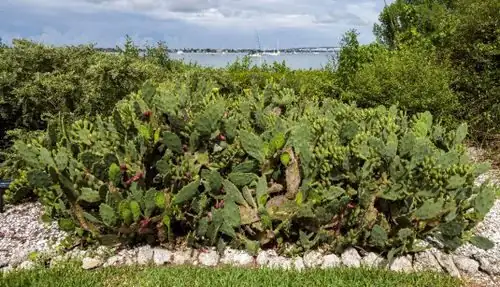
Planting and establishment watering
- Planting technique:
- Handle with thick gloves and tongs—glochids are sneaky.
- Set crowns slightly above grade; backfill with the gravelly mix; do not bury pads.
- Watering rhythm:
- First season: Water deeply, then wait until soil is completely dry before watering again. In hot weather, that might mean every 10–14 days on sandy soils; slower in cooler spells.
- Established plants: Water sparingly. In many climates, rainfall suffices; in intense heat waves, a deep soak every 3–4 weeks is plenty if the soil dries rapidly.
- Pro tip: Use drip emitters set a little upslope on berms, never pointed directly at the stem base.
Massing and spacing: sculpt the desert breeze
O. dillenii excels when planted in purposeful patterns that read from a distance.
- Low, impenetrable hedges:
- Spacing: 60–90 cm (24–36 in) on center
- Outcome: A bristling, living barrier in 2–3 seasons—ideal along property edges, sunny parking strips, or to steer foot traffic.
- Open, sculptural drifts:
- Spacing: 90–120 cm (36–48 in) on center
- Outcome: Individual forms remain legible; pads catch light and shadow, and bloom displays are easier to admire.
- Specimen rhythm in gravel gardens:
- Spacing: 1.2–1.8 m (4–6 ft) from other structural succulents (e.g., agaves, yuccas) to keep silhouettes crisp.
- Airflow and access:
- Leave a 60–90 cm (24–36 in) service lane behind hedges or large drifts for safe grooming.
- Keep at least 1 m (3 ft) setback from high-traffic paths and seating to prevent accidental encounters with spines.
Pollinator-friendly companions that thrive on low water
Turn resilience into a buzzing, fluttering scene by layering nectar and pollen across seasons. Choose regionally adapted, non-invasive selections, especially near coasts.
- Coastal, salt-tolerant palette
- Gaillardia pulchella (blanketflower): Continuous bee-and-butterfly magnet in poor, sandy soils.
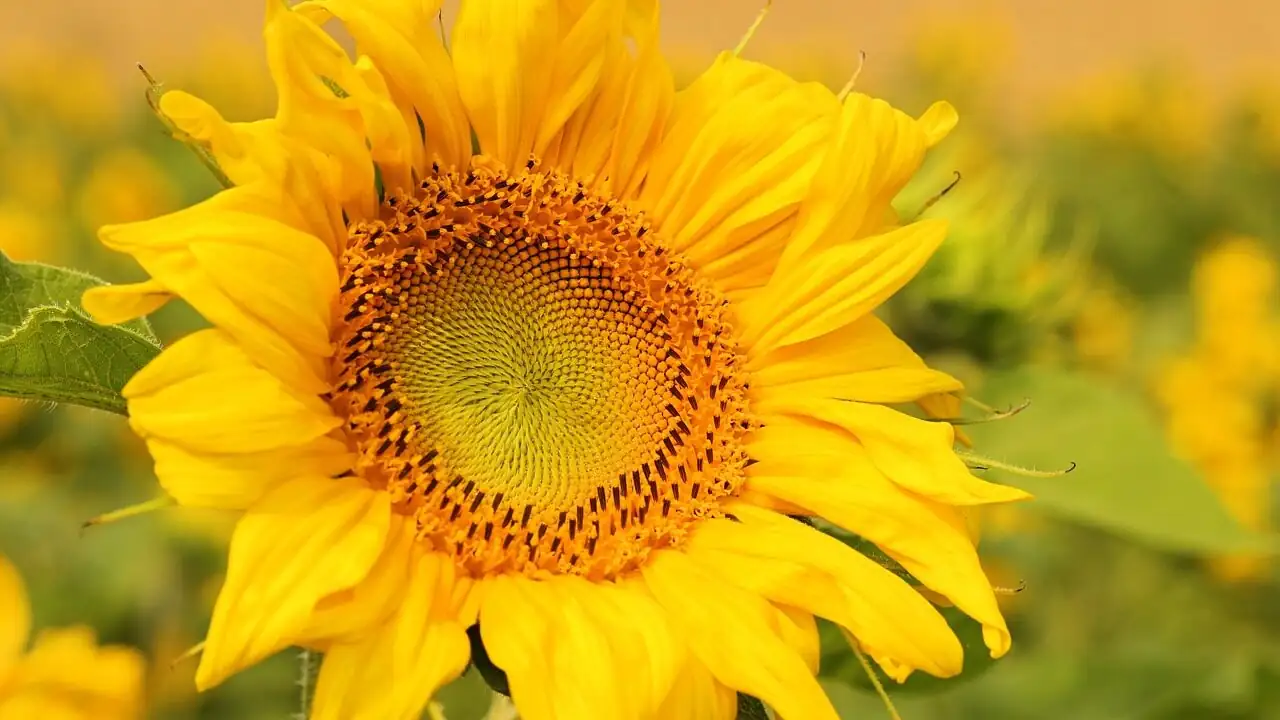
- Helianthus debilis (dune sunflower): Lush, cheerful daisy heads that handle salt spray.
- Limonium spp. (sea lavender/statice): Papery clouds of tiny blooms beloved by pollinators.
- Armeria maritima (sea thrift): Low cushions along the gravel edge, early nectar.
- Dyschoriste oblongifolia (twinflower) or native seaside verbenas: Groundcovers that stitch between cactus mounds.
- Hot inland xeric palette
- Hesperaloe parviflora (red yucca): Tall coral flowers draw hummingbirds for months.
- Salvia greggii and S. microphylla: Spring-to-fall nectar for bees, butterflies, and hummers.
- Eriogonum fasciculatum (California buckwheat) or regional buckwheats: Peak native bee value.
- Penstemon spp. suited to your region: Electric spikes for early pollinator pulses.
- Sphaeralcea ambigua (desert globemallow): Silky flowers, tough as nails.
- Grasses for movement and nesting habitat
- Muhlenbergia capillaris (pink muhly) or M. rigens: Airy seedheads, great texture with paddles.
- Bouteloua gracilis (blue grama): Wildlife-friendly, low water; frames the cactus without competing for moisture.
Note: Some ornamental favorites (e.g., lantana, certain salvias) can be invasive regionally—check local guidance before planting.
Design recipes you can build this weekend
- Dune-edge pollinator ribbon
- Stagger O. dillenii in a broken line, 90 cm (36 in) apart on a low berm.
- Weave in Gaillardia pulchella and Helianthus debilis between pads.
- Finish with a 3–5 cm gravel top-dress and scattered boulders to echo a rocky shore.
- Hot-driveway fortress hedge
- Double-row O. dillenii at 60 cm (24 in) spacing, rows offset by 30 cm (12 in).
- Back the hedge with Hesperaloe parviflora every 1.5 m (5 ft) for hummingbird spikes.
- Edge with blue grama for a soft, mow-free toe line.
- Courtyard xeriscape with silver and gold
- Anchor two O. dillenii specimens 1.5 m (5 ft) apart.
- Add Salvia greggii (bee fuel) and Limonium (coastal sparkle).
- Mulch in pale gravel to bounce light onto the pad surfaces for evening glow.
Care, the delightfully short version
- Water: Use the soak-and-dry method only when the soil is completely dry. Overwatering is the fastest route to failure.
- Feeding: In the growing season (spring–summer), light, occasional feeding with a cactus fertilizer (about 1–2 times monthly at 1/4–1/2 strength) is plenty. None in winter.
- Pruning: Minimal—remove only damaged or wayward pads with sterilized tools; allow cuts to callus before exposure to moisture.
- Pests: Generally tough. Watch for mealybugs, scale, or spider mites; spot-treat with alcohol on a cotton swab or use insecticidal soap. The big threat is rot from wet, poorly drained soils—solve with sharper drainage and stricter watering discipline.
Propagating for mass plantings
- Pad cuttings: Take a healthy pad, let it callus for 2–3 days in a dry, shaded spot, then set the base into dry cactus mix. Begin very light watering after 10–14 days, once roots begin to form.
- Offsets or seed: Offsets are easiest; seeds are slower but rewarding.
Safety, siting, and good stewardship
- Spines and glochids are real: Keep away from play areas, narrow gates, and hose bibs. Use tongs and thick gloves for maintenance.
- Invasiveness check: This species can naturalize vigorously in some regions. Verify its status locally—especially near wild dunes—and choose contained plantings or containers where appropriate.
- Pets and people: Generally considered non-toxic, but sap may irritate sensitive skin. The physical injury from spines is the primary risk.
Bloom timing and the pollinator show
Expect most flowering from spring into summer, with bursts of yellow blooms that may only last a day but arrive in succession. Bees, in particular, relish the open, pollen-rich bowls. Provide day–night temperature swings and abundant light to encourage more flowers; avoid overwatering during the growing season to keep pads firm and floriferous.
The “flower language” of a cactus
In modern “flower language” (a blend of Victorian symbolism and contemporary sentiment), cacti embody resilience and protection: life thriving where it seems impossible. That tracks with how O. dillenii performs—stoic in heat, unfazed by salt, enduring on lean soils. Some also read a quiet devotion in cacti: steady support with very few demands. It’s a fitting emblem for landscapes designed to conserve water yet pulse with life—beauty born from restraint.
—
Quick checklist
- Sun: 4–6+ hours of direct light
- Soil: Fast-draining, mineral-heavy, raised if possible
- Water: Deep, infrequent; always let soil dry completely
- Spacing: 60–90 cm for hedges; 90–120 cm for drifts; 1.2–1.8 m from big structural companions
- Climate: Best outdoors in Zones 9–11; protect from frost below ~5°C (41°F)
- Companions: Choose low-water, pollinator-forward plants suited to your region and salt exposure
Design with its strengths—drought, heat, and salt tolerance—and Opuntia dillenii rewards you with architectural drama, a busy pollinator calendar, and a garden that looks cooler the hotter it gets.