

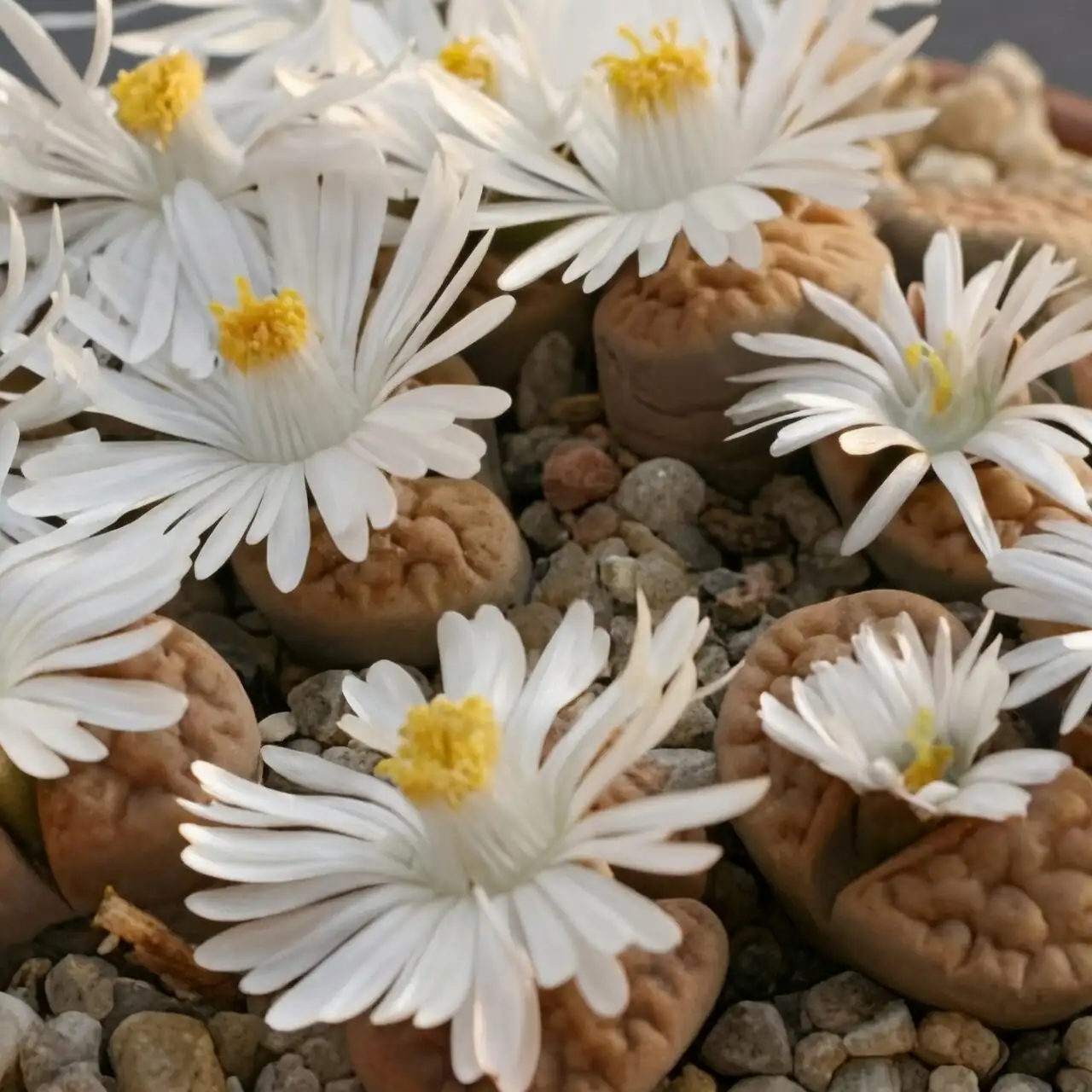
Imagine a plant so good at hiding that explorers once mistook it for a stone. Then the “pebble” blinked—opening a daisy-like flower from a neat fissure—and the world met Lithops, the Living Stones of southern Africa.
These miniature succulents perfected the art of camouflage on the gravel plains of Namibia and South Africa, evolving leaf-top “windows” and rainfall-timed rhythms to outlast heat, hunger, and drought. Today, they’re still playing the same quiet survival game—only now on our windowsills.
A stone that learned to hide: origins on Africa’s desert margins
Across southern Africa—especially Namibia and South Africa—Lithops occupy fierce, open country: stony flats, quartz-littered slopes, decomposed granite, and gravel beds so sun-bleached that anything green becomes a target. In this hard light, survival favors the inconspicuous.
- Stone-like camouflage: Their tops mirror local pebbles in grey-green, tan, and brown, speckled and marbled so precisely they vanish into the substrate. This “beauty in disguise” reduces grazing pressure and shields them from blistering sun.
- A broad but patchy native range: Most species are spread in widely separated, sparse colonies across arid and semi-arid zones of southern Africa, with a special richness in Namibia and South Africa.
Rain is erratic here—often arriving in brief pulses. Many Lithops experience rain mainly in spring and autumn; some coastal species, like the Lüderitz-area Lithops optica, also live with cool air and frequent fog. The unifying rule isn’t total rainfall but timing: Lithops tune growth and flowering to short, dependable windows of moisture.
Anatomy of invisibility: windows, patterns, and the two-leaf body
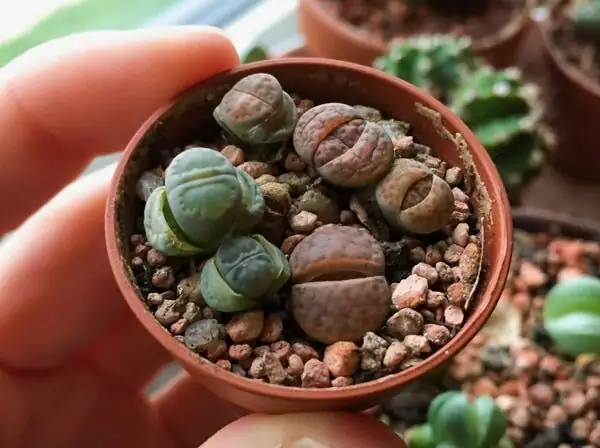
Strip a Lithops down to essentials and you find a single, ingenious module: two thick, fused leaves forming a small head just 1–4 cm across. That’s the whole plant—no showy stem, no leafy canopy—only a clever top and a slit between the lobes.
- Translucent “windows”: The upper surface often contains glassy panes that funnel sunlight into the interior tissues. Much of the body sits at or below soil level, so these windows let the plant photosynthesize while staying low and disguised.
- The central fissure: From this neat slit, autumn flowers burst like tiny suns—usually white, sometimes yellow. A single, surprisingly large, daisy-like bloom can seem far too generous for such a small plant.
- Leaf replacement: Each year a new pair of leaves grows within the old. As the season turns, the fresh pair swells, siphoning resources from the previous set, which shrivels into a papery shell. It’s a minimalist refresh, one set at a time.
The effect is part geological cosplay, part optical trick—patterning that echoes local rock, with internal skylights that power a slow, steady metabolism.
The rhythm of rain: timing life to moisture
In the wild, Lithops don’t sip constantly; they synchronize. To survive, they compress action into brief, favorable periods, then wait.
- Late summer to autumn: Peak time. New leaves mature and those signature flowers appear. In cultivation, cautious watering during this period supports growth and bloom—never soggy, always fast-draining.
- Heat of summer: Many Lithops slow down or rest. Shade lightly, increase airflow, and reduce watering sharply.
- Winter: Bright and mostly dry. Indoors, keep them warm and sunny; many growers aim to stay above about 12°C (54°F).
- Spring transition: The old leaf pair dries as the new pair takes over. This is the do-not-disturb moment—watering too soon can split the bodies and invite rot.
This seasonal poise is what makes them look “effortless” when we get the timing right—and unforgiving when we don’t.
The day the “pebble” bloomed: discovery and names
Lithops entered the botanical record in 1811, when explorer William John Burchell noticed a stone with a suspicious fissure near Prieska in South Africa’s Northern Cape. That “stone” turned out to be a succulent, and soon the genus had a name from Greek roots: lithos (stone) + opsis (appearance).
Local Afrikaans names paint an equally vivid picture: beeskloutjies (little cattle hoofprints), skaappootjies (sheep hoofprints)—apt for plants that really do resemble pressed steps in dusty ground. Today, collectors still pass pots back and forth hunting for varieties whose marbling recalls specific geologies—quartz, schist, or rust-tinted gravel—miniature landscapes at cup scale.
From desert to desk: keeping the illusion alive
Lithops are “easy” only when you adopt their rules: floodlit skies, ferocious drainage, and water delivered rarely and thoughtfully. Here’s how to echo the veld on a windowsill.
- Light
- Bright light to full sun; aim for 6+ hours of direct sun daily.
- Indoors, a south- or west-facing window is ideal. In extreme heat, provide light midday shade and strong airflow.
- Soil and pot
- Use a very fast-draining, gritty cactus/succulent mix with high mineral content (coarse sand, grit, pumice).
- Choose a small, shallow pot; a 7.5–10 cm pot suits one plant, and a 10–12 cm pot often holds 3–5.
- Decorative top-dressing stabilizes plants and completes the camouflage—just don’t trap moisture.
- Watering
- Let the mix dry completely; wait for slight wrinkling before a light drink, then let it dry fast again.
- Greatly reduce watering during hot summer rest.
- Late summer to autumn: water sparingly to support growth and flowering, never keeping the mix wet.
- Winter: keep mostly dry and bright.
- Critical: during leaf replacement, avoid watering until old leaves have largely dried.
- Temperature and humidity
- Best growth around 15–26°C (59–79°F). Protect from frost.
- Prefer low humidity and excellent ventilation; stagnant, damp air invites rot.
- Feeding
- Keep it light and infrequent. Options include a single very dilute balanced feed in autumn, or a very dilute, low-nitrogen cactus feed during active growth only—then stop for summer rest and winter.
- Troubleshooting
- Biggest risk: rot from overwatering or slow-draining soil.
- Pests to watch: mealybugs (including root mealybugs), aphids, and fungus gnats in damp mixes.
Evolution’s sleight of hand: why Lithops look like this
When sun sizzles and herbivores scour the ground, plants survive by being smaller, tougher, and less visible.
- Minimal surface, maximal storage: Two leaves, thick with water-storing tissue, present almost no vertical profile to desiccate.
- Sun without exposure: Translucent windows admit light while most of the photosynthetic surface hides below the soil crust.
- Pattern-matching: Local rock colors and speckling help break outlines; even keen eyes can miss them in the field.
- Patience as strategy: Slow growth, sparse clumping, and yearly leaf replacement economize energy and water.
These are not mere oddities—they’re case studies in adaptation, honed to desert tempo.
Meet a coastal outlier: fog-fed “rubies”
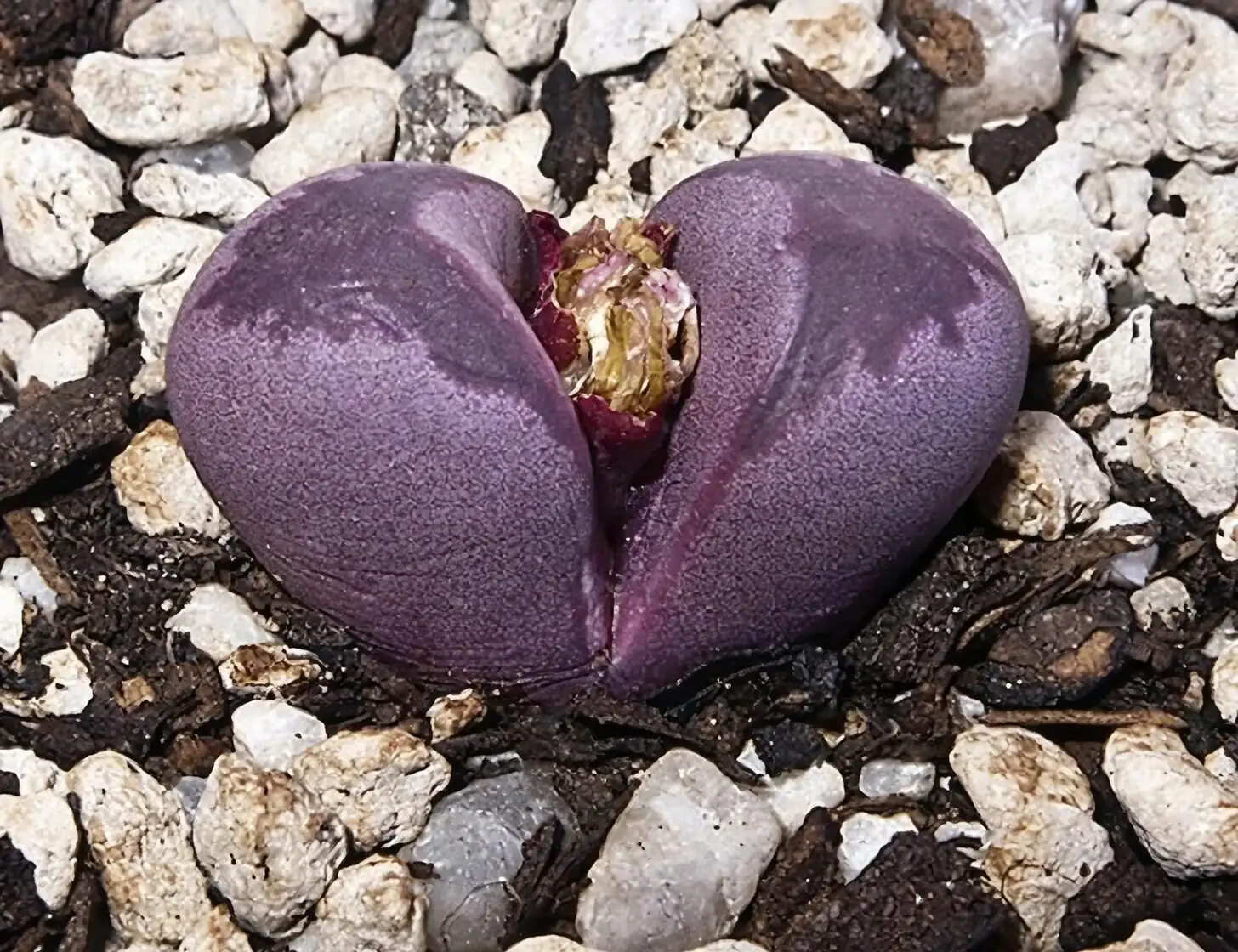
Along Namibia’s cool Atlantic fringe, Lithops optica grows among windblown sands and fog. A cultivated red selection, Lithops optica ‘Rubra,’ shows off ruby-toned windows and sides—proof that nature’s palette can be subtle or spectacular without abandoning survival’s blueprint. Its flowers are typically white, sometimes blushed at the tips, and appear in autumn like kindled sparks in sea-mist light.
Quick collector’s notes
- Size: Heads are tiny—about 1–4 cm across; plants clump slowly into small groups over time.
- Flowers: Autumn-blooming, daisy-like, commonly white; some species/cultivars bloom yellow. Seed-grown plants often take 2–3 years to reach flowering size.
- Hardiness: Tender. Suited to frost-free outdoor spots in mild climates (roughly USDA 10–11) and to bright indoor culture everywhere.
- Safety: Generally considered non-toxic to people and pets, but not edible; keep out of reach of curious nibblers.
Symbolism and “flower language” of Living Stones
If Lithops have a “flower language,” it’s a modern, collector-born one rather than an old folktale: resilience, quiet strength, and beauty in disguise. They thrive by seeming ordinary—just another pebble—then unfurl a luminous flower right when the year is thinning toward autumn. The deeper meaning isn’t about extravagance; it’s about timing, restraint, and the power of subtlety. They whisper that patience pays—that saving your bloom for the right season can be the most dazzling strategy of all.
Why they still captivate us
- They’re interactive: Miss a watering cue and you’ll learn quickly; match their rhythm and they reward you with impeccable form and improbable flowers.
- They’re pocket landscapes: A shallow dish can hold a lifetime of geology-inspired patterns.
- They’re conversation-starters: Few plants hide so well that you can “lose” them in their own top-dressing—until, one autumn afternoon, a daisy opens and the stone winks back.
From Namibia’s fog-laced gravel to a bright windowsill in your home, Lithops have journeyed without changing their rules. Respect their light, keep their feet dry, and let the seasons speak. The rest is a small miracle—two leaves, one window, and a flower where you least expect it.