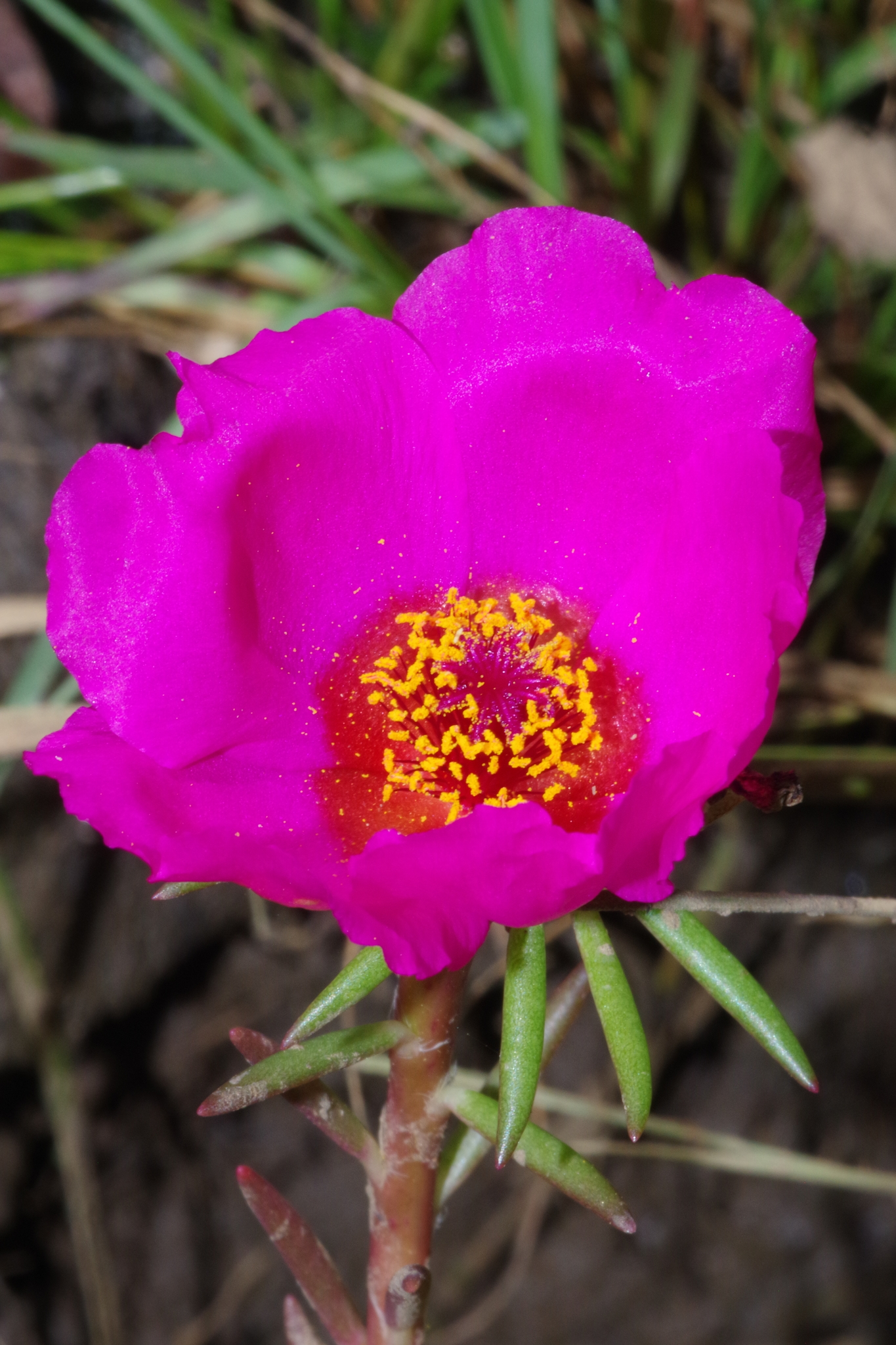

🌱 Plant Features
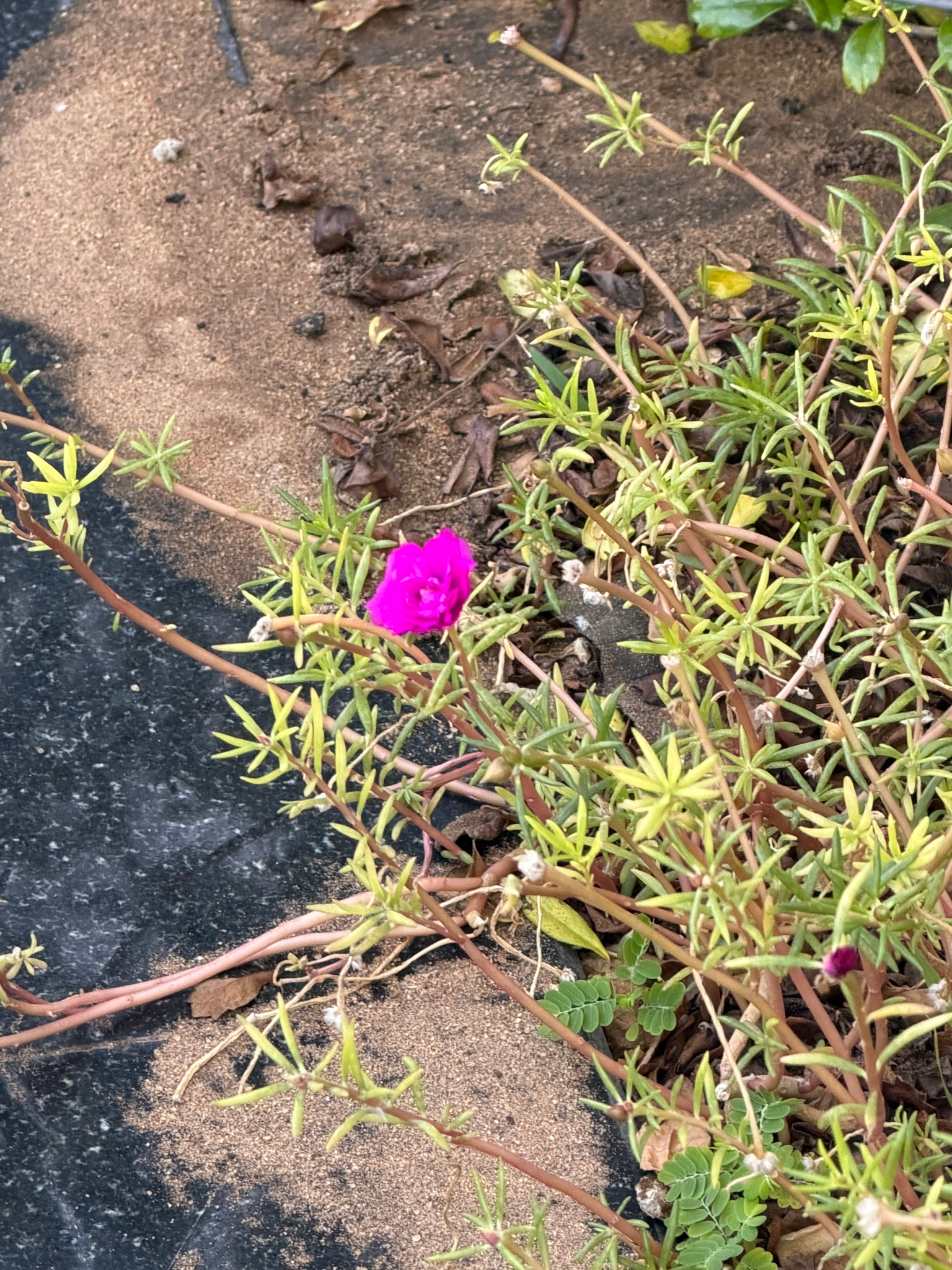
- Size:Grows about 15–30 cm (6–12 in) tall, spreading 30 cm (12 in) or more wide
- Foliage:Thick, fleshy, cylindrical leaves up to about 2.5 cm (1 in) long, arranged alternately or in small clusters. Leaves are typically green, sometimes showing reddish tints in strong sun or dry conditions.
- Flower:Bright, rose-like flowers about 2.5–5 cm (1–2 in) across with five petals in single forms, or fuller semi-double to double blooms in many cultivars. Colors range widely—red, orange, pink, yellow, white, and purple—often with slightly ruffled petals that resemble tiny roses.
- Flowering Season:Late spring through fall (approximately May–November), peaking in summer and early autumn
- Growth Habit:Low-growing, spreading/trailing, and many-branched. Stems are cylindrical and succulent, typically radiating from a central crown to form a dense mat.
🌤️ Environment
Sunlight
Full sun is essential—aim for at least 6–8 hours of direct light daily. Flowers open in strong sun and may stay closed in shade, cloudy weather, or at night.
Temperature
Best growth in warm to hot conditions around 20–30°C (70–85°F). Very heat-tolerant but frost-tender; plants collapse or die back with the first frost.
Humidity
Prefers dry air/low humidity. Handles drought well once established but dislikes persistently damp conditions.
Soil
Happy in lean, poor soils as long as drainage is excellent. Ideal is sandy or rocky, well-drained soil; consistently wet soil can lead to rot.
Placement
Sun-soaked spots: rock gardens, stone walls and cracks, borders/edging, containers, hanging baskets, and xeriscape beds.
Hardiness
Usually grown as an annual; can behave as a short-lived perennial in frost-free climates such as USDA Zones 10–11.
🪴 Care Guide
Difficulty
Very easy—one of the most beginner-friendly, low-maintenance sun plants.
Buying Guide
Pick plants with firm, succulent stems, healthy green foliage, visible buds, and no signs of pests, mushy spots, or rot (a common issue if plants were kept too wet).
Watering
Water deeply but infrequently. In hot weather, about once weekly is often enough; always let the soil dry between waterings. Overwatering is the fastest way to lose moss rose—wet soil can trigger root/stem rot. Containers may need slightly more frequent checks but should still dry well between waterings.
Fertilization
Usually unnecessary and can even reduce flowering if too rich. If you want to feed, use a balanced slow-release fertilizer at planting or a diluted liquid feed once or twice during the growing season. Avoid high-nitrogen formulas that push leafy growth at the expense of blooms.
Pruning
Minimal pruning. Blooms are generally self-cleaning, so deadheading isn’t required. A light trim can encourage bushier growth; in warm climates where it overwinters, a tidy-up in early spring helps refresh the plant.
Propagation
Very easy from seed or cuttings. Seeds: sow after the last frost; barely cover because light helps germination. At about 21–24°C (70–75°F), seeds often sprout in roughly 7–10 days. Cuttings: take about 10 cm (4 in) stem pieces, let them callus briefly, then place in lightly moist sandy mix; roots commonly form in about 10–15 days. It also self-seeds readily, so volunteers often appear next season.
Repotting
Repot container plants once roots fill the pot. Use a sharply draining mix (potting mix amended with sand/perlite) and always choose containers with drainage holes.
📅 Seasonal Care Calendar
Spring (Mar–May): sow seeds or take cuttings; transplant outdoors after last frost. Summer (Jun–Aug): peak bloom; water only during extended dry spells. Autumn (Sep–Nov): keeps blooming until frost; collect seed if desired. Winter (Dec–Feb): dies with frost in cold climates; may persist with slower growth in frost-free regions.
🔬 Pests, Diseases & Safety
Common Pests & Diseases
Generally trouble-free. Possible issues include aphids (often handled with a strong water spray or insecticidal soap) and occasional slug/snail damage. In wet, poorly drained conditions, it can suffer stem/root rots (including Pythium and Rhizoctonia) or Botrytis; prevention is mainly about sharp drainage, sun, airflow, and avoiding soggy soil.
Toxicity
Commonly regarded as non-toxic to people, though it isn’t considered an edible portulaca and may taste bitter. If pets nibble, mild stomach upset is possible—best to discourage grazing, especially in curious cats and dogs.
🎋 Culture & Symbolism
Symbolism:Often associated with resilience, warmth, happiness, and enduring love—its ability to bloom cheerfully through heat and dryness feels like a little lesson in perseverance.
History & Legends:Originally from South America, moss rose spread widely as an ornamental in the 18th–19th centuries. It’s famously at home in sunny, harsh microclimates—so much so that in some historic European neighborhoods (including parts of the Balkans) it’s been known to brighten cracks in old stonework and streets.
Uses:Primarily ornamental: groundcover, edging, rock gardens, containers, hanging baskets, and water-wise (xeriscape) planting. Its flowers provide nectar and pollen for bees. Not recommended for eating—unlike its relative common purslane (Portulaca oleracea), which is grown as an edible green.
❓ FAQ
Why won’t my moss rose bloom?
Almost always it’s not getting enough direct sun. Moss rose needs full sun (about 6–8+ hours) for strong flowering and for blooms to open. Too much water or high-nitrogen fertilizer can also reduce blooming.
Why do the flowers close at night or on cloudy days?
That’s normal. The flowers respond to light levels—opening in bright sun and closing in low light, evening, or cloudy weather.
Is moss rose an annual or a perennial?
In most climates it’s grown as an annual because frost kills it. In frost-free areas (often USDA Zones 10–11), it can behave like a short-lived perennial, and it also self-seeds readily.
How often should I water moss rose?
Less than most flowering plants. Water deeply, then let the mix dry. In summer heat, roughly once per week may be enough in the ground; pots may need checking more often, but avoid keeping them constantly moist.
Can I propagate moss rose from cuttings?
Yes—very easily. Take about 10 cm (4 in) stem cuttings, let them callus briefly, and root them in a lightly moist, sandy mix. They often root in about 10–15 days.
💡 Fun Facts
- Moss rose flowers famously open only in bright sunlight—hence the nickname “Eleven O’Clock” in some places.
- It’s not a true rose at all; the “rose” name comes from its ruffled, rose-like blooms.
- Moss rose is exceptionally drought-adapted and can withstand long dry spells once established.
- Its seeds are tiny—roughly about 8,400 seeds per gram.
- It’s known for an unusual photosynthetic flexibility (reported as using both C4 and CAM pathways), a rare combo that helps it cope with heat and drought.