

Ever done a double-take at a fuzzy succulent and thought… bear paw or panda? You’re not alone. Cotyledon tomentosa (Bear’s Paw) and Kalanchoe tomentosa (Panda Plant) are both velvety, both adorable, and both commonly mislabeled. The good news: once you know what to look for, you can tell them apart in seconds—no microscope required.
The fastest tell: paws vs. panda
- Bear’s Paw (Cotyledon tomentosa): chubby, paw-shaped leaves with 3–8 little “toes” (notches) at the tip—often blushed red in strong light like tiny claws.
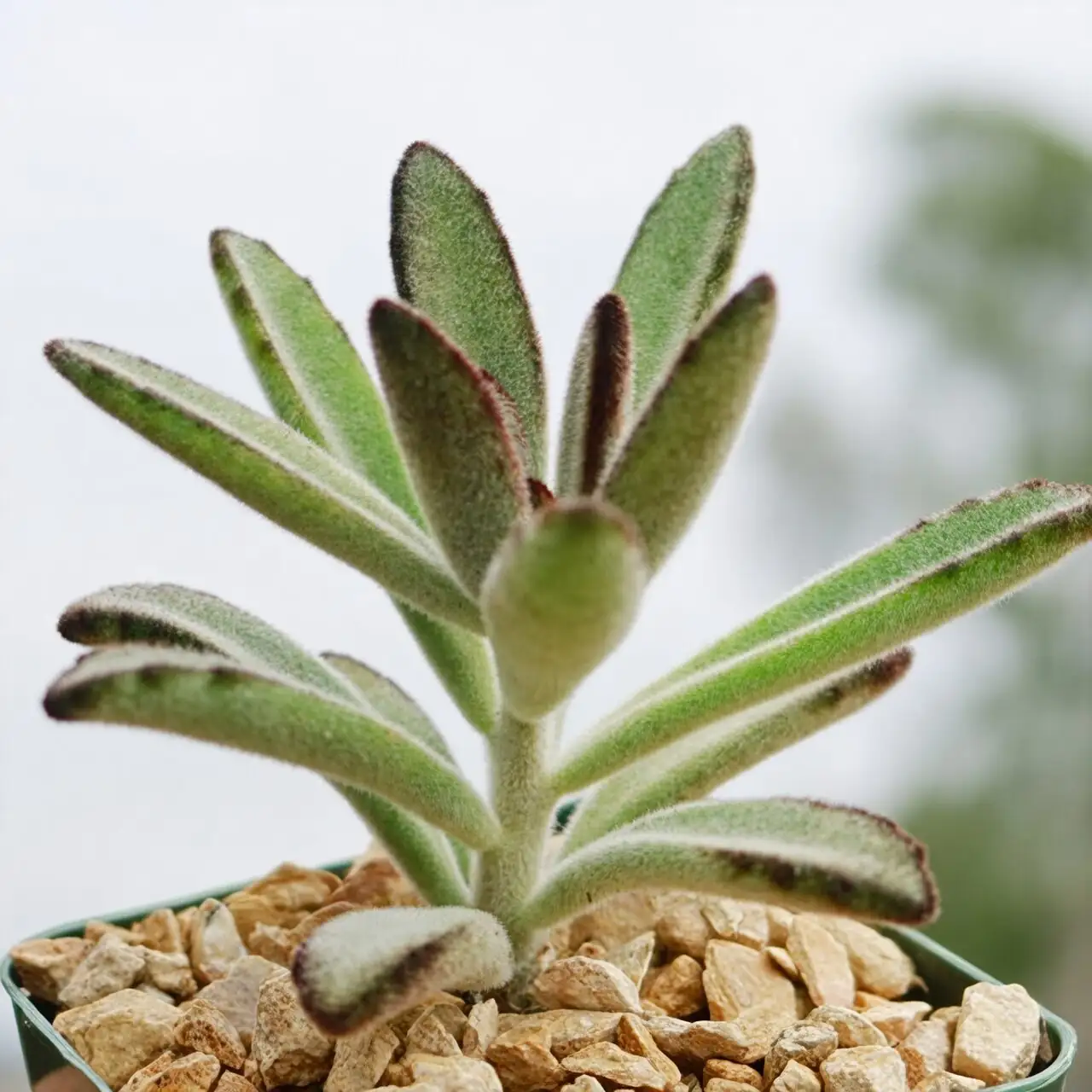
- Panda Plant (Kalanchoe tomentosa): narrower, spoon-to-strap-shaped leaves with smooth tips and chocolate-brown edging or spotting; no paw notches.
Think “round paws with claws” versus “narrow felted leaves with dark trims.”
Leaf clues you can spot across the room
Cotyledon tomentosa (Bear’s Paw)
- Leaves: plump, oval to oblong, distinctly notched at the tip; short, velvety hairs give a soft grey-green look.
- Color cue: in bright light, leaf tips/edges blush red, accenting those “claws.”
- Overall vibe: chunky, toy-like paws.
Kalanchoe tomentosa (Panda Plant)
- Leaves: longer and thinner, felted silver-grey to minty; margins usually traced with brown/rusty markings.
- Tips: typically smooth, not notched.
- Overall vibe: elegant, fuzzy paddles with dark hems.
Growth habit: how each plant “builds” itself
- Bear’s Paw: a compact, branching mini-shrub. In containers it’s commonly 10–20 cm tall (older plants can reach 20–50 cm over time, especially if light is weaker). Short internodes keep it looking bushy—unless light is low, when it can stretch.
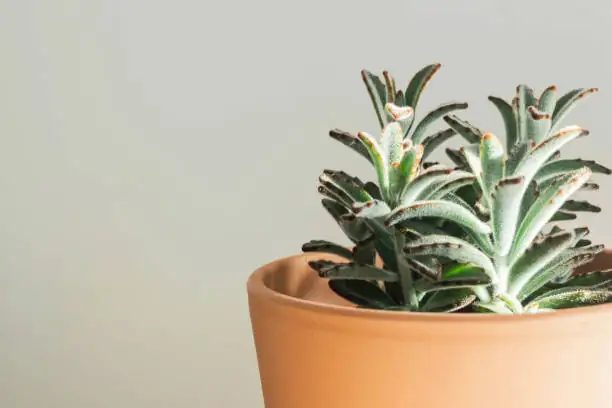
- Panda Plant: tends to grow taller and more cane-like, often with leaves clustered toward stem tips; older plants can look like fuzzy mini-trees.
Pro tip: If your fuzzy plant is already 30–40+ cm tall, sparsely branched, with slender leaves and dark margins, it’s almost certainly Panda Plant.
Flower differences (when you’re lucky enough to see them)
- Bear’s Paw (Cotyledon): small tubular, bell-like flowers in warm tones—orange, coral, or orange-red—held on upright stems above the foliage. More likely with strong light plus a cooler, drier rest; often in spring and/or late summer to autumn depending on conditions. Flower parts are typically in fives.
- Panda Plant (Kalanchoe): flowers are relatively modest—often greenish to yellowish with brownish markings—and far less commonly seen indoors. In Kalanchoe, flower parts are typically in fours.
A botanist’s shortcut: count the corolla lobes—5 points to Cotyledon, 4 to Kalanchoe.
Genus-level cues (when labels are missing or confusing)
- Where they’re from:
- Cotyledon tomentosa: Southern Africa (especially South Africa).
- Kalanchoe tomentosa: Madagascar.
- Bloom architecture:
- Cotyledon: bell-like tubular flowers with a warm palette and a “chunkier” look.
- Kalanchoe: usually narrower 4-merous tubes; often subtler colors.
- Safety note:
- Bear’s Paw: toxicity is not consistently documented; treat as potentially irritating/toxic if ingested.
- Panda Plant: commonly listed as toxic to pets—best kept out of reach.
Naming trap to know: Kalanchoe tomentosa cultivars like ‘Teddy Bear’ and ‘Chocolate Soldier’ add to the confusion. “Teddy Bear” is a Panda Plant nickname, but the true “Bear’s Paw” is Cotyledon tomentosa.
One-glance checklist
- Tip notches like toes (often red): Cotyledon tomentosa.
- Smooth, narrow leaves with brown edging: Kalanchoe tomentosa.
- Compact, bushy mini-shrub: Cotyledon.
- Taller, cane-like with leaves bunched at tips: Kalanchoe.
- Warm orange/coral, bell-like flowers (5 lobes): Cotyledon.
- Pale, modest flowers (4 lobes) and rarely seen indoors: Kalanchoe.
Tricky exceptions (and how to outsmart them)
- Toothless bear paws? There’s a recognized subspecies, Cotyledon tomentosa subsp. ladismithiensis, with longer, more cylindrical leaves that often lack the “toes.” In that case, rely on habit (compact, branching shrub) and flowers (5-parted, warm-toned bells) to clinch the ID.
- Young or low-light plants: Bear’s Paw might show weak or no red “claws” until it gets stronger light. Panda Plant’s brown edging is usually visible regardless of light.
- Variegation: Variegated Bear’s Paw grows slower and can be more sun-sensitive; the leaf shape and notches still tell the story.
Snap-care notes once you’ve confirmed Bear’s Paw (Cotyledon tomentosa)
- Light: bright light with several hours of sun for best shape and red-tipped “claws.” Morning sun plus bright indirect light later is ideal; protect from harsh midday/afternoon scorch in hot climates and acclimate gradually.
- Water: use soak-and-dry; let the mix dry well between waterings. Keep leaves dry—avoid misting, which can spot the fuzz and invite rot. In winter, keep almost dry, watering only if leaves begin to wrinkle.
- Soil: very well-draining succulent mix—think a roughly 1:1 blend of potting soil and mineral grit (pumice, perlite, coarse sand), in a pot with drainage.
- Temperature: best around 18–24°C (64–75°F); keep above 10°C (50°F). Not frost hardy (generally suited to USDA 10–11).
- Shape-up tips: pinch at ~15 cm (6 in) to encourage branching; refresh older, leggy plants from firm tip cuttings in spring or autumn.
Bloom nudge: a bright growing season followed by a cooler, drier rest often rewards you with those warm, bell-like flowers.
A note on symbolism
Bear’s Paw is often treated as a symbol of comfort, warmth, and playful companionship—a reputation born from its irresistibly paw-like leaves rather than any long-standing folklore. It’s the plant-world equivalent of a cozy hug: small, fuzzy, and cheering up a windowsill just by being there.
Ready for the field test? If you can spot “toes,” you’ve got the bear. If you see narrow, chocolate-trimmed paddles, you’ve got the panda. Either way, you win a delightfully fuzzy friend.