

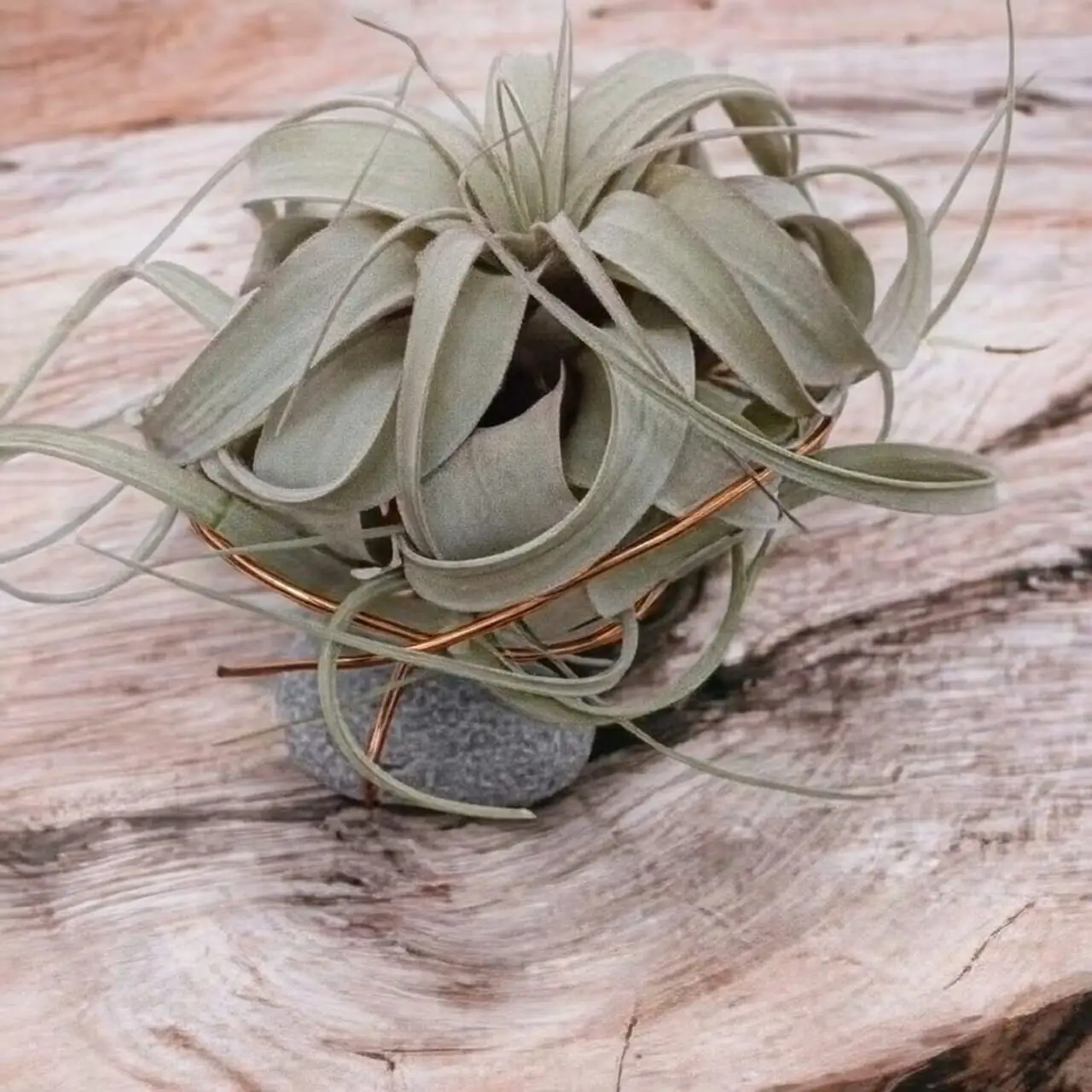
If a single plant could anchor a room like a piece of sculpture, it’s Tillandsia xerographica—the “King of the Air Plants.” Its broad, silvery ribbons curl into a poised rosette that begs to be placed on a plinth, perched on a slab of stone, or suspended like a modern mobile. The secret to turning this star into a gallery-worthy vignette is choosing companions that share its light and airflow needs, spacing them smartly, and watering with an artist’s restraint so no droplets linger in hidden folds. Here’s how to curate living displays that look exquisite and thrive for the long run.
Meet the star: form, feel, and rhythm
- Origin and persona: Native to dry forests and rocky slopes of southern Mexico, Guatemala, El Salvador, and Honduras, this rosette-forming epiphyte wears dense silvery trichomes (leaf scales) that help it capture moisture and shrug off bright, dry air.
- Scale and silhouette: 6–24 inches (15–60 cm) across at maturity; the flower spike can tower 12–35 inches (30–90 cm) and bears petite purple tubular blooms. After blooming, the mother slowly fades while producing “pups.”
- Light it loves: Bright light with some direct sun, such as an east window or filtered midday sun near a south window. Avoid deep shade and harsh, prolonged midday scorch.
- Big-picture care: Moderate humidity with strong airflow; no soil; fast dry-down after any watering. This species generally wants less water than many Tillandsia—think thorough misting, not long soaks.
Curating companions: plants that play beautifully with the King
Think of T. xerographica as your focal piece. Surround it with “supporting actors” that share its needs and contrast in shape or scale.
Choose by climate profile (compatibility first)
Prefer xeric-leaning Tillandsia that relish brightness and quick drying:
- Tillandsia ionantha (small, colorful rosettes; great as seasonal “pops” around the King)
- Tillandsia caput-medusae (sinuous leaves for a dynamic, sculptural counterpoint)
- Tillandsia harrisii (soft-silver, forgiving, harmonizes in tone)
- Tillandsia juncea (upright, grassy spires to add height and rhythm)
- Tillandsia streptophylla (curly, cloud-like—pairs well if your watering is light and airflow strong)
Use caution with moisture-loving mesic species (for example, bulbosa) that prefer heavier hydration; they can push you toward wetter routines the King dislikes. Extremely silver species like T. tectorum want even less water—either give them a drier “wing” of the display or stage them separately.
Scale, spacing, and breathing room
- Give the King space: Leave a 2–3 inch (5–8 cm) halo around the rosette so leaves can curl freely and air can move.
- Layer heights: Place taller, narrow species (juncea) behind or to one side; nestle small rosettes (ionantha) at the fore or in negative space between curls—never jammed under the King’s skirt.
- Plan for tomorrow: Expect pups and a potential 12–35 inch (30–90 cm) bloom spike. Reserve vertical clearance so the scene can evolve without crowding.
Light choreography for shared displays
- Aim for bright, open light with a splash of gentle sun: East windows are ideal; at a south window, diffuse midday rays with a sheer curtain.
- Avoid shadowing: A large xerographica can shade smaller companions. Use risers, pedestals, or driftwood branches to tier your vignette so every plant sees the sky.
- Rotate weekly: Quarter-turn the grouping so each side stays firm and silvery rather than softer and green from under-lighting.
Watering as a set: no traps, fast dry
The King’s rule: generous misting, then a complete dry within about 4 hours.

The practical routine
- Morning mist: Thoroughly mist all surfaces until the leaves glisten. In very dry homes, give the King an occasional 5–10 second rinse—but avoid long soaks unless severely dehydrated.
- Dry-down matters most: Use a fan’s gentle sweep or crack a window. The entire display should breathe; stagnant air is the fast track to rot.
- Drain the heart: After misting or a quick rinse, tip the rosette and let any hidden water escape. Never leave water pooled deep in the plant.
- Mixed-needs solution: If a companion prefers more water, remove it for a separate soak and return only when fully dry.
Mounts and materials that prevent moisture pockets
- Choose airflow-first bases: Grapewood, cork bark, cholla wood, or metal mesh stands give lift and ventilation.
- Keep it soil-free: Avoid packed moss, wet substrates, or containers that stay damp.
- Glass with caution: Terrarium-style pieces work only with wide openings and strong airflow. Closed globes and narrow-neck vessels trap humidity—reserve them for very brief styling or skip them entirely for the King.
- Smart fastening: Use plant-safe waterproof glue in tiny dots or clear fishing line, anchoring around the leaf bases—not sealing the plant’s core or smothering its underside.
Designing gallery-worthy vignettes
Composition that reads like art
- Odd numbers win: Group in threes or fives with one clear focal (the King).
- Build a skyline: Mix one broad rosette (xerographica), one vertical accent (juncea), and one compact piece (ionantha) for balance.
- Embrace negative space: Let shadows and the arc of leaves create breathing room—resist the urge to fill every gap.
Materials and mood
- Minimalist modern: Silver foliage on a dark stone plinth or matte black ceramic makes the trichomes glow.
- Organic sculptural: Driftwood or cork “branches” echo the plant’s native perches and add movement.
- Color cues: Pair silvers with a single accent hue (a small terracotta, soft sage ceramic, or muted sand). If using decorative sand or pebbles, keep them dry and free-draining—never a moisture catchment.
Seasonal switch-outs
- Spring–summer: Brighter light, slightly more frequent misting, and a rotating cast of blooming ionantha for color hits.
- Fall–winter: Reduce watering, maximize light, and lean into texture (stone, wood) while keeping air moving and dry-down quick.
Long-term harmony: bloom, pups, and redesign
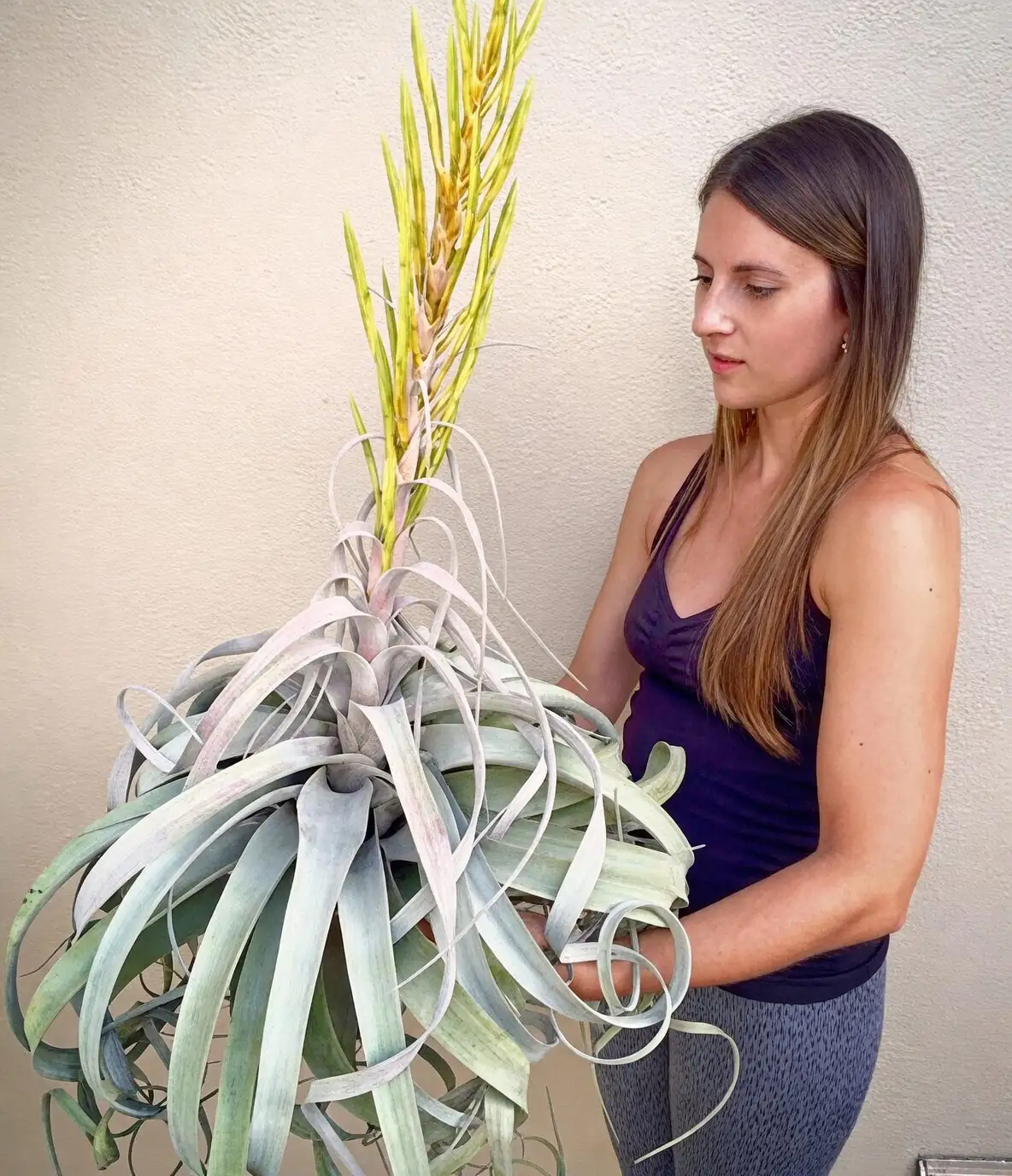
- Bloom etiquette: Enjoy the long-lasting spike with purple flowers. Don’t trim the mother rosette down afterward; she’ll gradually pass the baton to pups.
- Pups strategy: For a fuller sculpture, leave pups attached and let a clump develop. For a crisp, minimalist silhouette, separate when pups reach about one-third to one-half the mother’s size and restage with fresh spacing.
- Future-proofing: As your clump grows, remount or shift to a larger holder—tight containers limit airflow and invite problems.
Quick care compatibility checklist
- Light: Bright, with some direct sun; avoid deep shade and harsh, prolonged midday scorch.
- Air: Excellent ventilation is nonnegotiable—especially in groupings.
- Water: Mist thoroughly; ensure complete dry within ~4 hours. The King wants less water than many Tillandsia. Morning is best.
- Spacing: Maintain 2–3 inches (5–8 cm) of clearance; keep cores angled to drain.
- Temperature: 59–86°F (15–30°C). Protect below 50°F (10°C); frost-free only.
- Humidity: Moderate (around 40–60%) works well when airflow is strong.
- Feeding: Very light—bromeliad/air-plant fertilizer at 1/4 strength every 2–4 weeks in active growth; rinse with plain water occasionally.
- Grooming: Remove only fully dry, dead outer leaves. No leaf shine sprays.
- Pests: Watch for mealybugs and scale; dab with 70% isopropyl alcohol. Avoid oil-heavy products.
- Safety: Generally non-toxic to people and pets.
FAQs for curated sets
Can I display a xerographica with companions in a glass terrarium?
Only if it’s very well ventilated with a large opening and strong airflow. Closed or narrow-neck glass traps humidity and slows dry-down—high rot risk for the King.
How close can I place companions?
Leave at least 2–3 inches (5–8 cm) around the xerographica’s rosette. Stagger heights so foliage doesn’t overlap and trap water.
How often should I mist a mixed display?
In bright, airy indoor conditions, mist thoroughly about 1–3 times per week, adjusting seasonally. Always prioritize a complete dry within roughly 4 hours.
Can I fertilize a whole vignette at once?
Yes—mist with a bromeliad/air-plant fertilizer at 1/4 strength every 2–4 weeks during active growth, then occasionally rinse with plain water to prevent mineral buildup on leaves and display surfaces.
Why are some leaf tips browning?
Usually very dry air, inconsistent watering, or mineral-heavy water. Try slightly more frequent misting, use rain or filtered water, and keep bright light with strong airflow.
Symbolism sidebar: why this plant feels like modern art
Tillandsia xerographica is often linked with independence and resilience—a living sculpture that thrives without soil and asks for light, air, and a quick drink. While “flower language” traditions don’t formally assign meanings to air plants, contemporary design culture has embraced the King as an emblem of minimalist beauty and self-sufficiency. Displayed on a pedestal or hovering on airy wood, it reads like a manifesto: less fuss, more presence.
Curate with that spirit—clean lines, breathing space, and a shared microclimate—and your xerographica-centered vignette won’t just survive; it will set the room’s tone.