

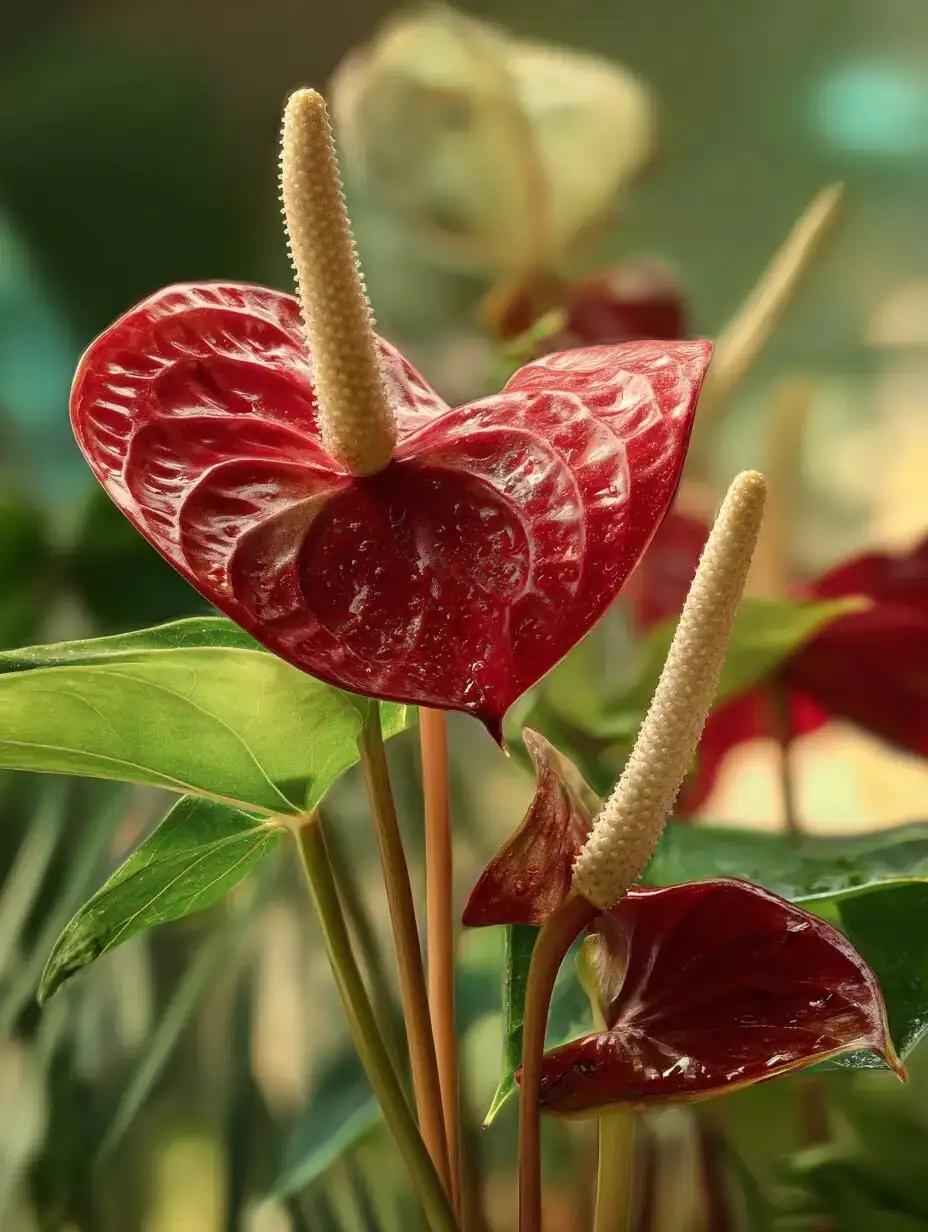
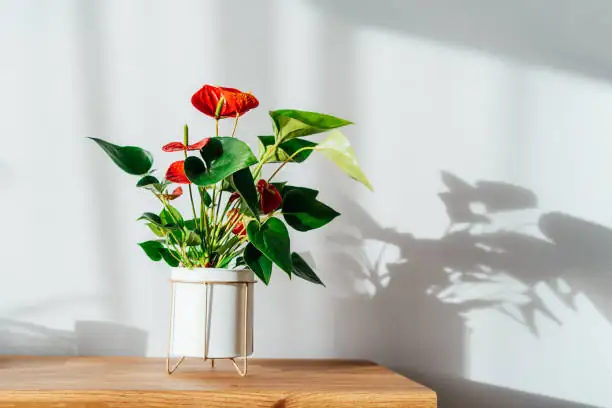
If plants threw costume parties, Anthurium andraeanum would win best disguise every time. Those glossy, heart-shaped “blooms” lighting up your living room? They’re not flowers at all—but a botanical magic trick perfected over millions of years in the tropical rainforests of Colombia and Ecuador.
That “flower” is a cunning leaf in costume
- The star of the show is a spathe—a single, waxy, brilliantly colored bract (a modified leaf). It’s most commonly red, pink, or white, but can be burgundy, green, or even bicolored.
- The true flowers are tiny and packed by the hundreds on the finger-like spike called the spadix, which pairs with the spathe like an exclamation point beside a heart.
- Why the costume? Color grabs attention—pollinators see a billboard, not a bulletin board—so the spathe acts like a neon sign directing them to the actual flowers.
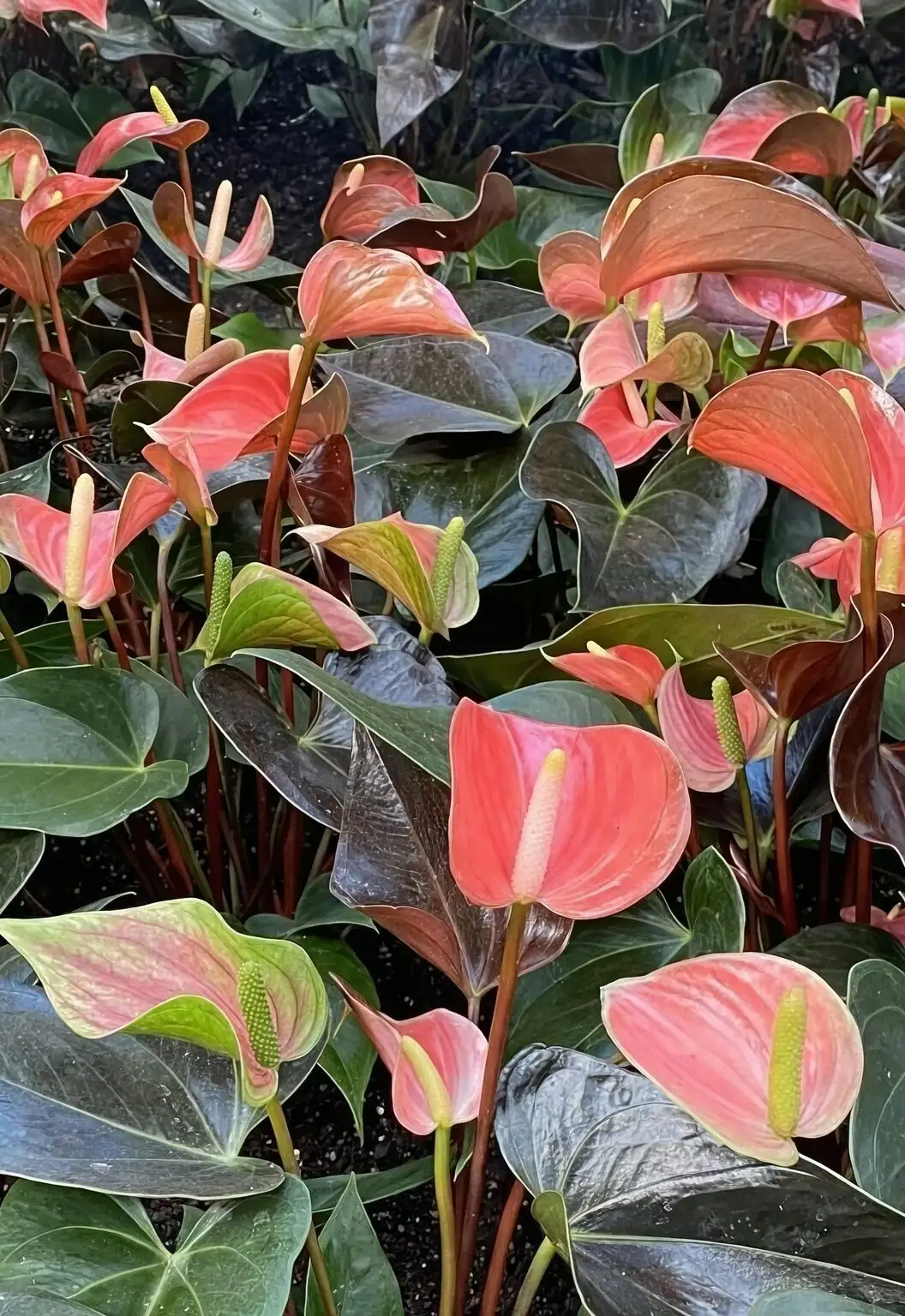
Fun payoff: Because a spathe is a leaf, not a delicate petal, it ages slowly and stays beautiful for weeks—one reason Flamingo Flower is a global cut-flower staple.
Meet the spadix: a conveyor belt of tiny flowers
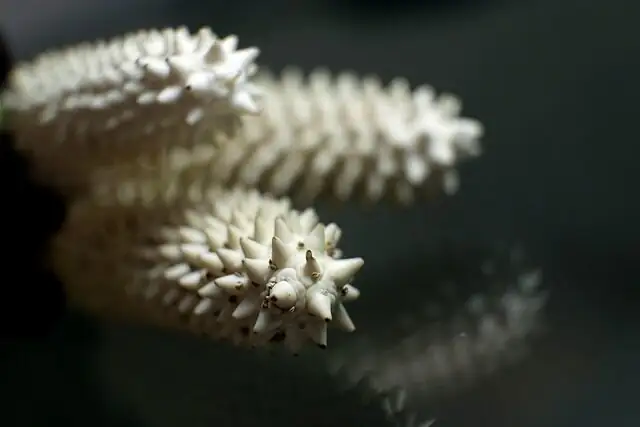
Look closely and you’ll notice the spadix is studded with minuscule flowers in spiral ranks. They don’t all “turn on” at once. Instead, Anthurium runs a carefully timed dance called protogyny: each tiny, bisexual flower is female first, then male.
- Female phase (the receptive window): Flowers ooze microscopic sticky droplets on their stigmas—like the plant holding out its hands for pollen. Indoors, you can sometimes spot a subtle sheen on the spadix.
- Male phase (the pollen party): A day or two later (timing varies by cultivar and conditions), those same flowers dust off pollen. The shift often moves like a wave along the spadix.
- Why the choreography? It’s brilliant anti-selfing engineering—by separating the female and male phases in time, the plant nudges cross-pollination, which boosts genetic diversity.
Nerdy home experiment:
- Watch for the female-phase “gleam” on one spadix, then—using a clean, dry paintbrush—collect pollen from a different spadix that’s already in its male phase and dab it on. If pollination succeeds, the spadix may swell into bead-like berries over coming weeks. It’s rare indoors, but possible with patience.
Pollination plot twists: who’s doing the matchmaking?
In the wild, Anthurium species are irresistible to a range of tiny visitors:
- Scent-seeking euglossine bees, certain flies, and even derelomine flower weevils have all been documented ferrying pollen among Anthurium species.
- Some aroids famously warm their spadices to turbocharge scent dispersal (hello, Titan Arum), boosting pollinator attendance. While not all Anthuriums heat up dramatically, the family’s trick box is full of sensory lures—color, texture, and fragrance that shiftingly appears during the female and male phases.
Indoors, you’re more likely to have a private show than a wild pollinator parade. That said, the inflorescence still runs through its phases; if you look closely, you can witness the entire mini-drama on your windowsill.
Why the show lasts so long (and why florists love it)
- The spathe’s surface is thick and waxy, with fewer delicate tissues than a typical petal—translation: low water loss and impressive staying power.
- The spadix staggers its flower maturation, so the inflorescence remains interesting over time.
- Plants can rebloom repeatedly under warm, bright, humid indoor conditions, keeping the color coming for months on end.
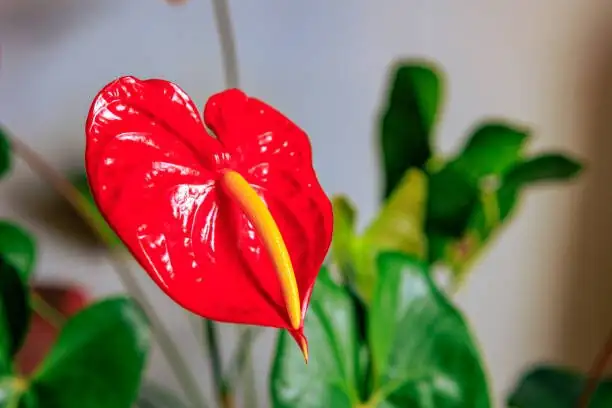
No surprise: Anthurium andraeanum is one of the world’s most important tropical cut flowers.
Quirks that delight plant nerds
- Spirals you can see: On some spadices, the tiny flowers are arranged in elegant, visible spirals—nature’s Fibonacci vibes in miniature.
- Color shifts with age: Many spathes deepen or take on a greenish cast as they mature. Not a problem—just normal aging.
- Bicolored spadices: The spadix itself can be white, green, pink, pale purple, red-brown, or even bicolored depending on cultivar and stage.
- Aerial roots on patrol: Mature plants often push aerial roots near the surface. You can top-dress them with moist sphagnum to boost humidity right where the plant wants it.
- Water-culture friendly: Yes, you can grow Flamingo Flower with its roots in water. Keep only the lower roots submerged, refresh weekly, and add a light hydroponic nutrient.
Care, but make it science (quick, precise, and proven)
Light
- Bright, indirect light to light shade. East windows are ideal; a sheer-curtained south/west window a few feet back also works.
- More filtered light = better flowering. Harsh midday sun can scorch.
Temperature
- Sweet spot: 20–30°C (68–86°F) for peak performance; still happy around 16–24°C (61–75°F).
- Keep above 15°C (59°F). Below about 13°C (55°F), chilling damage and bloom stalls can occur.
Humidity and airflow
- Aim for 50–60%+ relative humidity with gentle air movement.
- Humidifier or pebble tray helps; if misting, do it early and avoid wet leaves at night.
Soil and potting
- Use an airy aroid mix that never compacts: bark + coco coir/peat + perlite is excellent, or mix general potting soil 1:1 with orchid bark.
- Keep the crown at or slightly above the substrate; let aerial roots breathe at the surface.
Watering
- Evenly moist, not soggy. Water when the top 2–3 cm (about 1 in) is just dry; soak and drain thoroughly.
- In warm, fast-drying conditions this might be every few days; in winter, less. Water during the warmer part of the day (roughly 9 a.m.–4 p.m.) to reduce cold stress.
Feeding
- Spring–summer: feed every 2 weeks with a diluted liquid fertilizer; balanced to bloom-leaning works well—higher potassium formulas (e.g., 20-8-20) at half strength are favorites.
- Autumn–winter: reduce frequency.
Grooming and reblooming
- Snip off spent spathes and yellowing or crowded leaves at the base with clean scissors to tidy and redirect energy into new growth.
- Steady warmth, bright filtered light, and humidity are your bloom trifecta.
Repotting and propagation
- Repot every 2–3 years or when root-bound; common pot sizes range 12.5–20 cm (5–8 in).
- Division is the most reliable home method: split off a clump with its own roots (3+ leaves is ideal) and pot in fresh airy mix.
- Advanced growers can root stem sections with nodes in moist sphagnum; new roots often form in 20–30 days.
Tiny troubleshooting
- Leaves turning yellow? Most often overwatering or poor drainage. Let the top 1 inch dry, then water thoroughly; ensure a chunky, free-draining mix.
- Fewer flowers in winter? Light and warmth dip. Move to brighter indirect light and keep temperatures above 15°C (59°F).
- Pests to watch: Spider mites, mealybugs, scale, and thrips. Treat early with insecticidal soap or horticultural oil and improve airflow. Avoid wet foliage at night to deter fungal leaf spots.
Safety check
Flamingo Flower is beautiful but not snackable. Its sap contains insoluble calcium oxalate crystals that can irritate skin and cause mouth and throat discomfort if chewed by people or pets (especially cats and dogs). Keep it out of reach; wear gloves if you’re sensitive.
Symbolism with roots
Anthurium is often gifted as a token of hospitality, confidence, warmth, and lasting love. The meaning isn’t ancient folklore so much as a modern reading of its features:
- Heart-like spathes suggest affection.
- Upright, enduring spadix-and-spathe displays echo steadfastness.
- Long-lasting “blooms” naturally symbolize longevity and commitment.
It’s plant language grounded in observation rather than myth—and it suits a houseplant that keeps shining for weeks.
Quick stats for the curious
- Botanical name: Anthurium andraeanum
- Common names: Flamingo Flower, Anthurium, Laceleaf, Painter’s Palette, Tailflower
- Family: Araceae (the aroids)
- Origin: Colombia and Ecuador; now grown worldwide indoors and as a cut flower
- Habit and size indoors: Upright, clump-forming evergreen perennial; typically 30–60 cm tall and wide (many houseplants around 45 × 30 cm)
- Foliage: Glossy, deep green, heart- to arrow-shaped leaves on upright petioles
- Inflorescence: Waxy spathe in reds, pinks, whites, burgundies, greens, or bicolors; spadix in white, green, pink, red-brown, pale purple, or bicolored
- Flowering season: On and off year-round indoors with warm, bright, humid conditions
- Placement: Near bright east/north windows or set back from stronger exposures behind a sheer curtain; bright bathrooms are great
- Hardiness: Frost tender; outdoors year-round only in very warm climates (roughly USDA 11–12)
Bonus: a breeder’s-eye wink
Modern breeding has dialed in compact, free-branching plants with extra-colorful, extra-durable spathes—perfect for tabletops and windowsills. Many new cultivars keep the sciencey charm (that spadix still runs its female-to-male marathon) while being even more generous with repeat “blooms.”
In short: Your Anthurium is a masterclass in plant engineering wrapped in a shiny red heart. Once you see the spadix-and-spathe duet for what it really is, you’ll never look at that “flower” the same way again—and you’ll have a lot more fun watching it.