


If you’ve ever paused before a “mini sago palm” on a market stall—shiny fronds like a perfectly combed fountain atop a stout, pet-like trunk—you’ve met a plant that carries centuries of meaning on its armored shoulders. Cycas revoluta is not a true palm at all, but a cycad, a living fossil from a lineage older than flowering plants themselves. In East Asia, its “flower language” (a poetic shorthand for plant symbolism) circles three ideas: resilience, longevity, and prosperity. Where did these meanings come from? Follow the iron thread in its name, the evergreen form that never seems to tire, the rare thrill of a cone, and its place in feng shui and gift-giving, and the story snaps into focus.
From sotetsu to sūtiě: the “iron” that forged a meaning
In Japan, this species is known as sotetsu; in Chinese it’s commonly called 苏铁 (sūtiě)—literally “revive” + “iron.” Whether the characters began as a phonetic borrowing or a poetic descriptor, the idea of “iron” stuck, and with it a temperament:
- Iron-spined presence: The plant builds a hard, stocky trunk (caudex) that feels almost engineered, and its fronds are stiff and impeccably ordered. “Iron” became shorthand for toughness and steadiness.
- Evergreen resolve: Those feather-like leaves remain richly green year-round, even in shadier nooks, projecting stamina and staying power.
- Slow and sure: Growth is deliberate, not flashy—one tidy flush of new fronds, then a long, unhurried pause. Patience and composure became part of its persona.
Together, the “iron” name and evergreen habit naturally seeded the idea of resilience (a will that doesn’t bend), while its slow, steady, extraordinarily long life speaks to longevity.

Evergreen poise and the promise of longevity
Native to the warm islands of southern Japan, including the Ryukyu chain, Cycas revoluta brings an ancient calm to modern spaces. It grows very slowly, forming a compact, upright silhouette with a rosette of glossy fronds atop a stout caudex. Cared for well, a single plant can remain with a household for decades—and in ideal conditions, much longer.
This is why, in the language of East Asian ornament and gifting, it stands for long life. A plant that outlasts fads and furniture, witnessing the ebb and flow of family life, feels almost ancestor-like—quietly present, evergreen, and enduring.
The rarity of cones, and why prosperity is in the air
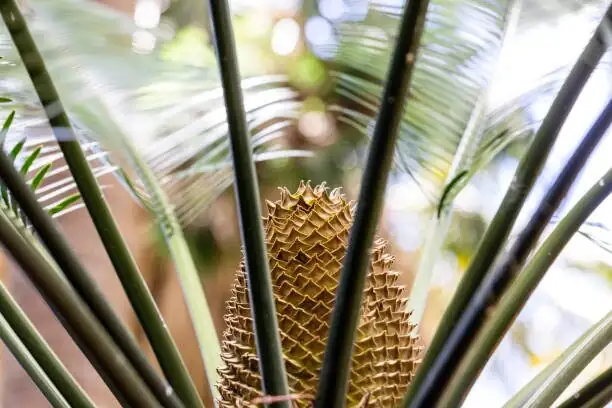
Cycas revoluta doesn’t “flower” in the typical sense. It’s dioecious: male and female cones appear on separate plants, usually in summer. In home and office settings—where plants are often young, container-bound, and pruned for neatness—coning tends to be infrequent. When a mature specimen finally crowns itself with a cone, the moment lands like a small celebration.

- In practice: The cone’s arrival often coincides with peak vigor and good care—conditions that also align with life’s “lucky streaks.”
- In meaning: That sudden, showy center-stage cone reads as bounty, ripeness, and culmination—hence its tie to prosperity. Offsets (“pups”) that periodically appear at the base reinforce this theme of increase and continuity.
Feng shui: guiding where resilience takes root
Within feng shui traditions, sago palm is treated as an auspicious Wood-element plant with an active, upright energy. Practitioners often recommend:
- Directional emphasis: East (and sometimes Southeast) to support family harmony, growth, and new beginnings.
- What it’s meant to boost:
- Growth and vitality (Wood element’s upward, renewing force)
- Stability and steady progress (that “iron” backbone in plant form)
- Resilience through challenges (evergreen stamina)
- Placement tips:
- Choose a bright, airy spot with good ventilation; avoid dark corners and cold drafts.
- Keep it out of bedrooms and kitchens in feng shui practice.
- Use natural-toned, well-drained containers that feel grounded and calm.
- Above all, keep it healthy—vibrant plants are thought to circulate supportive qi more effectively.
Note: Feng shui is a cultural practice. Whether or not you follow it, these cues dovetail smartly with good horticulture and the plant’s traditional symbolism.
Gift-giving: messages to send (and care notes to tuck in)
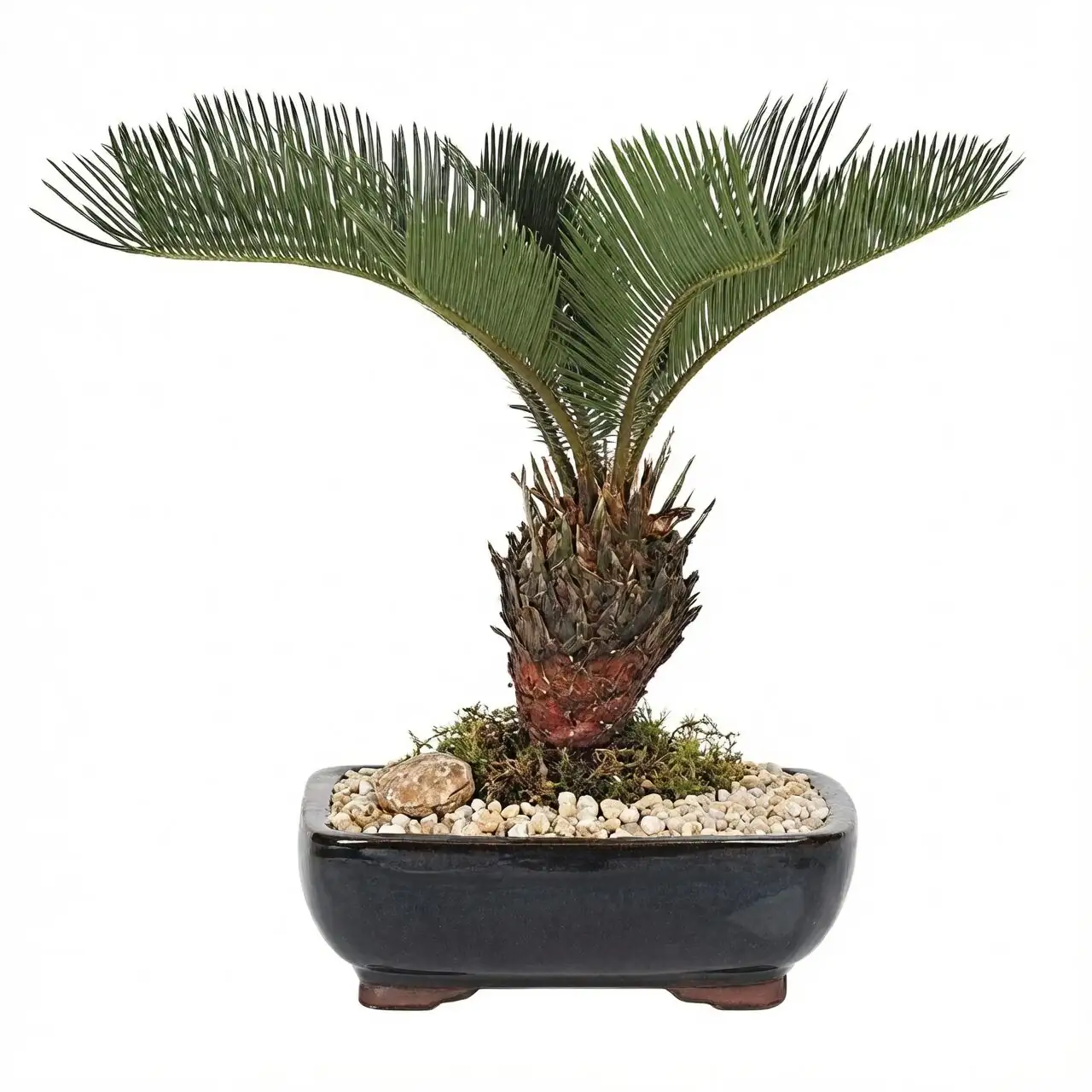
A bonsai-style sago palm makes a memorable present for housewarmings, business openings, anniversaries, and milestones. Here’s the subtext your gift carries:
- Resilience: “Stand firm; you’ve got this.”
- Longevity: “May your years be many and steady.”
- Prosperity: “May your efforts ripen and multiply.”
How to choose a meaningful specimen:
- Look for a firm, upright caudex and a tidy, symmetrical crown of deep-green fronds.
- Avoid plants with spotting, pests, or a mushy growing point.
- Leafless “bald” caudex gifts are common in markets—pick one that’s hard, oval, and blemish-free.
A small care card completes the gesture:
- Light: Bright light to gentle sun; good airflow helps it stay crisp.
- Water: Let the top of the mix dry before watering again; never leave it sitting in water.
- Soil: A sharply draining, fertile mix—think loam plus peat/coir with added grit or sand.
- Winter: Keep brighter and drier, ideally above 7–10°C (45–50°F).
- Safety: All parts are highly toxic if ingested, especially seeds—keep away from children and pets.
Living with Cycas revoluta: care that echoes its symbolism
Resilience thrives on right conditions. Give yours what its “flower language” promises back:
- Sunlight and air: Adaptable from bright light to full sun with acclimation; shade-tolerant indoors. Prioritize ventilation to fend off scale insects.
- Watering rhythm: Deliberate and conservative. Let the top of the mix dry; reduce in autumn; keep on the dry side in winter to avoid rot.
- Humidity: Warm, moderately humid air is welcome; in rooms above 18°C (64°F), light misting can help during the growing season.
- Feeding: Monthly, lightly, in spring–summer with a balanced fertilizer; go easy in winter.
- Grooming: Remove aging, yellowing outer fronds only after the newest flush has fully expanded. After cones finish (male) or seeds mature (female), remove the spent structure to refocus energy on leaves.
- Repotting: Every 2–3 years for smaller plants (5–6 years for large ones) into a fast-draining mix; avoid overpotting.
- Propagation: By seed or by offsets (pups) in spring; let cut surfaces callus before potting.
- Watch-outs: Overwatering in cool conditions is the fast lane to root and crown rot. Scale insects thrive in stale air—wipe, then treat with horticultural oil or insecticidal soap as needed.
A brief cultural timeline
Cycads are often called “living fossils,” and Cycas revoluta has long been cultivated ornamentally in East Asia. Its sculptural fronds, slow heartbeat of growth, and staying power made it a classic for patios, courtyards, and bonsai-style displays—an enduring presence that seemed to measure time more by generations than by years.
Flower language, unpacked
- Resilience: Encoded in its Chinese name 苏铁—“iron” as image and ideal—and embodied in the plant’s armored trunk, rigid fronds, and refusal to rush.
- Longevity: A life measured in decades (and more) fits the wish for a long, steady arc of fortune and health.
- Prosperity: The evergreen crown’s year-round fullness, the occasional appearance of cones in summer, and the multiplication of pups all signal ripeness and increase.
A final note on “flowers”: Cycas revoluta doesn’t bear true flowers—it forms cones. But that’s exactly the charm of its flower language: a poetic vocabulary that sees past petals to the spirit of the plant itself. Evergreen, iron-willed, and quietly abundant, the sago palm speaks volumes without needing to bloom.