


Imagine walking a branch-road high above the forest floor, where moss muffles your steps and orchids share the canopy traffic. There—cradled in a fork of bark—is a living chalice: a neat rosette of silver‑green leaves arched into a vase, brimful of rain and secrets. That is Aechmea fendleri, the Dragonfly Bromeliad—an epiphyte that turned a leaf rosette into a rain-catcher and built a tiny world inside.
Born in the Canopy: How a Bromeliad Became a “Tank”
Life off the ground is both feast and famine. Perched on tree limbs, epiphytes don’t parasitize their hosts; they simply borrow real estate. The challenge is water and nutrients—both scarce on bare bark. Aechmea fendleri’s elegant answer is architectural:
- Vase-shaped rosette: Arching, strap-like leaves converge to form a central “cup” that naturally holds water.
- Trichome toolkit: The leaf surfaces are dusted with microscopic scales that wick moisture and nutrients directly from the tank and humid air.
- Micro-ecosystem: That water reservoir becomes a tiny habitat (a phytotelm), a refuge where insects and microorganisms swirl through a miniature food web. Their cast-offs become fertilizer for the plant.

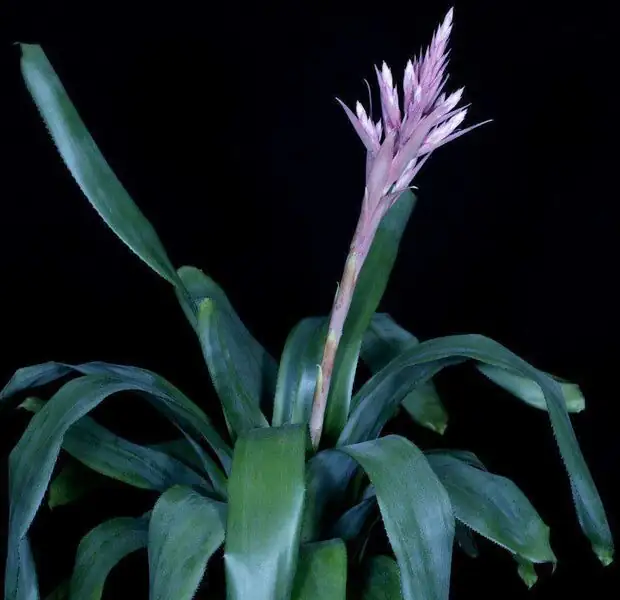
Come summer, a tall inflorescence rises, crowned with showy pink bracts. Look closer: the true flowers are small and purple, short-lived jewels attended by pollinators, while the bracts stay colorful for weeks, flagging the feast long after the flowers fade.
Native Ground (and Branches): Northern South America
Aechmea fendleri is native to northern South America—notably Venezuela and adjacent regions—where it grows as an epiphyte in tropical forests. It thrives in bright, filtered light beneath the canopy, where sunbeams are softened by leaves and moisture hangs in the air.
What it looks like in the wild:
- Silvery poise: A refined silver‑green sheen and subtle banding help the leaves manage light and evaporative stress.
- Perfect proportions: About 60 × 60 cm (24 × 24 in), a size that balances water storage with wind stability.
- Seasonal spectacle: In summer the plant hoists a tall flower spike, its pink bracts glowing against the forest’s deep greens, while small purple flowers open in succession.
Discovery, Names, and a Dash of Lore
In the 19th century, the tropical Americas drew botanists like lodestones. Specimens of this species were gathered by the intrepid plant collector Augustus Fendler in Venezuela; the French botanist Édouard André later described the species and honored the collector with its specific epithet: fendleri.
Commonly called the Dragonfly Bromeliad, it carries a name that fits its sleek, hovering presence and delicately poised bracts—like wings held at rest.
Flower language, thoughtfully considered
Bromeliads are bound to the symbolism of hospitality and resilience. The “hospitality” arises from the rosette’s water-holding cup—a natural goblet that welcomes life. “Resilience” reflects their ability to flourish high in the canopy with no soil at all, turning scarcity into strategy. While not an ancient folklore tradition, this modern “language” of bromeliads echoes the cultural weight of their pineapple cousin and the quiet endurance of the epiphyte’s way of life.
Field Guide: How to Recognize Aechmea fendleri
- Form: Rosette-forming epiphyte; gradually clumps by producing offsets (“pups”) around the base.
- Foliage: Arching, strap-like leaves, silver‑green with subtle banding; tight, vase-shaped rosette with a central “cup.”
- Inflorescence: Summer bloom; a tall spike topped with showy pink bracts and small purple flowers. The bracts remain ornamental long after the blossoms.
- Size: About 60 × 60 cm (24 × 24 in).
Conserving a Canopy Cistern
Because it lives on trees, Aechmea fendleri depends on intact forests with healthy host branches and steady humidity. Key considerations:
- Habitat pressure: Loss of tropical forest canopy reduces available epiphytic habitat and the connected web of organisms that use bromeliad tanks.
- Tiny worlds matter: Each rosette-cup shelters microfauna; protecting the plant protects its miniature ecosystem.
- Ethical cultivation: Choose nursery-propagated plants (pup-grown, not wild-collected). Supporting growers who propagate offsets helps meet demand without depleting wild stands.
- Protected places: Conserving forest corridors and mature trees in northern South America helps keep these aerial reservoirs—and the life they host—thriving.
Bring a Slice of the Canopy Home: Care and Culture
Think like a branch. Give air around the roots, clean water in the rosette, and dappled light on the leaves.
Light and Placement
- Bright, filtered light; partial sun/partial shade.
- Indoors: East or bright north window; or set a few feet back from a south/west window with a sheer curtain.
- Avoid harsh midday sun, which can scorch leaves.
Temperature and Humidity
- Ideal temperature: 15–27°C (59–81°F). Keep above 10°C (50°F).
- Not frost-hardy; outdoors year-round only in warm, frost-free climates (roughly USDA Zone 10–11).
- Humidity: Moderate, with a boost in hot weather. Dry indoor air can invite spider mites.
Watering: The Cup and the Roots
- Use rainwater or distilled water to fill the central rosette “cup.”
- Refresh/top up every 4–8 weeks to avoid mineral buildup or stagnation.
- Keep the potting mix lightly moist in the growing season; in winter, let the mix dry before watering again.
- In hot, dry spells, mist daily or every other day for extra humidity.
Soil and Pot
- Airy, fast-draining epiphyte mix is essential.
- Great options:
- Equal parts orchid bark mix + perlite + coconut coir, or
- A 1:1 blend of orchid bark mix and general-purpose potting mix.
- Choose a snug pot (often 12.5–15 cm / 5–6 in). Oversized pots stay wet too long.
Feeding
- Spring through late summer: feed every 2 weeks at 1/2 strength with a balanced liquid fertilizer.
- Apply into the rosette cup or as a foliar feed; flush occasionally with plain water to prevent salt buildup.
Grooming and After the Show
- After blooming, remove the spent flower spike.
- Trim only fully brown tips; avoid cutting healthy green tissue.
- The mother plant will eventually decline as pups mature—normal for bromeliads.
Propagation and Repotting
- Pups: Separate when they’re 1/3–1/2 the size of the mother and have roots. Pot into the same airy mix and secure them well.
- Repot only when crowded, stepping up one pot size at a time.
Pests, Health, and Safety
- Watch for mealybugs, scale, and spider mites (especially in dry air).
- Prevent rot with excellent drainage and airflow; never let the pot sit in water.
- Low toxicity overall; sap may irritate sensitive skin and chewing may upset pets—keep out of curious mouths.
Calendar Quick-Notes
- Spring–late summer: lightly moist mix, fertilizer every 2 weeks.
- Summer heat: maintain water in the cup; mist daily/every other day if very dry.
- Winter: water only after the mix dries; refresh cup water every 4–8 weeks.
Why the Dragonfly Bromeliad Wins Hearts
- Architectural grace: a sculptural, vase-shaped rosette that looks curated by nature.
- Long-lasting color: pink bracts hold their beauty well beyond the fleeting purple flowers.
- Living terrarium: the central cup hosts a pocket ecosystem—fascinating for the curious and a reminder that even a teacup of water can be a world.
In the canopy, Aechmea fendleri is a resourceful neighbor that catches the rain, feeds a microcosm, and blooms like a sunrise. On your windowsill, it asks for dappled light, clean water, and a bit of air at its roots—and in return, it brings the forest’s quiet, resilient magic home.