

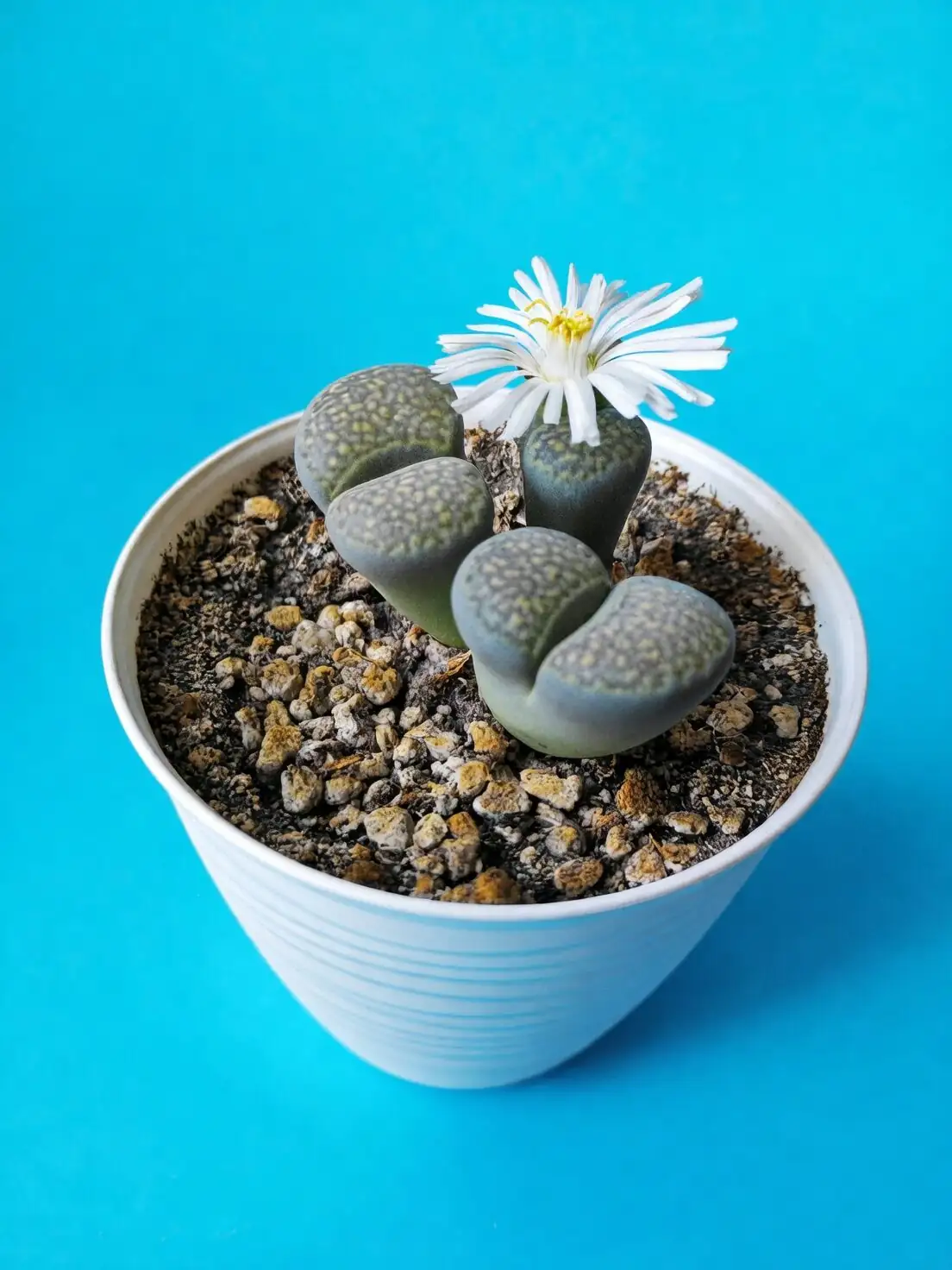
If you’ve ever stared at a pot of gravel and thought, “Wait… did that pebble just bloom?” you’ve met the delightful deception of Lithops. These “Living Stones” are the ultimate collector’s riddle: tiny, patterned succulents that masquerade as pebbles yet send up daisy-like flowers from a seam between two fused lobes. Ready to play the identification game so you never mix up your pebble-mimics again? Let’s turn your eye into a Lithops laser.
Meet the Living Stones (Lithops spp.)
- Family: Aizoaceae (the mesemb family)
- Native range: Southern Africa, especially South Africa and Namibia
- Habit: Ultra-compact succulents forming single heads 1–4 cm across (often 1–3 cm), gradually clumping with age
- Signature look: A “two-leaf body” with a central slit; top surfaces patterned in grey-green, tan, or brown with dots, marbling, and sometimes translucent “windows”
- Showtime: Late summer to autumn, a single daisy-like flower (usually white, sometimes yellow) bursts from the central fissure
They’re slow, stoic, and superbly camouflaged—perfect for a bright windowsill or collector’s tray.
The Collector’s ID Game: Spot the Lithops in a Tray of Stones
Round 1: Body plan—two lobes and a central slit
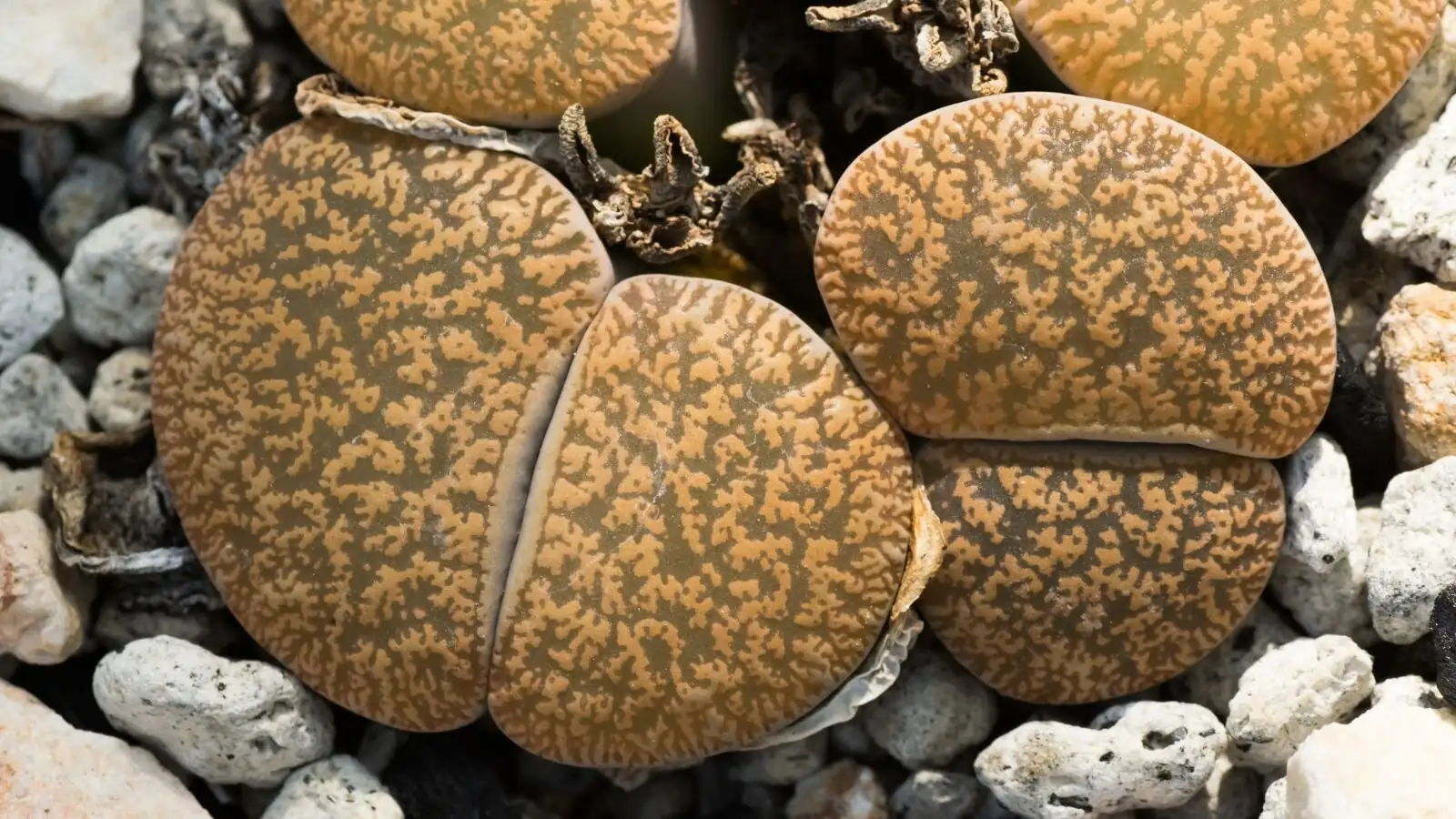
- Find the seam. A true Lithops head is one body made of two thick, fused leaves split by a clean central fissure.
- The top is flat to slightly domed, not ballooned. Think “pressed pebble,” not “puffed bun.”
Pro tip: If you see an unmistakable “pair of cheeks” with a definite slit down the middle, you’re on the right track.
Round 2: Skin patterns and “windows”
- Colors and markings are camouflage: marbling, speckles, and lacy patterns that mimic surrounding stones.
- Many species have translucent “windows” that let light into internal tissues—look like frosted nets or panels on top.
Pro tip: These windows often look like tiny skylights—subtle, not glossy.
Round 3: The single surprise flower
- Timing tells: Flowers typically appear from late summer through autumn.
- A single, showy daisy emerges from the slit. Most are white; some species/cultivars are yellow.
- Mature timing: Seed-grown plants often need 2–3 years to bloom.
Pro tip: One head, one flower at a time is a strong Lithops clue.
Round 4: Seasonal rhythms—watch the leaf replacement
Lithops have a living metronome:
- Autumn: Active growth and flowering; patterns look crisp.
- Winter: Mostly dry and bright; new leaves form inside, fed by the old pair.
- Spring: Old leaves finish drying into a papery sheath; avoid watering until they’re mostly spent.
- Hot summer: Many rest; water sparingly, shade lightly at midday, and ventilate.
Pro tip: The “new pair replaces old pair” cycle is classic Lithops biology—and central to care.
Round 5: Scale and clumping
- Individual heads are mini—about 1–4 cm across.
- Over years, plants may clump into tidy clusters, but stay low and close to the substrate.
Pro tip: If the “stone” is thumb-sized, squarish on top, and only a few centimeters wide, you’re in Lithops land.
Round 6: Root and pot clues
- Shallow, relatively sparse roots like gritty, fast-draining media.
- Shallow pots are favored; pebbly top-dress fits their natural “lost in gravel” look.
Pro tip: A 10–12 cm pot often hosts 3–5 heads—neat, not crowded.
Look‑alikes You’ll Never Mix Up Again
Conophytum vs. Lithops
- Body shape:
- Lithops: Two fused lobes with a central slit; top is flat to slightly domed.
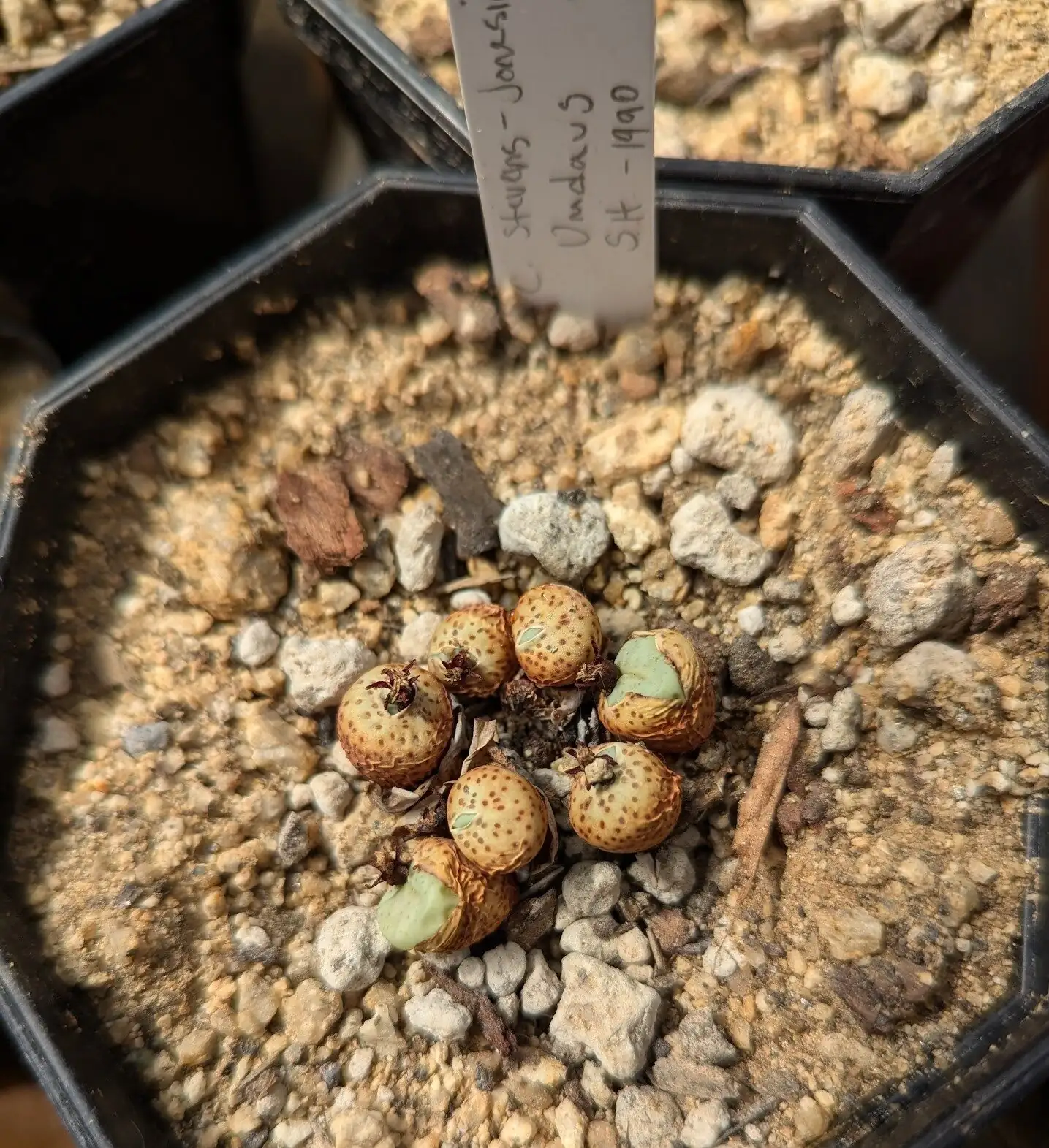
- Conophytum: Often a single, rounded cone or button with a small pore or “mouth” on top; many species cluster tightly.
- Seasonal feel:
- Both are mesembs with fall flowering in many species, but Conophytum bodies often appear more singular and button-like rather than clearly two-lobed.
- Fast ID cue: If the top looks like a single button with a tiny mouth rather than a distinct two-lobed seam, think Conophytum.
Pleiospilos nelii (Split Rock) vs. Lithops
- Build:
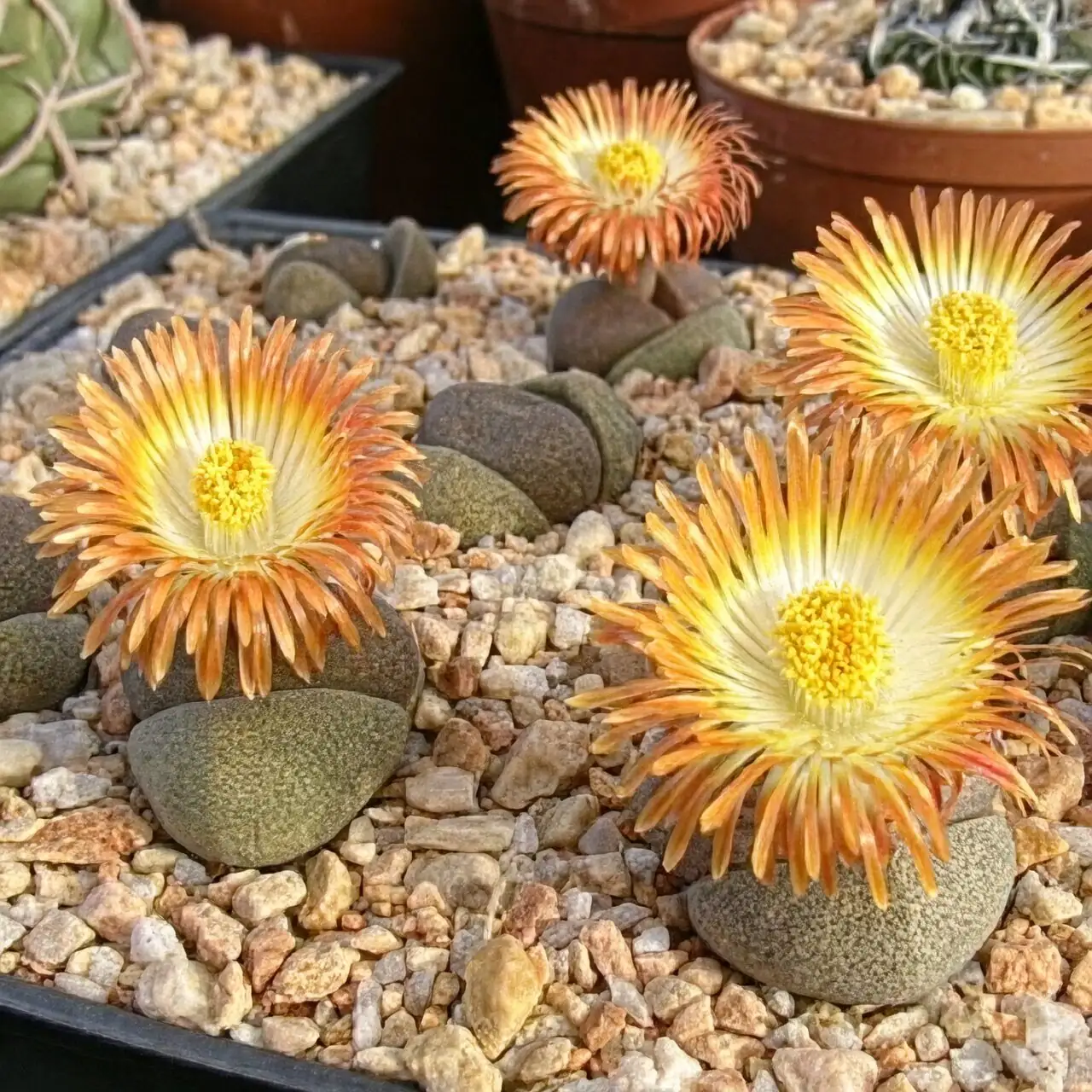
- Pleiospilos: Bulkier, more rounded, often thicker-bodied “split rock.”
- Lithops: Flatter, pebble-pressed profile.
- Flowers:
- Pleiospilos can produce multiple blooms in a season or even at once.
- Lithops typically present one flower per head at a time.
- Fast ID cue: If you see a plumper “split rock” with more than one bloom opening together, that’s Pleiospilos territory.
Fenestraria (Baby Toes) quick aside
- Upright, multiple toe-like leaves with translucent tips forming clusters—very different from the paired, flat-topped Lithops head.
Care Decoded From the ID (Bright light + dry wit)
Light and placement
- Aim for bright light to full sun: 6+ hours of direct sun is ideal.
- Indoors: A south- or west-facing window is best (east can work); acclimate newly acquired plants gradually.
- In very hot conditions or behind glass at midday, provide light shade and excellent airflow to prevent scorching.
Watering—the golden rule of restraint
- Let the mix dry completely. A good beginner cue: wait for slight wrinkling, then water lightly and let it dry fast again.
- Seasonal tweaks:
- Summer heat: Many Lithops rest—water sharply less, prioritize shade and airflow.
- Late summer to autumn: Cautiously increase watering for growth/flowering, never keeping soil wet.
- Winter: Keep bright and mostly dry.
- Leaf replacement: Hold water until the old pair has largely dried; watering too soon risks splitting and rot.
- Never leave water in a saucer.
Soil and pot
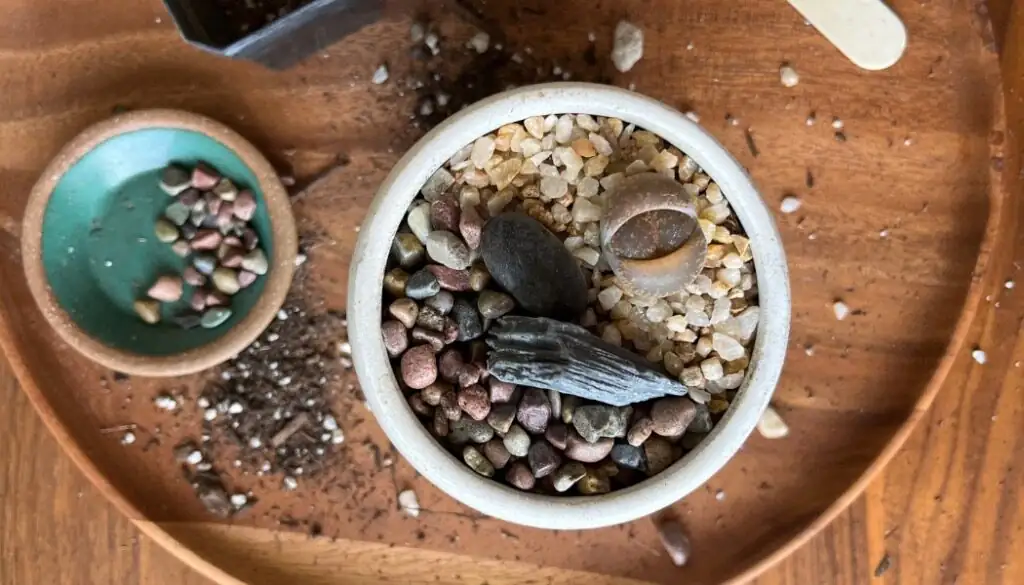
- Use a very gritty, fast-draining cactus/succulent mix with high mineral content (coarse sand, grit, pumice).
- DIY idea: Start around 2 parts mineral to 1 part potting soil; increase mineral if drying is slow.
- Shallow pots suit their roots; a 7.5–10 cm pot fits a single head; 10–12 cm pots can host 3–5.
Temperature and humidity
- Best growth: 15–26°C (59–79°F).
- Keep winter temps above ~12°C (54°F) for typical indoor culture; prolonged cold below ~5°C (41°F) is risky.
- Prefer low humidity and fresh air; avoid persistently damp, stagnant conditions.
Feeding, repotting, grooming
- Fertilizer: Very light hand. Either:
- One balanced liquid feed at 1/4 strength in autumn, or
- During active growth only, very dilute low‑nitrogen cactus feed about every 2 weeks, then stop during summer rest and winter.
- Repotting: Infrequent—about every 2 years, or longer if the mix stays open and fast-draining.
- Grooming: Remove only fully dry, papery old leaves during repotting; leave anything still fleshy.
Pests and problems
- Biggest risk: Rot from overwatering or slow-draining soil.
- Watch for: Mealybugs (including root mealybugs), aphids, fungus gnats in damp mixes; outdoors, birds may peck.
- Prevention: Gritty substrate, full dry-downs, bright light, airflow, and quarantine new arrivals.
Buying Like a Pro: The Quick Checklist
- Look for firm, plump heads with crisp patterns and a clean central slit.
- Avoid mushy bases, blackened tissue, soft spots, scars from severe sunburn, or persistent wet soil.
- For beginners, choose heads at least ~1 cm across.
- If pests are suspected, plan to repot into fresh, gritty media after quarantine.
The One-Glance Calendar
- Spring: Minimal water until old leaves have dried; bright light, good airflow.
- Summer heat: Many rest—light shade at midday, ventilate, water far less.
- Late summer–autumn: Cautious watering supports growth and flowers.
- Winter: Keep bright, warmish (above ~12°C/54°F indoors), and mostly dry.
Safety and Symbolism (and the “flower language” question)
- Safety: Generally considered non-toxic to people and pets—though not edible. The small, firm bodies can be a choking hazard for kids and curious pets; display out of reach.
- Symbolism: Lithops are a living metaphor for resilience and “beauty in disguise,” thriving in harsh deserts while looking like ordinary stones.
- About flower language: Traditional “flower language” systems rarely include desert succulents like Lithops. Modern enthusiasts assign meanings—endurance, hidden charm—based on their camouflage and tenacity. Treat it as a contemporary, culture‑driven reading rather than a historic canon.
ID Drills: Test Your Eye
- Scenario A: A palm-sized, chunky “split rock” opens two daisies at once. Lithops or not?
- Answer: Not. Multiple simultaneous blooms and bulkier build point to Pleiospilos nelii.
- Scenario B: A thumb-sized, flat-topped pebble with lacy windows and a single white daisy in October.
- Answer: Lithops—two lobes, central slit, single flower in autumn.
- Scenario C: A tight cushion of tiny cones with a small pore at each apex.
- Answer: Conophytum—more button/cone bodies, not clearly two-lobed.
Why Collectors Fall in Love
- You can “lose” them in their own top-dressing (camouflage champs).
- The flower looks comically oversized for such tiny bodies.
- From seed to first bloom often takes 2–3 years—slow, but all the sweeter when the daisy pops.
With the fused-lobe silhouette, the central slit, the annual leaf-replacement ritual, and that single autumn daisy keyed into your vision, you’ll spot a Lithops across a gravel pan—and never mistake a split rock or cone plant for your beloved Living Stones again. Bright light, fast drainage, a featherweight watering hand, and you’re set for a lifetime of tiny, blooming pebbles.