

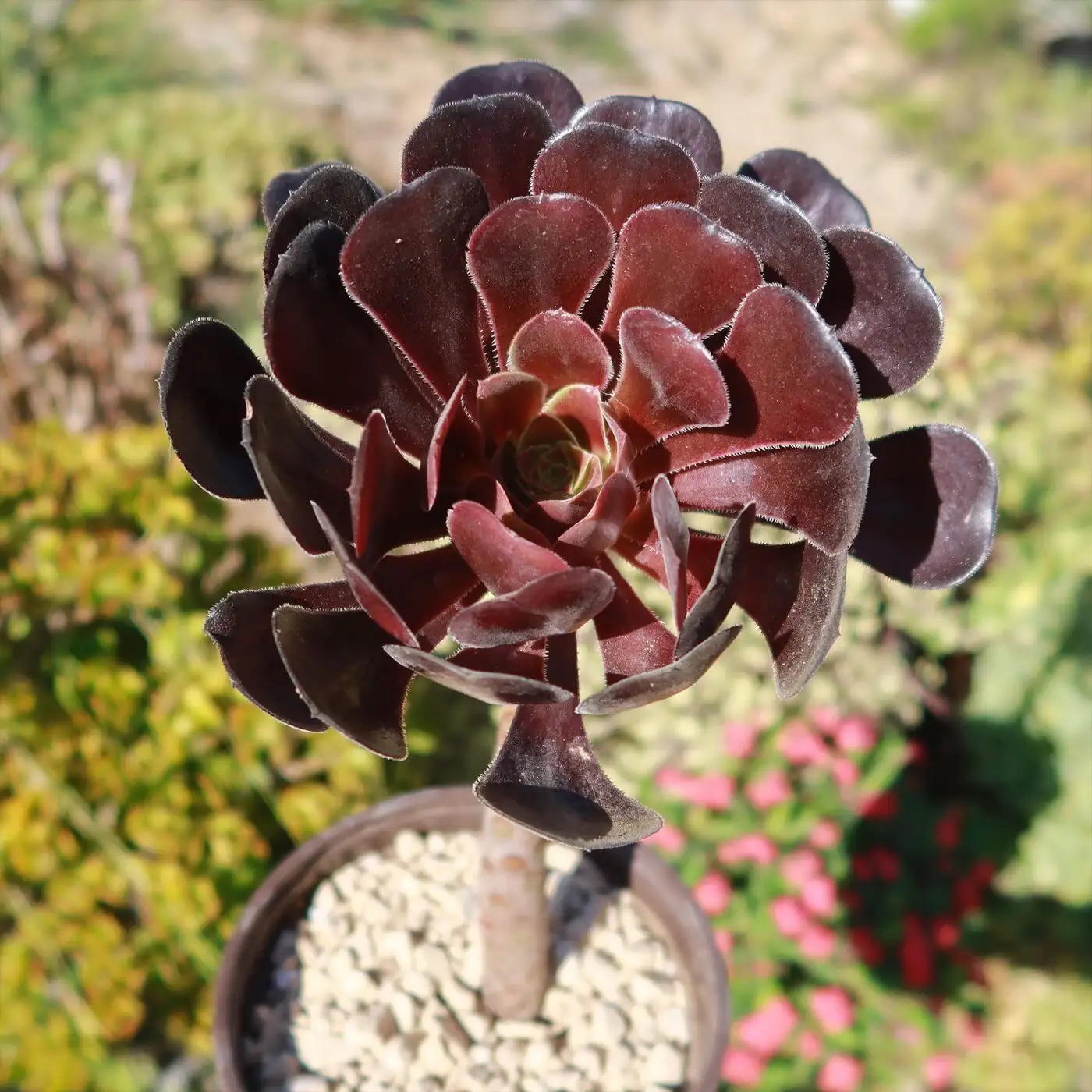
Imagine a bouquet of satin-dark roses perched atop woody stems, each “flower” a living solar panel. That’s Aeonium arboreum ‘Zwartkop’—the Black Rose Aeonium—an architectural succulent whose near-black rosettes come alive in cool, bright weather and take a thoughtful pause when summer turns scorching. To really understand why it behaves this way, we have to peek under the hood: into the geometry of its rosettes, the night-breathing magic of CAM metabolism, and the protective power of purple pigments acting as a natural sunblock.
Meet the Black Rose Aeonium
- Botanical name: Aeonium arboreum ‘Zwartkop’ (Crassulaceae)
- Also called: Black Rose Aeonium, Aeonium ‘Zwartkop’, Black Tree Aeonium, Black Rose
- Origin story: A cultivated form of Aeonium arboreum, a species native to the Canary Islands (Macaronesia)
- Look and habit: A branching, rosette-forming succulent with dense, spoon-shaped leaves that read deep burgundy to near-black in strong light. Over time it can form a shrub-like clump, a striking “architecture plant” for bright windows and patios.
Typical size and containers:
- Young, compact plants often stand around 10 cm (4 in) tall and wide.
- With age and space, it can reach about 60 × 60 cm (24 × 24 in).
- Small-to-medium specimens do well in 12–15 cm (4.7–6 in) pots with drainage.
Flowering:
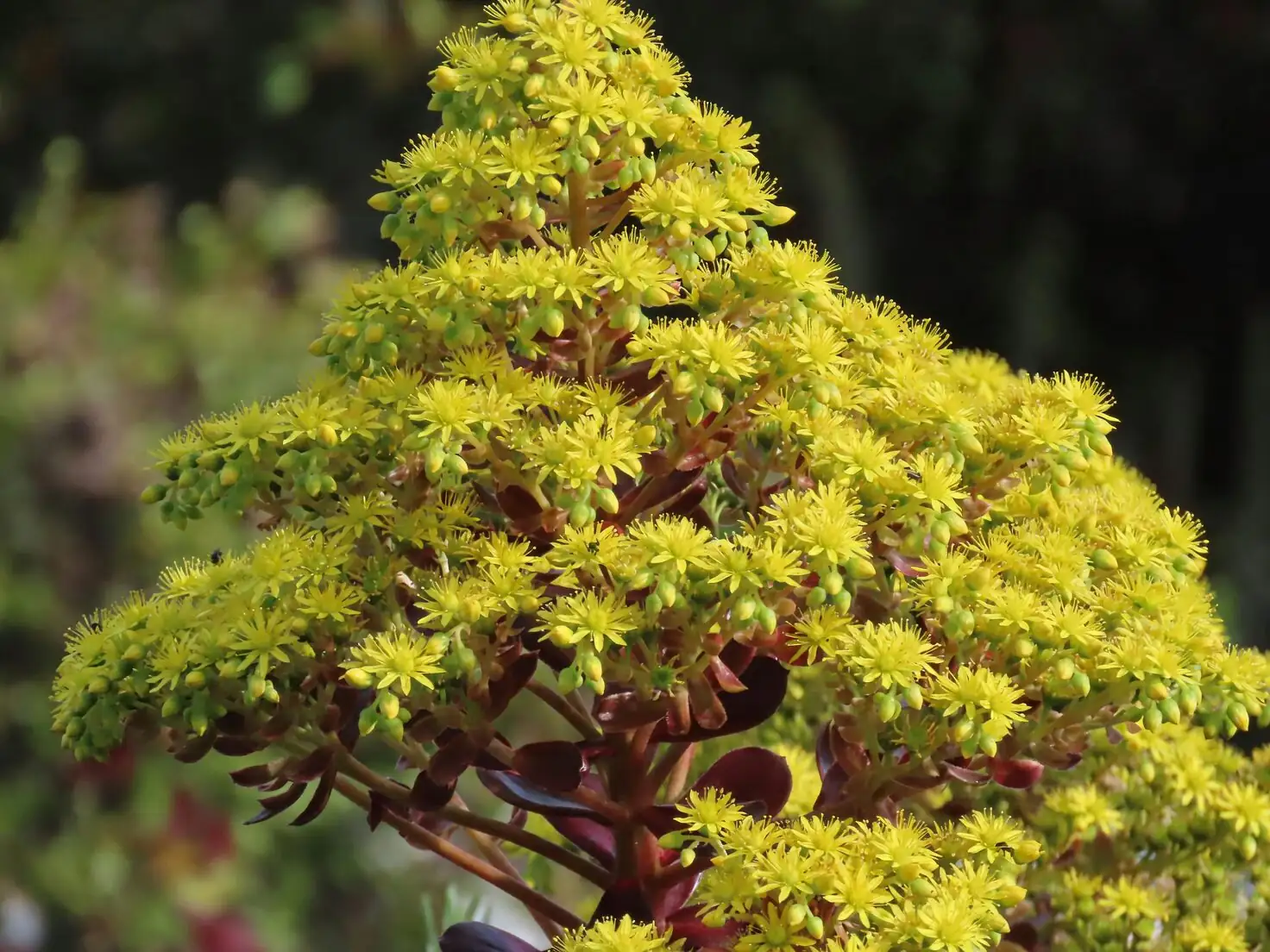
- Mature rosettes can send up clusters of small, starry yellow flowers in spring.
- After bloom, that rosette usually declines (monocarpic), but side rosettes carry on.
Why it thrives in cool seasons (and slows in hot summers)
1) Rosette architecture: a living solar panel with built-in climate control
Aeonium rosettes are precision-engineered spirals. Each spoon-shaped leaf overlaps its neighbor to create:
- Efficient light capture without excessive glare. The rosette’s curvature spreads sunlight across many leaves like a diffused lens.
- Self-shading and a gentler microclimate. Packed leaves trap a thin boundary layer of air that reduces water loss in breezes.
- Water funneling. Dew or occasional rain slides toward the crown and stem, where it can be used efficiently.
- Heat-defense mode. In hot, dry spells the rosettes often tighten and cup inward, shading younger leaves and the growth center to reduce stress.
As the plant matures, stems branch, and you get a small “tree” of rosettes—dramatic and easy to shape with pruning.
2) CAM metabolism: night-breathing to save water
As a member of the Crassulaceae, ‘Zwartkop’ uses CAM (Crassulacean Acid Metabolism), a drought-savvy strategy where:
- Stomata open at night to take in CO₂, storing it as acids (like malate).
- During the day, stomata largely stay closed to conserve water while photosynthesis runs on last night’s CO₂ stash.
What this means for growth rhythm:
- Cooler, brighter months (often autumn through spring) are the comfort zone: light is strong, temperatures are moderate, and water loss is limited—perfect for growth.
- In hot summers, the plant often slows or semi-dorms. Rosettes can tighten, and new growth eases off to wait out the heat. This is normal—lean into it by drastically reducing water.
3) Anthocyanins: the plant’s natural sunblock
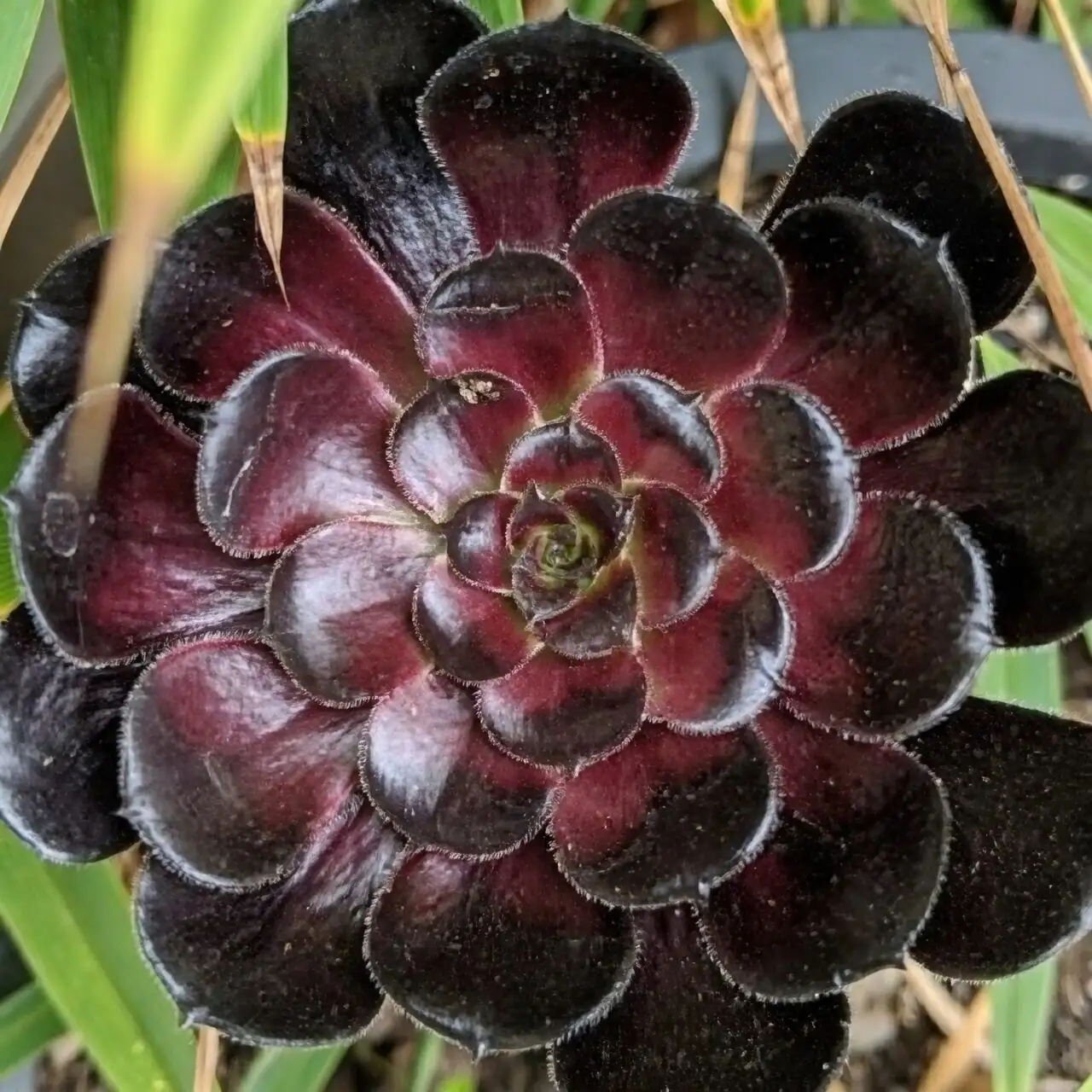
Those near-black leaves aren’t just stylish—they’re protective. Deep burgundy-purple pigments (anthocyanins):
- Act as a sunscreen, absorbing high-energy light and filtering UV/blue wavelengths before they can damage chloroplasts.
- Reduce photoinhibition (light stress), helping the plant photosynthesize more steadily in bright conditions.
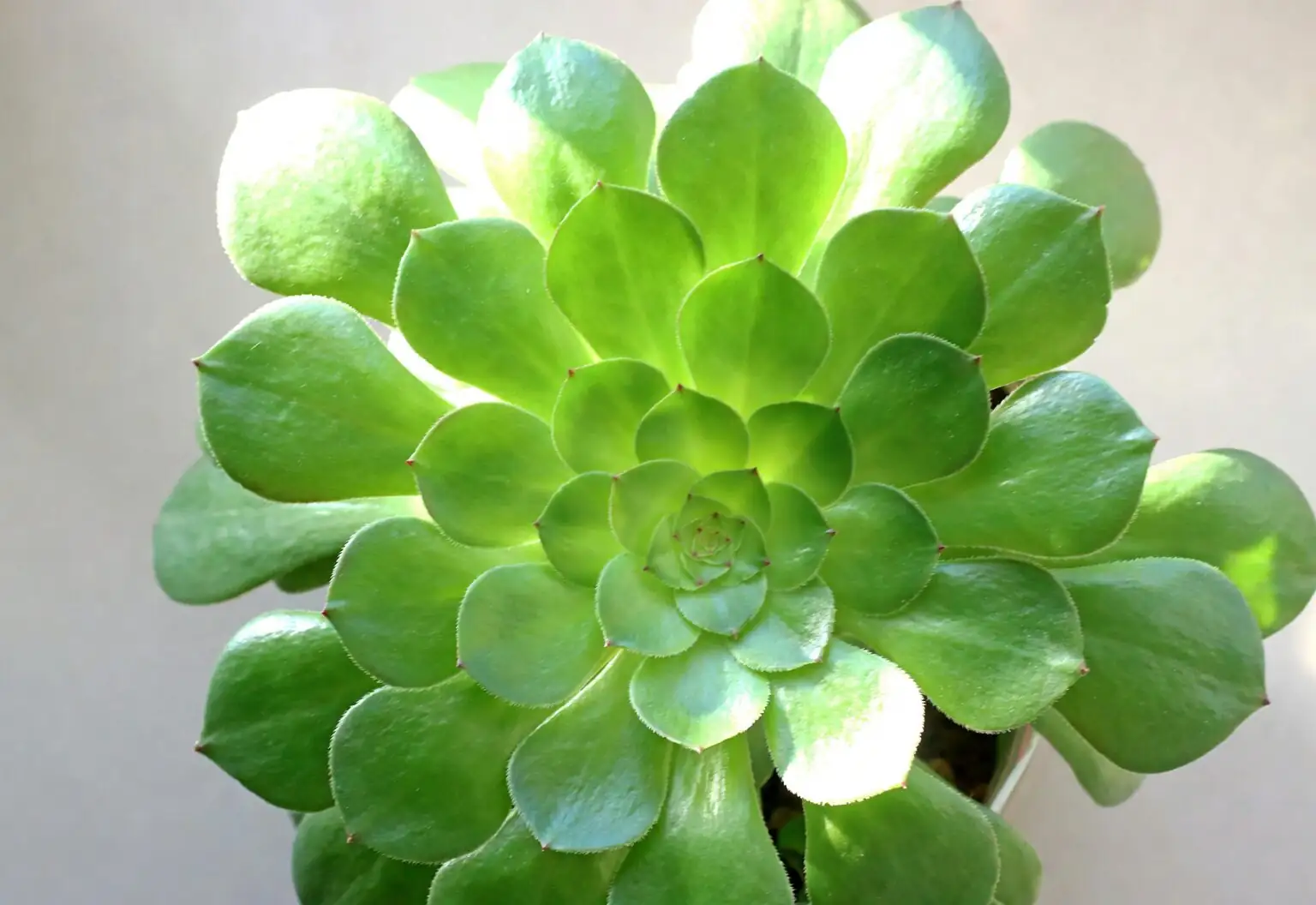
- Shift with conditions. In very strong light—especially when days are bright and air is cool—color deepens to near-black. In lower light, leaves trend burgundy to reddish-purple, often with a greener center during active growth.
Together, CAM and anthocyanins let ‘Zwartkop’ drink at night, sunbathe by day, and ride out heat spikes by toning down growth until conditions improve.
Light, temperature, and placement
Light:
- Best: full sun to very bright light; indoors, give it the brightest window you have.
- Tolerates bright partial shade, but color lightens and rosettes may open flatter.
- In very hot weather (especially behind glass), protect from harsh midday sun to prevent scorch—sheer curtains or moving the pot a bit back helps.
Temperature and hardiness:
- Thrives around 20–25°C (68–77°F); generally happy 10–24°C (50–75°F).
- Keep frost-free. Aim to stay above about 6°C (43°F); protect carefully as temps approach 0°C (32°F).
- Best outdoors year-round only in mild, frost-free climates (roughly USDA 10–11).
Humidity and airflow:
- Prefers low to average indoor humidity with good airflow.
- High humidity plus low light encourages stretching and rot; ventilation is your friend.
Pro tip for tall specimens:
- As the plant branches and gains height, it can get top-heavy. Use a weighty pot or a layer of decorative stones on the soil surface to stabilize it.
Soil, watering, and feeding
Soil:
- Use a fast-draining cactus/succulent mix. Start with a standard potting base cut generously with grit, coarse sand, or pumice for air and drainage.
- Never let it sit in waterlogged soil.
Watering rhythm:
- Active growth (typically autumn through spring): water thoroughly, then let the top layer of mix dry before watering again. Keep slightly moist but never soggy.
- Hot summer semi-dormancy: keep the mix almost dry; offer only small “sips” if rosettes begin to wrinkle.
- Cool indoor winters: water sparingly to prevent root rot.
Feeding:
- Feed monthly at half strength during the main growth windows (winter through late spring and/or through spring and autumn).
- Choose a balanced fertilizer diluted to 1/2 strength or a low-nitrogen succulent feed.
- Skip feeding during summer dormancy; overfeeding leads to weak, stretched growth.
A note for hydro-curious growers:
- It can be done, but it’s fussier than soil. Keep only part of the roots in water (some above the waterline), use nutrients in spring/autumn, and plain water in summer/winter. Strong light and airflow remain essential.
Pruning, shaping, and propagation
Pruning and tidying:
- Remove shriveled lower leaves as they age.
- After flowering, wait for the blooming rosette to dry, then remove it; side rosettes will carry on.
- If stems stretch, cut back to shape and encourage branching. Many growers refresh their plants from cuttings every 2–3 years for a compact form.
Propagation:
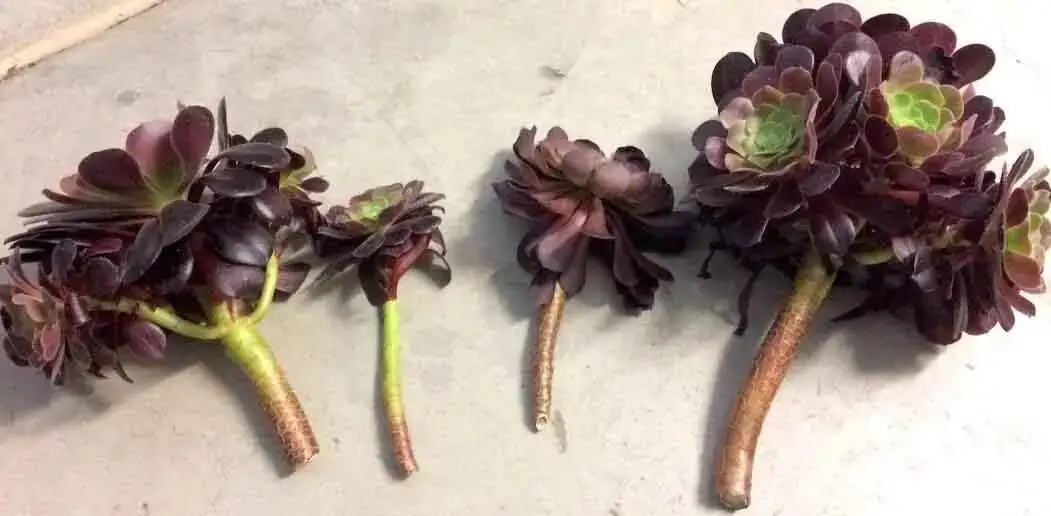
- Stem cuttings are easiest. Take a healthy rosette with a short stem, let the cut callus for several days, then place in a dry, gritty mix. Begin light watering only after roots form.
- Expect roots in about 3–4 weeks under good conditions.
- Seeds can be surface-sown in spring or autumn around 20–22°C (68–72°F); keep evenly moist with good ventilation for germination in roughly 9–14 days.
Repotting:
- Repot in spring.
- Young or fast-growing plants benefit from annual refreshes; otherwise, every 2–3 years is fine.
- Move up just one pot size and always use a pot with drainage holes. Common pot sizes for small-to-medium plants: 12–15 cm (4.7–6 in).
Season-by-season game plan
- Autumn–spring: prime growth. Give very bright light or sun; water when the surface dries; feed monthly at half strength.
- Early spring: watch for yellow, star-shaped flowers on mature rosettes. Remove the spent rosette once it dries.
- Summer: protect from harsh midday sun behind glass; cut watering way back and keep nearly dry during semi-dormancy.
- Winter: keep frost-free and on the dry side if rooms are cool; maintain strong light to avoid stretching.
Troubleshooting: color, stretch, scorch, and rot
Color going greener or burgundy rather than black?
- You likely need more light, or temperatures are warm. Move to a brighter spot and ensure excellent light in cool seasons.
Rosettes stretching or opening wide and lanky?
- Increase light intensity and airflow; reduce nitrogen; consider pruning and re-rooting tops.
Leaf scorch?
- Intense midday sun behind glass can crisp edges. Add a sheer curtain or shift the plant a little back from the window during heatwaves.
Mushy stems or wilted crown?
- Overwatering or poor drainage. Unpot, remove rot, and re-root healthy rosettes in a gritty, dry mix.
Pests:
- Mealybugs, aphids (often on flower stalks), whiteflies, and scale can appear. Treat early with insecticidal soap or horticultural oil and repeat as needed. Improve light and airflow for overall resilience.
Safety:
- Generally not listed as highly toxic, but the sap can irritate sensitive skin. Keep away from pets and kids and wash up after pruning if you’re sensitive.
Design uses and display tips
- A focal-point container plant for sunny windows, bright balconies, and patios.
- Gorgeous in mixed succulent bowls and framed, open-air arrangements.
- Avoid sealed terrariums or bottle gardens—‘Zwartkop’ wants more light and airflow than closed systems provide.
Flowering, form, and the long view
- Expect clusters of small, yellow stars in spring on mature rosettes. That rosette is monocarpic; it declines after the show, while side rosettes keep the plant going.
- Strategic pruning keeps the silhouette balanced and encourages branching. Over time, you’ll sculpt a living candelabra of black rosettes.
Name, meaning, and modern “flower language”
- The cultivar name ‘Zwartkop’ translates to “black head,” a nod to the leaf color.
- In contemporary plant lore, Black Rose Aeonium often symbolizes resilience and bold elegance—staying stylish under bright, dry conditions that would wilt fussier plants.
- Unlike traditional Eastern “flower language” systems tied to historic literature and ritual, modern succulent symbolism is more a product of today’s design culture and social media: we read meaning from form, color, and toughness. Here, the almost-black rosette—geometric, glossy, unflappable—has become shorthand for modern poise under pressure.
Quick-start checklist
- Light: as bright as possible; protect from harsh midday sun in extreme heat.
- Temperature: happiest 10–25°C (50–77°F); keep frost-free (above ~6°C/43°F).
- Soil: fast-draining, gritty succulent mix; never waterlog.
- Water: more from autumn to spring; barely in summer heat; sparingly in cool rooms.
- Feed: monthly at half strength in active growth; none in summer dormancy.
- Prune/propagate: trim leggy stems; root cuttings after callusing; remove spent flowering rosettes.
When you give Aeonium arboreum ‘Zwartkop’ cool, bright days, it pays you back with saturated, near-black rosettes that look carved from obsidian—and when summer bakes, it simply closes ranks, waits it out, and lives to dazzle another season.