

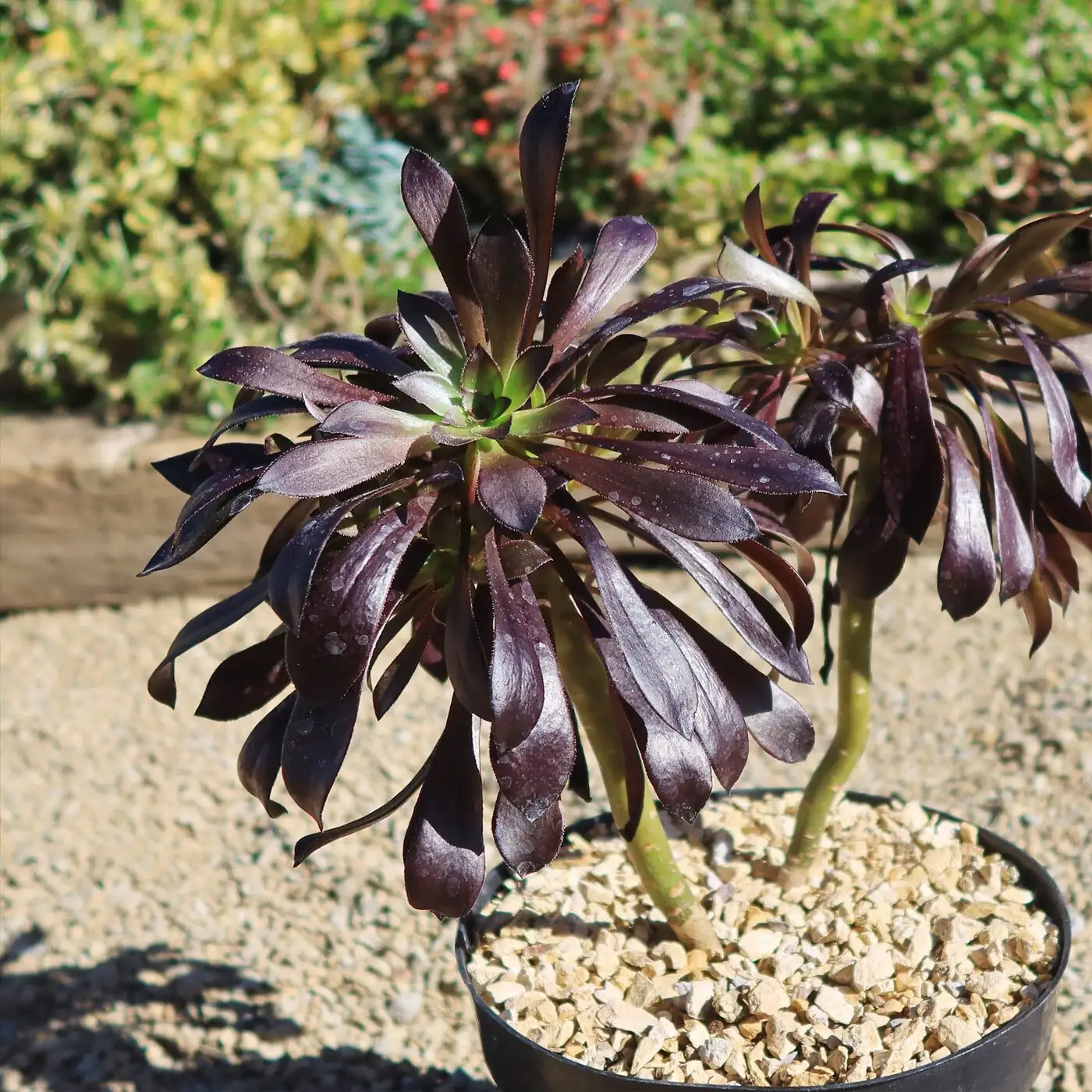
If a goth rose became a succulent and decided to grow on little tree trunks, you’d get Aeonium arboreum ‘Zwartkop’—the Black Rose Aeonium. Its glossy rosettes deepen from burgundy to nearly black in bright light, perched like dark blossoms on branching stems. It’s architectural, surprisingly easy once you learn its cool‑season rhythm, and wildly shareable thanks to fast‑rooting cuttings.
Meet the Black Rose Aeonium
- Scientific name: Aeonium arboreum ‘Zwartkop’ (Crassulaceae)
- Also called: Black Rose Aeonium, Aeonium ‘Black Rose’, Black Tree Aeonium, ‘Zwartkop’
- Heritage: A cultivated dark‑leaf form of a species native to the Canary Islands (Macaronesia). Now grown worldwide.
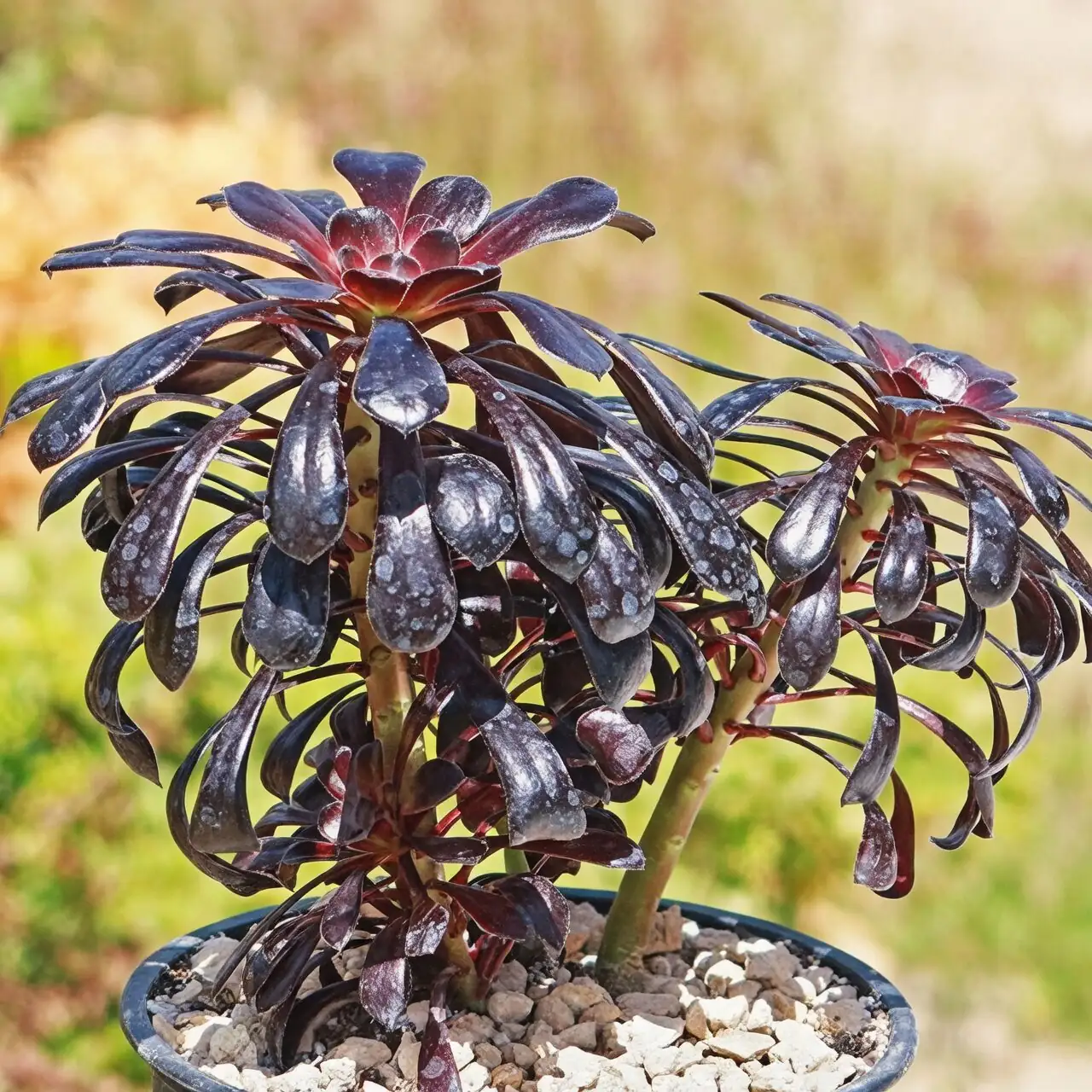
- Habit and size: A branching, shrub‑like succulent. Kept small in pots as a single rosette (about 10 cm/4 in tall), but with age and pruning it can reach roughly 60 × 60 cm (24 × 24 in).
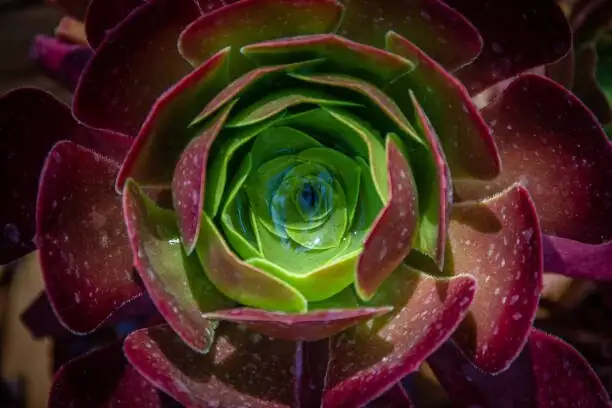
- Look closer: Spoon‑shaped leaves form tight rosettes at stem tips. In strong light and cooler seasons the foliage reads near‑black; in lower light it shifts to burgundy‑purple or greener, often with a slightly greener center while actively growing.
- Flowers: Mature rosettes can send up conical sprays of tiny, starry yellow blooms in spring. The blooming rosette is monocarpic—it declines afterward—but the plant usually carries on via side rosettes.
Why does it look so dark? The color‑shift science (lite)
Think of that near‑black color as built‑in sunglasses. Pigments called anthocyanins act like a sunshield:
- Bright light turns the dial toward deep burgundy to black.
- Cooler temperatures boost those pigments too, so winter and early spring color is often richest.
- Less light = less “sunglasses,” so rosettes look redder or greener. During active growth, centers often stay a touch greener—new cells are busy dividing before loading up on pigment.
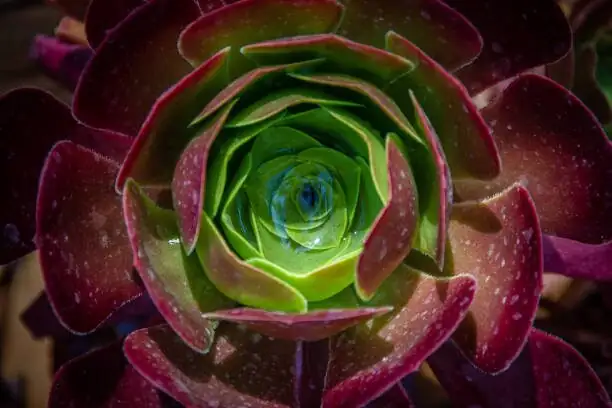
Tip: Indoors, aim for the brightest window you have. Outdoors, give strong light but ease off harsh midday sun during heatwaves, especially behind glass, which magnifies heat.
A cool‑season sprinter, a summer sitter
Aeonium ‘Zwartkop’ flips the usual houseplant script.
- Main growth: Autumn through spring (often strongest in cool, bright months).
- Summer: Frequently slows or semi‑dorms in hot weather. Rosettes may tighten or cup; stems mostly pause elongation. That’s normal.
Watering through the seasons
- Active growth (autumn–spring): Water deeply, then let excess drain. Water again when the top layer of mix dries. Keep evenly moist—not soggy.
- Hot summer semi‑dormancy: Keep the mix almost dry. Give only small “sips” if rosettes begin to wrinkle, then let dry again.
- Winter in cool rooms: Go lighter on water to prevent rot; bright light and airflow help.
A quick seasonal cheat sheet:
- Autumn–spring: Bright light, water when the surface dries, feed monthly at half strength.
- Early spring: Possible flowering on mature rosettes; remove the spent rosette once dry.
- Spring: Great time to repot, tidy old leaves, and prune to shape.
- Summer: Shade from harsh midday heat, especially behind glass; reduce watering sharply.
Light, temperature, and airflow
- Sunlight: Full sun to very bright light; tolerates bright partial shade. Indoors, think south or east windows, or strong grow lights. In extreme heat, filter midday sun to prevent scorch (sheer curtains help).
- Temperature: Happiest around 20–25°C (68–77°F); generally fine from ~10–24°C (50–75°F). Keep it frost‑free—protect carefully as temperatures approach 0°C (32°F). A practical minimum is above ~6°C (43°F).
- Humidity: Low to average is best, with good airflow. High humidity + low light = stretch and rot risk. If you mist, mist the air around the plant lightly, not the rosette.
Soil that loves speed: fast drainage, always
- Mix: Use a gritty, free‑draining cactus/succulent mix. Blend standard potting base with coarse sand, grit, and/or pumice for airflow and rapid drainage.
- Pot: Always choose drainage holes. Typical sizes for small/medium plants: 12–15 cm (4.7–5.9 in). Upsize just one pot at a time.
- Repotting: Spring is ideal; refresh annually for fast growers or every 2–3 years otherwise.
Watering, demystified
- The move: Water thoroughly until it drains, then never let the pot sit in water. Wait for the top layer to dry before watering in the cool‑season growth window.
- Thirst vs. trouble:
- Thirsty: Slightly wrinkled leaves that perk up after a modest drink.
- Trouble: Mushy stems, blackened centers, or a perpetually wet mix. Act fast—dry it out, improve light and airflow, and check roots.
- Experimental hydro note: It can be done, but it’s fussier. Keep only part of the roots in water with some above the waterline. Feed lightly in spring/autumn; use plain water in summer/winter.
Feeding for structure, not speed
- When: Only during main growth. Monthly at half strength with a balanced formula or low‑nitrogen succulent feed.
- Skip: Summer semi‑dormancy. Overfeeding = weak, stretchy growth.
Shape, prune, and the monocarpic moment
- Monocarpic rosettes: After blooming in spring, that rosette’s life cycle ends. Let it dry, then remove it. Side rosettes usually carry on.
- Pruning: Cut back leggy stems in spring to encourage branching and a fuller “tree” silhouette. Many growers refresh old plants by restarting from cuttings every 2–3 years.
The fastest way to more ‘Zwartkop’: cuttings
Stem cuttings root fast—great news for sharers and stylists.
- Snip a healthy rosette with a short piece of stem.
- Let the cut end callus for several days in bright, indirect light.
- Set into a dry, gritty mix; don’t water yet.
- Begin light watering only after roots form (often in 3–4 weeks), then ramp up gradually.
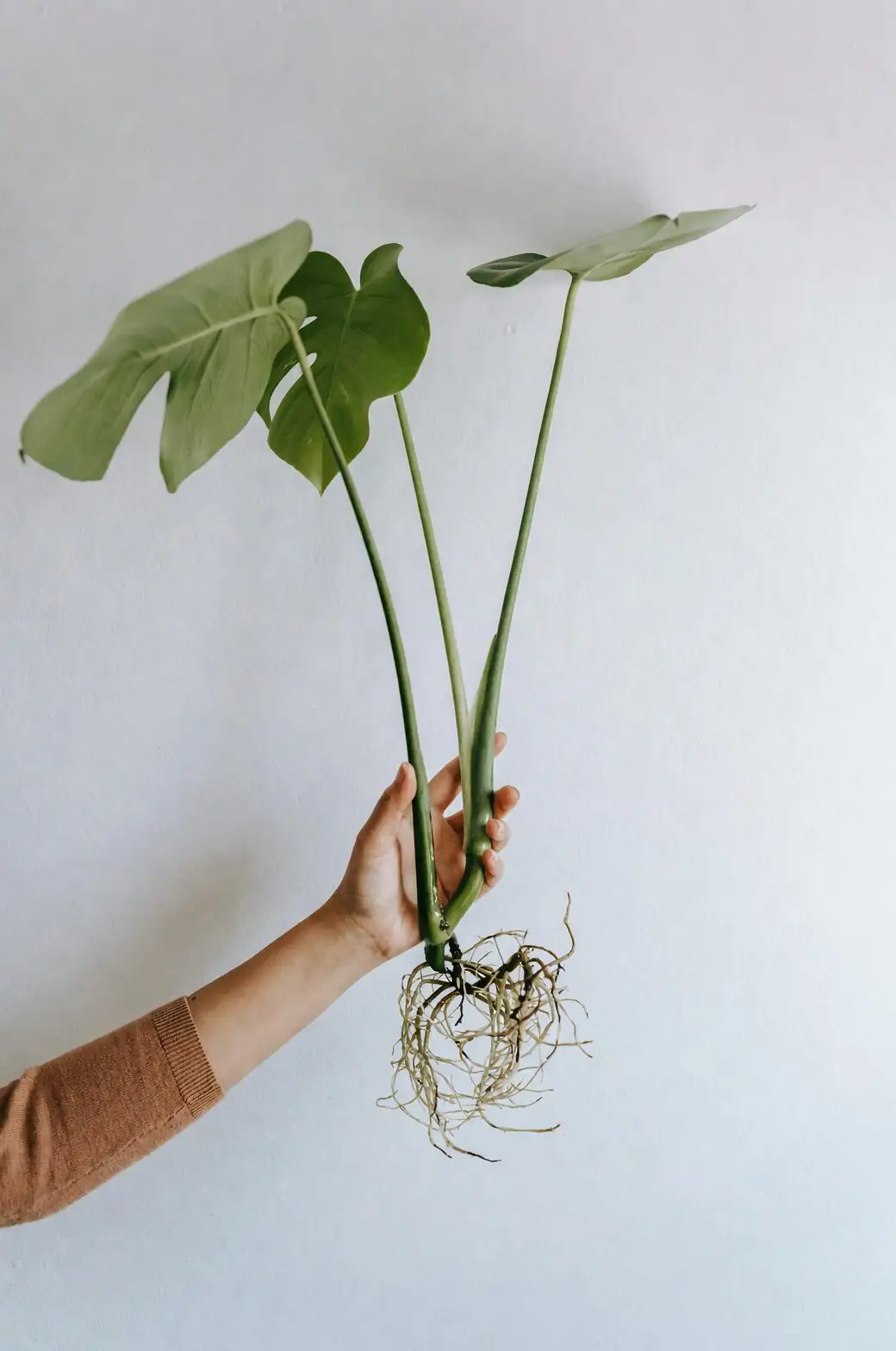
- Offsets: Pot up side rosettes the same way.
- Seeds (for the patient): Surface‑sow in spring or autumn at ~20–22°C (68–72°F). Don’t cover; keep evenly moist with gentle airflow. Germination often in 9–14 days.
Styling and display ideas
- Architectural anchor: A moody focal point in modern containers or Mediterranean‑style plantings.
- Color contrast: Pair with silver echeverias, lime crassulas, or pale gravel for drama.
- Mixed bowls and framed art: Works beautifully in open, airy designs. Skip sealed terrariums—this plant prefers bright light and strong airflow.
- Placement: East‑facing balconies with morning sun, bright south windows with a sheer, or under quality grow lights.
Buying smart
- Choose tight, symmetrical rosettes with firm, glossy leaves and a healthy center.
- Avoid mushy stems, blackened centers, scars/soft patches, or pots that feel swampy.
- Sun acclimation: Start bright, then step up to stronger sun over 1–2 weeks to avoid scorch.
Troubleshooting and quick fixes
- Stretching (etiolation): Not enough light. Move to a brighter spot or add grow lights; consider pruning and restarting cuttings.
- Scorch: Brown, papery spots from intense heat/sun, especially behind glass. Filter midday sun and increase airflow.
- Pests: Mealybugs, aphids (especially on blooms), whiteflies, and scale. Treat early with insecticidal soap or horticultural oil; repeat as needed.
- Rot: The number‑one risk. Caused by soggy mix, low light, or cool‑wet combos. Improve drainage, light, and watering intervals.
- Leaf spot/rust: Avoid wet foliage late in the day and boost ventilation.
- Safety: Not known as highly toxic, but the sap can irritate sensitive skin. Keep away from nibbling pets/children and wash hands after pruning.
Fun facts
- The same plant can swing from almost black in strong light to burgundy or even greener in lower light.
- It’s a cool‑season grower—opposite many houseplants that surge in summer.
- Stem cuttings root quickly once callused, making it a very shareable succulent.
- With age and pruning, it becomes a little “tree” of rosettes—hence “tree aeonium.”
Symbolism and the so‑called “flower language”
There isn’t an ancient, formal flower‑language tradition for aeoniums; modern meanings come from how they look and grow. ‘Zwartkop’ often symbolizes:
- Resilience: It stays stylish through bright sun and lean watering, and rebounds after summer slowdowns.
- Bold elegance: Those glossy, near‑black rosettes read like couture in plant form.
If you gift one, the subtext is “strength with style”—a living sculpture that thrives when the days are bright and the care is thoughtful.
P.S. You’ll sometimes see it nicknamed 黑法师 (Black Magician) in Chinese plant circles—a nod to its dramatic, near‑black rosettes and a little bit of horticultural mystique.