


If you love plants you can sculpt, Ficus benjamina (the weeping fig) is a dream partner—graceful by nature, yet responsive enough to become a tailored statement piece. Think elegant arches, cloud-like pads, or a polished, umbrella canopy. Below, you’ll find a design-forward playbook: how to prune for fullness, wire with confidence, and keep leaves glossy under bright, filtered light.
Meet Ficus benjamina, your shape-shifting muse
Native to tropical and subtropical Asia and northern Australia, this evergreen ficus has naturally cascading branches and rich, glossy leaves. Outdoors in the tropics, it’s a substantial tree; indoors, it’s a versatile foliage plant that takes beautifully to pruning and training—even bonsai-style silhouettes. Keep it warm, provide steady light, and maintain evenly moist (never soggy) soil; when content, it grows with elegant momentum. When stressed (cold, drought, abrupt changes), it “tells” you with leaf drop—useful feedback you can act on.
Light, warmth, and humidity: the gloss trifecta
Shine begins with environment—polish the setting, and the foliage will follow.
Bright, filtered light (the sweet spot)

- Place near a bright window with sheer curtains or indirect light.
- In warm months, a sheltered patio/balcony with bright, filtered sun is ideal; shield from harsh midday rays.
- It tolerates medium indoor light, but brighter conditions yield denser growth and better response to shaping.
Temperature and humidity targets
- Aim for 20–25°C (68–77°F). Above 30°C (86°F) is fine if you adjust watering; avoid below 10°C (50°F), and never below 5°C (41°F).
- Winter comfort range: 13–16°C (55–61°F).
- Humidity around 60–70% helps prevent leaf yellowing and drop. Use a humidifier or occasional misting in dry rooms.
Watering rhythm (evenly moist wins)
- Growing season: water thoroughly when the top layer feels slightly dry; don’t allow the pot to sit in runoff. In summer warmth, many plants need watering about every 2–3 days (adjust for pot size, light, and temperature).
- If the mix dries too far, expect leaf drop and even blackened shoot tips.
- Winter: reduce to roughly once every 10 days and maintain warmth and humidity.
Feeding for sheen and steady growth
- During spring–summer, feed about every 10 days with a balanced houseplant fertilizer (one option: 15-15-30). Dial back in autumn; pause if winter growth slows.
Leaf-care that actually works
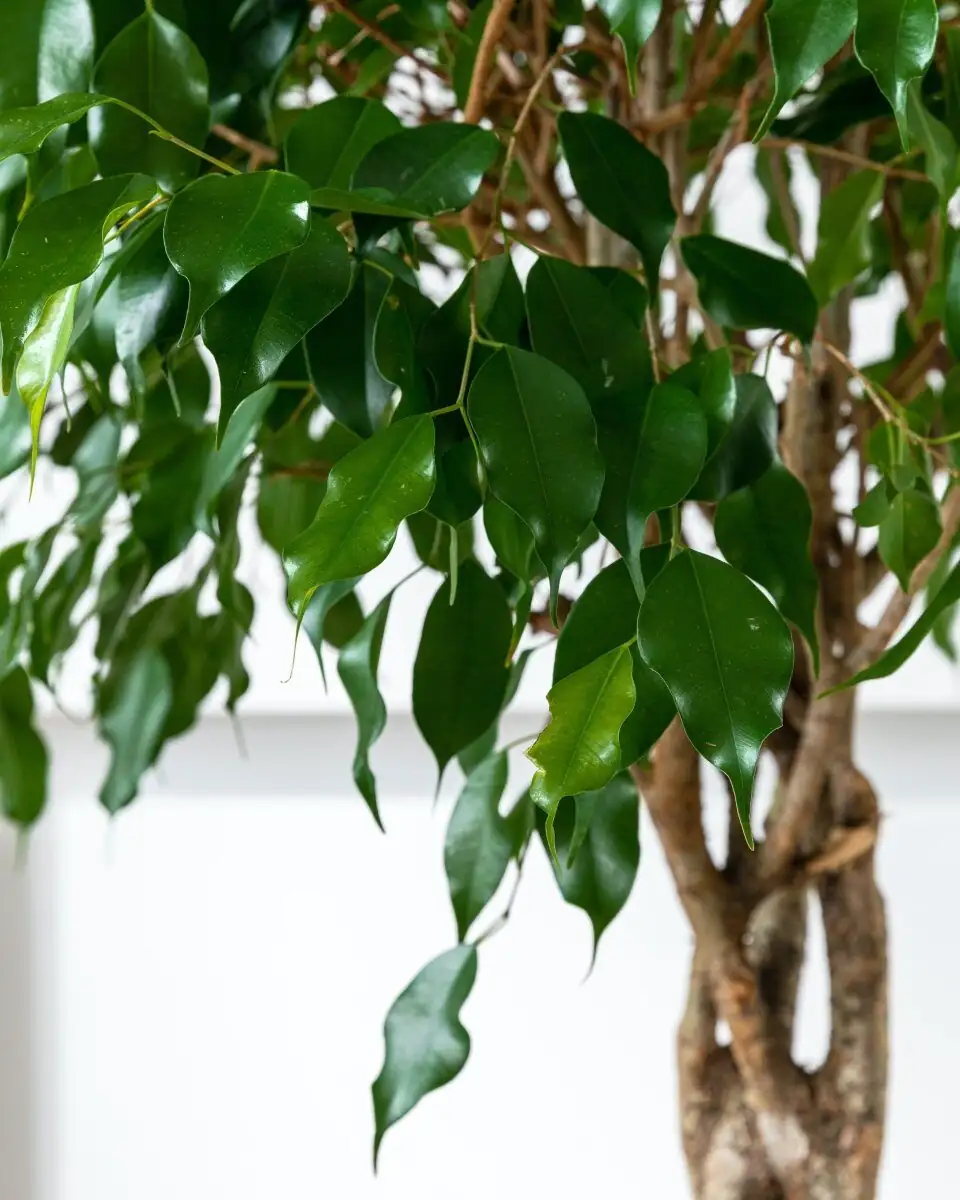
- Dust dulls gloss. Wipe leaves gently with a soft, damp cloth, or give the plant a lukewarm shower and let it drip-dry in bright, filtered light.
- Skip heavy leaf-shine sprays; clean leaves plus good light and nutrition are the real secret.
- To minimize leaf spot risk, avoid leaving foliage chronically wet—mist in the morning so leaves dry quickly.
Design-forward shaping: prune with a plan
Weeping fig loves structure. Use strategic cuts to prompt denser branching and a fuller silhouette.
Read the growth pattern
Like many trees, Ficus benjamina shows apical dominance—tips and topmost growth run ahead of the interior. To counter that and fill in the middle:
- Prune the top and outermost shoots more often.
- Let more light reach interior nodes to encourage back budding and lateral shoots.
When to prune
- Best during strong growth (spring through summer). This timing speeds recovery and maximizes branching response.
- Light tidying in autumn is fine; hold off on hard pruning in winter unless necessary.
Strategic pruning for fullness
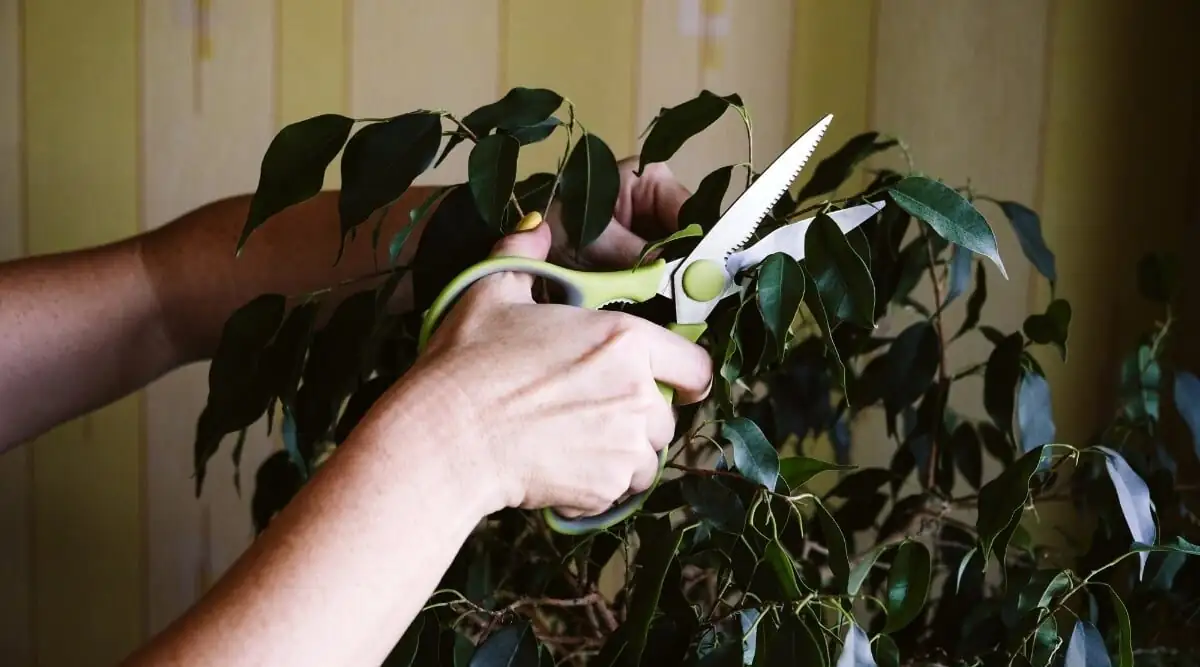
- Tip-pinching: Regularly pinch or snip the newest pair of leaves at the ends of fast-growing shoots. This slows the leader and nudges side shoots to develop, thickening the canopy.
- Cut back to a leaf node facing the direction you want new growth.
- Thin crowded crossings to let light penetrate—interior light equals interior leaves.
- Keep foliage on every branch you plan to keep. Ficus benjamina can be picky about being stripped too hard; leaving some leaves reduces dieback risk and keeps sap flow robust.
- Clean, sharp tools only. The milky latex will bleed after cuts—blot with a paper towel. Wear gloves if you have sensitive skin.
Shape maintenance
- Every 4–6 weeks in the growing season, reassess the outline:
- Tighter silhouettes: trim outermost growth more frequently.
- Airy, weeping silhouettes: maintain longer, arched leaders, and prune secondary shoots to create layered “veils” of foliage.
Wiring basics: graceful lines without bark bite
Wiring sets the line; pruning refines the mass. Do both, but wire first on branches you intend to reposition.
Materials and setup
- Use anodized aluminum wire for indoor ficus. Choose wire about 1/3 to 1/2 the thickness of the branch.
- Anchor wire securely (to the trunk base or an opposite branch) and wrap at about a 45° angle. Keep wraps neat and evenly spaced—no wire crossing.
- Protect tender bark if needed by placing a thin strip of paper tape or raffia beneath the wire on very soft shoots.
How to wire Ficus benjamina effectively

- Wire during active growth so branches set more quickly.
- Position primary branches first, then secondaries. Create gentle, natural curves—avoid abrupt kinks.
- For weeping styles: angle primaries slightly downward, then arc them outward; let secondaries drape, adjusting so each layer gets light.
- For upright, fuller domes: lift primaries slightly upward with subtle undulation, then prune for compact pads.
Aftercare and timing
- Check wires every 1–2 weeks in summer; growth is fast and wire can bite quickly on smooth bark. Remove as soon as the branch holds its shape.
- Don’t wire heavily right after repotting. Give the plant a few weeks to re-establish.
- Major tip: Wire before hard pruning on that branch so you can place it while it still carries foliage (helps reduce dieback and makes the line easier to read).
Quick styling recipes
Pick a silhouette, then follow the mini-roadmap.
The polished umbrella canopy
- Select 5–7 evenly spaced primaries around the trunk.
- Wire primaries with a slight upward start, then a gentle outward lift; keep the central leader the highest point.
- Pinch tips frequently through summer to build a dense, rounded dome.
- Thin the underside lightly so the outline stays crisp and light can enter.
Layered weeping tiers
- Choose 3–5 arched primaries, wired slightly downward.
- On each primary, prune secondaries into “fans,” leaving open air between layers.
- Maintain length on terminal weeping shoots; nip side shoots to keep veils distinct.
Compact cloud topiary (bonsai-like)
- Reduce to 3–5 structural pads.
- Wire branches to create horizontal “shelves,” then cut back to short, repeated shoots to form tight clouds.
- Prune outer edges more often than inner twigs for that plush, sculpted face.
Braided or multi-stem column
- Plant 3 young stems close together; gently braid while supple, securing loosely with soft ties.
- Train a tiered canopy above the braid using the umbrella technique.
Mini-forest (from cuttings)
- In late spring–early summer, root 10–12 cm tip cuttings in a sandy, free-draining mix (often about 4 weeks to root).
- Pot a group in varying heights; wire subtle lean and spacing; prune for staggered, airy crowns.
Soil, pots, and repot rhythm
- Use a loose, well-aerated mix—houseplant soil blended with coarse sand or perlite.
- Smaller indoor plants: repot in spring into 15–20 cm (5.9–7.9 in) pots; larger specimens (around 30 cm / 11.8 in) typically every 2 years.
- After repotting, hold strong pruning/wiring for several weeks and keep light bright but filtered.
Seasonal styling calendar
- Spring
- Prime time to repot and begin structural pruning/wiring.
- Start feeding every 10 days; increase watering as days warm.
- Propagate: tip cuttings May–June; air-layer May–July.
- Summer
- Water generously (often every 2–3 days). Mist to support new leaves.
- Maintain the silhouette with tip-pinching; check wires weekly.
- Autumn
- Ease up on fertilizer as growth slows. Selectively thin to keep light moving through the canopy.
- If summered outdoors, transition inside before temperatures dip; avoid cold drafts.
- Winter
- Bright window, steady warmth (ideally 13–16°C / 55–61°F).
- Water roughly every 10 days; keep humidity up.
- Minimal shaping—just tidying. Guard against spider mites in dry rooms.
Troubleshooting: leaf drop and other snags
- Sudden leaf drop? Common triggers include letting the mix go bone-dry, very dry indoor air, cold drafts or low temperatures, insufficient light, spider mites, or abrupt moves. Correct watering first, increase light and humidity, and keep it warm.
- Spider mites love dry air. Boost humidity, rinse foliage, and treat with insecticidal soap or horticultural oil if needed.
- Leaf spot can occur. Improve airflow, avoid chronically wet foliage, and treat early with a suitable fungicide if necessary.
Safety and handling
The milky latex sap can irritate skin and eyes. Wear gloves when pruning and keep the plant away from pets and small children—it’s considered toxic to cats and dogs if chewed.
Symbolism and design mood
Weeping fig is often associated with resilience and steadiness—evergreen presence, quiet arcs of growth, sculpted serenity indoors. It doesn’t flaunt showy blooms; its tiny flowers are hidden inside fig-like syconia. Perhaps that’s the point: its “flower language” is understated constancy—beauty that rewards patience and thoughtful design rather than spectacle.
—
Design takeaway: set the line with wire, build the mass with strategic pruning, and polish the gloss with bright, filtered light and steady care. With those three moves, your Ficus benjamina becomes less houseplant and more living sculpture.